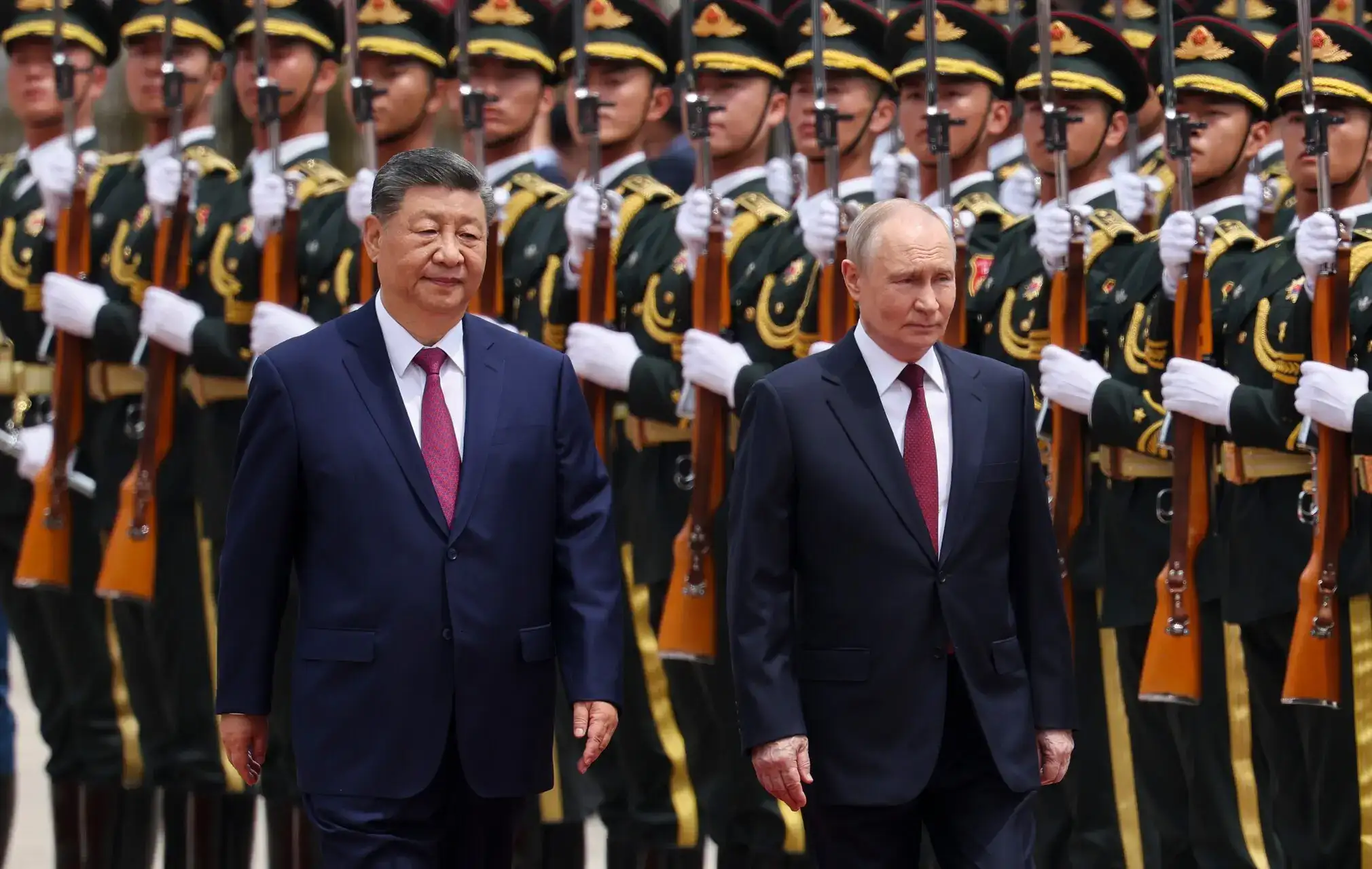
Chinese leader Xi Jinping and Russian President Vladimir Putin concluded a highly orchestrated summit in China that projected absolute solidarity against what they termed unilateral hegemony. Coming just one week after the Chinese president hosted US President Donald Trump, the meeting sent clear and significant signals about the accelerating emergence of a multipolar world order. The two leaders signed over 40 agreements and fiercely criticized the defense and nuclear policies of the US, warning against a global return to the law of the jungle.
Yet behind the flawless red carpet pageantry and lofty declarations of an unyielding partnership lies a cold geopolitical asymmetry. While Russia increasingly depends on its neighbour for economic survival and battlefield sustainability, China is carefully leveraging its position to manage its own global interests without becoming entirely shackled to an isolated ally. The two back-to-back summits appear to be Xi’s masterclass in balancing an unpredictable Trump and a weakened Putin.
Also Read: Xi and Putin unite in criticism of US, but fail to clinch big gas deal
The grand theater of a multipolar alliance
The summit opened with maximum fanfare in Beijing, featuring an honour guard inspection, a 21-gun salute and groups of cheering children waving flags. This elaborate display was designed to show the world that the bond between the two nations remains unshakable despite intense Western pressure. In their joint statements, the two presidents explicitly laid out a shared vision for a post-US-led multipolar world order that promises nations greater equality and mutual respect. Putin was particularly effusive, using a traditional Chinese proverb to express his fondness by telling Xi that one day apart feels like three autumns.
Beyond the personal warmth, the two leaders formed a aggressive defensive front against the military policies of the US. They issued a lengthy joint statement that took direct aim at Trump’s proposed $175 billion Golden Dome defense system, arguing that a new missile field threatens global strategic stability. They also criticized the US over the expiration of the last remaining bilateral nuclear arms control treaty, which lapsed in February after the Trump administration failed to respond to a Russian proposal for a one-year extension.
By standing together against these policies, the two leaders successfully used the summit to position themselves as the primary counterweight to Western dominance.
The stalled energy lifeline and economic realities
Beneath the grand declarations of a partnership with no limits, the economic discussions revealed the sharp limits of their current alignment. The primary objective for the Russian delegation, which travelled with a large group of energy executives, was to finalise a contract for the long-delayed Power of Siberia 2 pipeline. If completed, the 2600-kilometer prospective pipeline would transport 50 billion cubic meters of natural gas annually from Siberian extraction fields through Mongolia into northwest China. This project is vital for the Russian economy, which is desperately seeking to replace the lucrative European energy markets that evaporated following the invasion of Ukraine four years ago.
Despite optimistic statements from the Russian government, the summit ended without a signed agreement for the pipeline. While Kremlin spokesman Dmitry Peskov told reporters that a basic understanding had been reached regarding the route and construction methods, he admitted that various nuances still need to be ironed out and no clear timeline exists.
Analysts note that key issues regarding gas pricing remain entirely unresolved. Xi did not even mention the pipeline by name during his public remarks, choosing instead to state generally that cooperation in energy and resource connectivity should serve as the ballast of the relationship. This silence underscores China’s reluctance to become overly dependent on a single nation for its energy supplies, allowing Chinese negotiators to drive an incredibly hard bargain.
Deepening dependence versus strategic hedging
The lack of a breakthrough on the gas deal highlights a stark reality. The geopolitical relationship has become deeply lopsided. Since launching its military campaign in Ukraine, which has devolved into a costly stalemate, Russia has become increasingly dependent on Chinese economic backing. The Russian military relies heavily on Chinese dual-use technologies to sustain its battlefield capabilities, making Putin's access to Chinese markets a matter of national survival.
Since the war in Ukraine, any gas sales that were previously heading to Europe, that is all dried up, and Russia is in desperate need of revenue to replace that, observed Katrina Yu, a chief regional correspondent.
In contrast, China is executing a sophisticated balancing act that prevents it from fully aligning with Russian military ambitions. The Chinese government has consistently avoided explicitly endorsing the war in Ukraine, choosing instead to include language in the joint statement emphasising that the United Nations Statutes must be respected.
Also, China is highly vulnerable to global trade disruptions caused by ongoing conflicts. The current war between the US and Iran has closed the Strait of Hormuz, a vital artery that supplies roughly 40 percent of Chinese oil imports. Xi used the summit to call for a complete cessation of hostilities in the Middle East, noting that an early end to the conflict is essential to maintain the smooth operation of industrial supply chains and international trade.
The triangulation of great power diplomacy
The diplomatic choreography of the past week demonstrates that China views its relationship with the US as a priority that must be managed alongside its ties to Russia. By hosting both Trump and Putin within seven days, Xi demonstrated that China now acts as an indispensable global diplomatic player capable of engaging rival superpowers on its own terms. While the meeting with Putin was built on established ideological trust, the previous week's meeting with Trump was a vital exercise in economic damage control aimed at mitigating the impact of US tariffs, technology restrictions and support for Taiwan.
The cooperation between the two Eurasian giants is ultimately structured to give them leverage when dealing with the West, rather than to create an isolated bloc. Zhang Xin, a professor at the Russian Studies Center of the East China Normal University, told NYT that the recent interactions among the three major powers have raised the possibility that the cooperation between China and Russia could provide some new space for the involvement of the United States. He added that the construction of a multipolar world does not necessarily exclude the United States, and what it rejects is specific hegemonic behaviours.
Consequently, while Russia seeks an adversarial restructuring of the global order to escape its current isolation, China remains a cautious, pragmatic actor that values its access to the global economy too much to completely sever ties with the West.