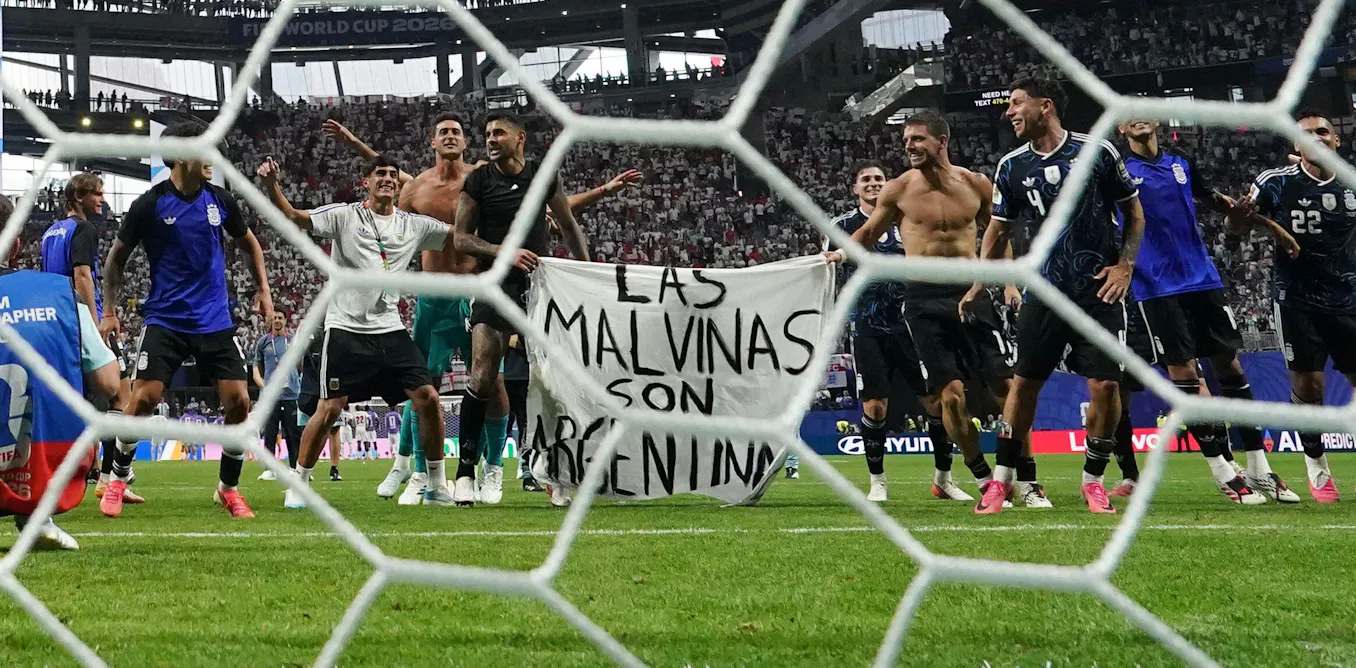
The sovereignty dispute between Britain and Argentina over the Falkland Islands (or Las Islas Malvinas) was brought centre-stage once again in the aftermath of the World Cup semi-final in Atlanta.
Several members of Argentina’s squad celebrated with a banner plucked from the stands occupied by Argentine supporters that declared: “Las Malvinas son Argentinas” (the Falklands are Argentine).
The banner and its unfurling triggered a range of responses, depending on where you stand on the sovereignty dispute between the UK and Argentina. For Argentines, the phrase is a part of everyday life, displayed on public transport, murals and monuments. It is repeated by politicians and other public figures regularly, as a constant reminder of Argentina’s sovereignty claim.
For Argentina’s players, the act of carrying this banner wouldn’t have been hugely controversial - particularly in front of their adoring fans. But they would have been acutely aware of Fifa’s regulations given the tense atmosphere in the build up to the game, as well as the security cordon supposedly enforced by Fifa to prevent political slogans and banners from entering the stadium.
The UK and its government reacted quite differently. The British press, as you’d expect, exploded. The Sun wrote of “shameless Argentinian players” and a “vulgar sign”. UK secretary of state for trade and business, Peter Kyle said the banner was “entirely inappropriate”.
Outgoing prime minister, Keir Starmer, has called on Fifa to investigate this breach of its regulations regarding the display of political statements at matches under its jurisdiction.
Press reports also highlighted the offence caused to Falklands War veterans and the people of the Falkland Islands. The Falkland Islands government in particular expressed their outrage and disappointment that their home had been dragged into the aftermath of a football match in which they weren’t even represented. This was a match between England and Argentina. The Falklands Islands are a British Overseas Territory.
The state of Anglo-Argentine relations
The tense and ill-tempered semi-final will have done little to improve relations between Argentina and the UK, even if Argentina’s president, Javier Milei, rather hopefully declared that his country was “getting closer every day” to gaining sovereignty of the islands as a consequence of his diplomatic approach.
In reality, little has changed. The waving of the banner is not evidence of a resurgent Argentine nationalism. Argentina’s claim to the Falklands has long been an ever-present aspect of public life most especially evident in football stadiums throughout the nation. What is more controversial is the display of this geopolitical slogan on such a high-profile global stage.
Nor does it herald any meaningful progress towards the sovereignty negotiations with the UK that Argentina has long-desired. The UK remains steadfast in its support of the Falkland islanders’ right to self-determination and maintains that negotiations cannot take place without the consent of the Falkland Islands Government.
Where next?
Milei has little evidence to back his claims regarding Argentina’s diplomatic progress. He has been markedly less active in pushing Argentina’s sovereignty claim than some of his recent predecessors such as Néstor and Cristina Kirchner and Alberto Fernández.
These presidents were far more firebrand and confrontational in their approach to the Falkland Islands, constantly threatening and implementing measures to disrupt the islands’ economy, an approach that also yielded minimal tangible diplomatic results.
That said, Milei and Argentinian leaders before him have continued to push their sovereignty claim. Why? Presidents and politicians of all stripes clearly recognise the significance of the islands to the Argentine people and the political capital to be gained from pushing the issue at home. But while the Falklands/Malvinas sovereignty dispute rarely cuts through in international media coverage of geopolitics, there are several factors that mean this sovereignty dispute could feature more regularly in coming years.
For one thing, the development of phase 1 of the Sea Lion oil field to the north of the Falkland Islands could begin as early as 2027. So there is considerable potential for tensions to rise once again.
Argentina’s recent angry response to a British warship entering its waters without requisite permission is perhaps a sign of increased surveillance and sensitivity around shipping movements in and around the South Atlantic. Argentina frequently lodges complaints about the movements of military aircraft and ships between the Falklands and South America. This may well intensify as economic interests come to the fore.
In addition, the geopolitical uncertainty generated by the second Trump administration (that considers Milei a staunch ally) has caused pronounced anxiety for overseas territories and strategically located islands around the world. The US president has regularly expressed his desire to “acquire” Greenland from Denmark and the White House has reportedly considered a plan to purchase the Chagos Islands that remain part of the British Indian Overseas Territory.
Evidence of the warm relations between the US and Argentina at present came in the days following the semi-final controversy over the banner, when Andrew Giuliani, head of the White House Fifa task force, defended the Argentine team’s right to free speech. This reaction will have prompted both disappointment and dismay by government officials in the both UK and the Falkland Islands.
The recent events are a reminder of the geopolitical uncertainty characterising the second Trump administration that has regularly threatened and disrupted formerly stable alliances and diplomatic positions. For the UK Foreign Office and the Falkland Islands government this inconsistency is clearly a worrying development that will be monitored ever more closely in the months and years ahead.
This article was originally published on The Conversation. Read the original article.