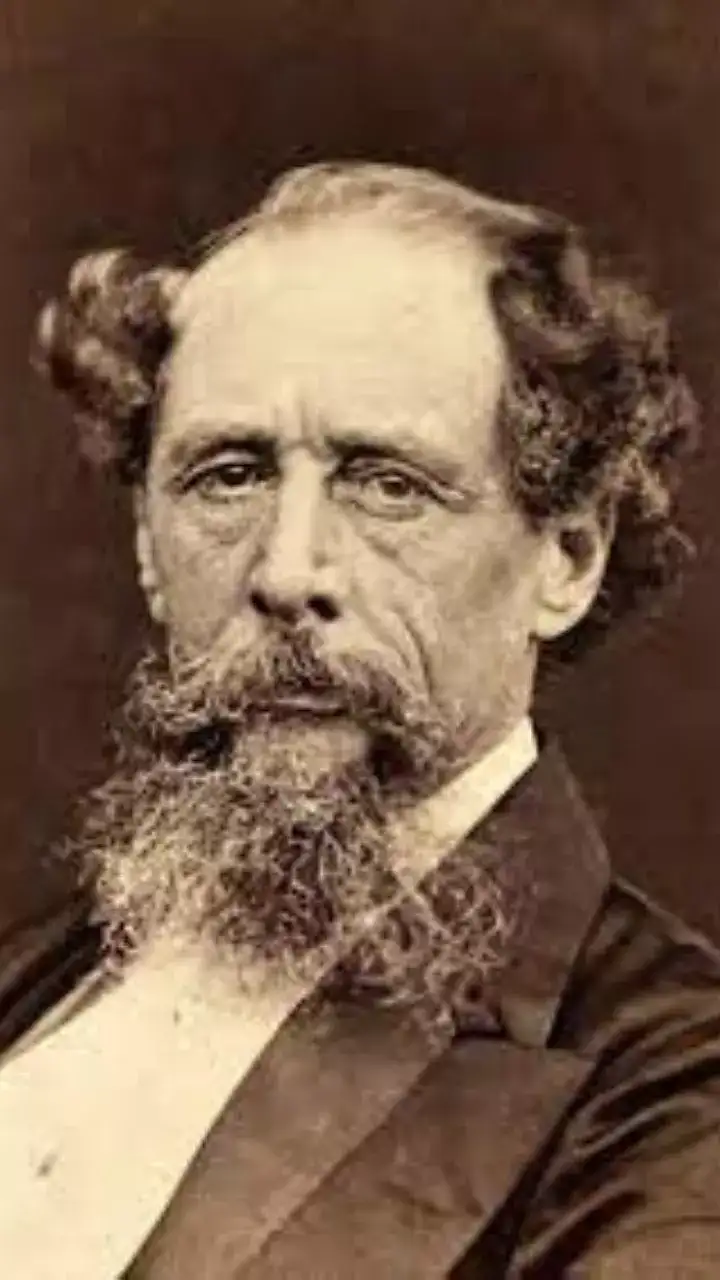
Words of wisdom by Charles Dickens: Few quotes have endured the test of time as powerfully as the words of Charles Dickens: “A loving heart is the truest wisdom.” In an age driven by technology, competition, and constant change, this timeless insight feels more relevant than ever. The phrase is simple. Yet beneath its simplicity lies a profound truth about human nature, success, relationships, and the meaning of a well-lived life.
We live in an age that rewards speed and output above everything else. Metrics rule. Productivity hacks circulate like gospel. People optimize their mornings, their diets, their decision trees — and still find themselves standing in the middle of successful lives feeling oddly hollow.
Dickens understood this contradiction long before modern psychology had language for it. He watched London's rising merchant class accumulate wealth while losing basic human warmth, and he wrote about it with the precision of a surgeon and the grief of a man who had once been desperately poor himself. A loving heart, to Dickens, was not weakness. It was the one faculty that kept a human being human.
The Timeless Life Lessons of Charles Dickens: What does “A loving heart is the truest wisdom” really mean?
The word wisdom tends to summon images of aged scholars, long books, and slow deliberation. We imagine wisdom as the product of years, accumulated through study and careful thinking. But Dickens pointed somewhere else entirely. He pointed to the heart — specifically, a loving one — as the seat of the deepest knowing. This was not anti-intellectual.
Dickens was a ferociously intelligent man, a self-taught writer who devoured everything he could find. But he had watched intelligent people make catastrophic moral decisions because their intellect was not guided by any warmth for other human beings. He saw businessmen who could calculate profit to the penny but could not recognise the suffering of the child working their machines. Intelligence without love, Dickens observed, tends to become a very sophisticated instrument for justifying cruelty.
History bears this out in ways that are difficult to argue with. The architects of some of history's most destructive systems were often educated men. They read widely, debated eloquently, and constructed elaborate logical frameworks that led to monstrous outcomes. What they lacked was the capacity to feel — genuinely feel — the humanity of the people their decisions affected.
Dickens, by contrast, had that capacity in abundance. He visited prisons and slums not for research alone, but because he could not stop himself from caring. That caring was not a distraction from his intelligence. It was the engine of it. Every memorable character he created, every social injustice he exposed, every institution he dismantled on the page — all of it ran on the fuel of a loving heart. His wisdom was inseparable from his compassion.
How a Painful Childhood Shaped the World's Greatest Wisdom on Human Kindness
At twelve years old, Charles Dickens was pulled out of school and sent to work at Warren's Blacking Warehouse, pasting labels onto boot polish jars for ten hours a day while his father sat in Marshalsea debtors' prison. He was not yet a teenager.
The humiliation scarred him so deeply that he could barely bring himself to speak of it in adulthood — his own wife reportedly had no idea the episode had occurred until after his death. That wound, however, became the source of his greatest gift. Because Dickens never forgot what it felt like to be small, overlooked, and utterly dependent on the mercy of others, he never lost the ability to write about such people with complete and utter conviction.
This is perhaps the most underappreciated truth about his life: pain, processed with honesty instead of bitterness, becomes a kind of wisdom no education can manufacture.
Dickens could have hardened. Many do. Instead, the experience made him finely attuned to the suffering of others in a way that shaped every page he ever wrote. When Ebenezer Scrooge begins A Christmas Carol as a man whose cleverness has curdled into contempt for humanity, Dickens is not writing fantasy.
He is writing autobiography in reverse — showing what he might have become had he not chosen to let the heart lead. The redemption of Scrooge is, at its core, Dickens's personal manifesto: a loving heart is recoverable, always, and its recovery is always worth the cost.
The Decision That Changes Everything: Choosing the Heart Over the Clever Mind
Every significant life comes to a fork in the road at some point, and the fork is almost always between what is expedient and what is compassionate. Dickens faced this fork repeatedly, and the choices he made — often at professional and personal cost — are what distinguished him from the merely talented writers of his era.
When he published Oliver Twist in 1837, he was attacking the Poor Law Amendment Act, legislation that enjoyed wide establishment support. He could have written something safer. He had a family to support, a reputation to build, and powerful enemies to avoid making. But the loving heart, once genuinely inhabited, tends to override such calculations. He wrote the truth as he saw it, and it changed public consciousness.
The lesson here is not simply that courage pays off, though in Dickens's case it did. The deeper lesson is about the quality of decision-making that emerges when a loving heart is genuinely in operation. When you can actually feel the consequence of your choices on other people — when their reality is not an abstraction but something your heart registers — you make different decisions. Not easier decisions, often harder ones. But better ones, in the fullest sense of the word.
Thomas Edison, who admired Dickens deeply, once remarked that most people miss opportunity because it shows up wearing overalls. Dickens would have added that most people miss wisdom for the same reason — it shows up wearing the face of someone else's suffering, and they look away.
Why a Loving Heart Outlasts Every Other Form of Intelligence in the Long Run
There is a certain kind of success that collapses the moment it is no longer being actively maintained. The man who climbed to the top through pure calculation and self-interest often finds, in quieter moments, that he has nothing to show for it that actually sustains him.
Dickens wrote about this pattern obsessively. Scrooge. Dombey. Gradgrind. These are not villains in any simple sense — they are portraits of intelligence without love, and what it does to a life over time. What makes them so enduring as characters is that readers recognise them immediately, not just in the world but in themselves. The temptation to close the heart for the sake of efficiency is not a Victorian problem. It is a permanent human problem.
What Dickens offers as the counterweight is not naivety. A loving heart, in his conception, is not blind or sentimental. It is clear-eyed and sometimes very tough. When he campaigned for child labour reform, when he called out the hypocrisy of charitable institutions that helped no one, when he wrote with fury about a legal system that ground the poor to dust — none of that was soft. But it was all powered by the same loving heart. That is the insight most people miss when they read him.
The loving heart is not the alternative to clear thinking and decisive action. It is the source of the best of both. It keeps intelligence honest. It gives courage a reason. It makes wisdom practical rather than decorative. In the end, what endures of any person's life is not how much they knew or how shrewdly they moved. It is how they made other people feel, and what they chose to do about the suffering they witnessed. Dickens knew this. He staked his entire life and body of work on it. And two centuries later, the verdict is in.