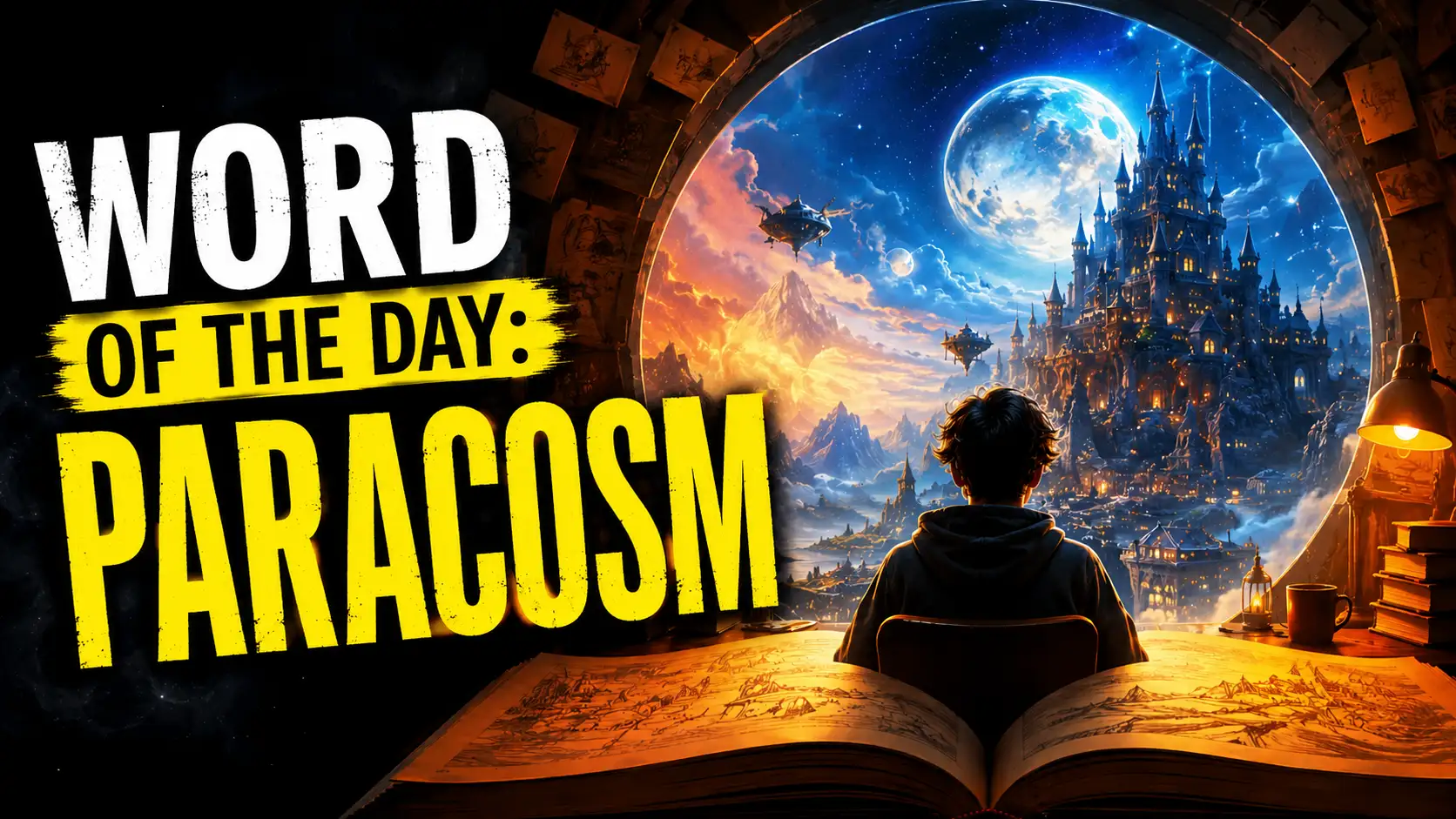
Word of the Day: Language has a remarkable ability to preserve ideas that might otherwise fade from human memory. Some words describe physical objects, while others capture emotions, behaviors, and experiences so specific that they seem almost magical. Among the most fascinating entries in the English lexicon are those rare terms that illuminate hidden corners of the human mind. These words often remain unfamiliar to the general public despite describing experiences shared by millions of people. They offer a glimpse into the extraordinary complexity of imagination, creativity, and inner life.
In today's fast-paced world, where reality is constantly mediated through screens, social media feeds, and endless streams of information, the ability to retreat into imagination remains a uniquely human gift. Children invent elaborate fantasy kingdoms, writers construct fictional universes, and even adults sometimes find themselves mentally escaping into richly detailed worlds of their own making. Yet few people realize there is a precise word for such an intricate imagined realm. That word is both elegant and intellectually captivating, making it a worthy addition to any vocabulary enthusiast's collection.
READ ALSO: Word of the Day: Aphanisis
Word of the Day Today: Paracosm
Paracosm (noun)
Pronunciation: PAIR-uh-kozm
IPA: /ˈpærəˌkɒzəm/
A paracosm is a detailed imaginary world, often created and developed over a long period of time. Unlike a simple daydream, a paracosm typically contains its own geography, history, culture, language, characters, and internal rules.
The term is frequently associated with children who create elaborate fantasy worlds, but adults, including novelists, artists, game designers, and filmmakers, can also develop paracosms.
Paracosm: Origin of the Word
The word paracosm combines the Greek prefix "para-", meaning "beside" or "beyond," with "cosmos," meaning "world" or "universe."
The term emerged in the 19th century as psychologists and literary scholars began studying imaginative worlds created by children. Over time, it became a useful concept in psychology, literature, and creativity research.
Today, the word is often used to describe everything from childhood fantasy kingdoms to the vast fictional universes found in popular books, films, and video games.
READ ALSO: Word of the Day: Abderian
Paracosm: Meaning in Modern Usage
While the traditional definition focuses on imaginary worlds, modern usage has broadened considerably.
A paracosm can refer to:
- A child's invented kingdom populated by fictional characters.
- An author's detailed fictional universe.
- A role-playing game's immersive setting.
- A private mental world developed over years.
- A creative framework that exists alongside reality.
The key feature is depth. A paracosm is not a fleeting fantasy—it is an organized and evolving world.
Paracosm Synonyms
While no synonym captures the exact meaning, several words come close:
- Fantasy world
- Imaginary realm
- Fictional universe
- Dreamworld
- Alternate reality
- Mythic landscape
- Invented kingdom
- Creative cosmos
- Inner world
- Fantasy domain
Paracosm Antonyms
- Reality
- Actuality
- Real world
- Fact
- Truth
- Physical existence
- Material world
- Objectivity
- Authenticity
- Concreteness
How to Use Paracosm in Sentences
Everyday Conversation
"During long train rides, she often escaped into a paracosm she had been building since childhood."
Literature
"The novelist spent decades expanding a paracosm filled with ancient civilizations and forgotten gods."
Psychology
"Researchers found that children who create a paracosm often display remarkable creativity and storytelling abilities."
Education
"The student's elaborate paracosm became the foundation for an award-winning science-fiction project."
Business and Innovation
"Many groundbreaking inventions begin as a kind of paracosm where creators imagine possibilities that do not yet exist."
Paracosm in Different Genres
Fiction
Fantasy and science-fiction writers frequently construct paracosms before writing a single chapter.
Example:
"The author's paracosm contained three moons, seven continents, and thousands of years of recorded history."
Journalism
The word can be used metaphorically to describe isolated communities or highly specialized environments.
Example:
"The tech startup operated within a paracosm of innovation largely disconnected from traditional corporate culture."
Poetry
Poets may use the term to evoke imagination and introspection.
Example:
"Within her paracosm, every memory bloomed into a constellation."
Popular Culture
Many beloved franchises began as someone's personal paracosm before becoming global phenomena.
Why This Word Matters
Paracosm is more than an obscure vocabulary word. It highlights one of humanity's most distinctive abilities: the power to imagine worlds that do not exist and then bring pieces of those worlds into reality.
Many artistic masterpieces began as private paracosms. Authors, filmmakers, architects, and inventors often start with an imagined universe before transforming ideas into tangible creations. The word therefore bridges fantasy and innovation.
Psychologists also view paracosms as evidence of sophisticated cognitive development. Creating an entire world requires memory, organization, creativity, and long-term thinking. Far from being mere escapism, a paracosm can become a training ground for problem-solving and storytelling.
Some words survive because they fill a unique gap in language. Paracosm is one of those rare terms. It provides a name for the intricate imaginary worlds that many people create but few know how to describe. Rich in psychological significance and literary charm, it reminds us that imagination is not simply a diversion, it is often the foundation of creativity itself.
Whether you are a writer developing a fantasy epic, a dreamer inventing private adventures, or someone fascinated by the hidden architecture of the mind, paracosm is a word worth remembering.