Dr Worawit Tantiwattanasap, director of Umphang Hospital, has spent his entire career treating patients along the remote and rugged terrain of the Thai-Myanmar border. "Border doctors are like soldiers, but the enemy isn't people or armies, but disease," he tells me in our interview on June 19. "Preventing epidemics from crossing into Thailand is crucial."
He has a passionate way of cutting through every policy debate about who deserves care and who doesn't. "Borders are concepts created on paper by maps; they don't exist in the wild," he says. "Mosquitos fly back and forth across the border, travel without passports, don't ask for visas. We have to take care of everyone; we shouldn't choose by nationality."
Dr Worawit has received the 2026 United Arab Emirates Health Foundation Prize from the World Health Organization (WHO). The award was presented during the 79th World Health Assembly in Geneva, Switzerland, on May 20.
He has been working in one of five Thai districts bordering Myanmar's Karen State, now called the Karen Nation of Kawthule. For him, the border line is barely a century old. When the British carved Burma away from Siam, the demarcation cut through Karen communities who kept living as if the border weren't there, visiting family, marrying across it, giving birth in the forest with the help of midwives. Many of those births were never registered. Generations later, the result is a population Dr Worawit calls "quasi foreigners": Karen people born and raised in Thailand who hold no Thai ID, stateless on land their families have occupied for as long as anyone remembers.
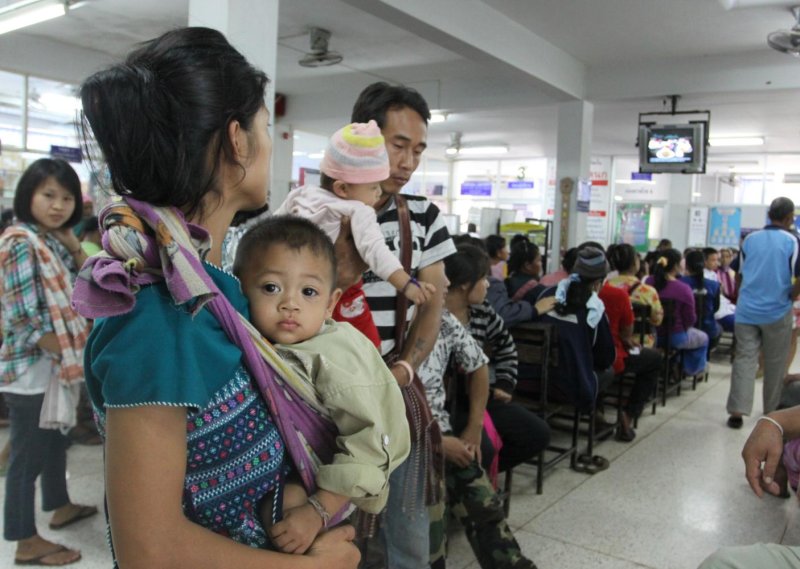
Then there are the genuine foreigners, Karen refugees who fled fighting in Myanmar and settled in border camps. Tak province holds three of the largest: Mae La, Umpiem, and Nu Po, together housing roughly 60,000 people, a sizeable share of the refugees still living in camps along the border. UNHCR and international NGOs support them. Beyond the camps, by Dr Worawit's rough count, perhaps half of the roughly 280,000 people living in the border zone outside any official designation are similarly stateless or undocumented; the rest are migrant labourers drawn to Mae Sot's garment factories. Almost none of them carry a Thai ID card. The Interior Ministry has tried registering them with a special card, short of granting residency, but the population is remote, often off the grid, and moves too fast for the bureaucracy to keep pace.
What unites them, in Dr Worawit's telling, is geography and disease. The border districts sit in remote, tropical terrain on both sides; Thai and Myanmar alike are rural and underserved, a decade behind in basic medical infrastructure. "There are diseases that can spread," he says, "malaria, cholera, tuberculosis, meningococcal meningitis, diphtheria, whooping cough, every single disease imaginable". War on the Myanmar side, with its displacement and troop movements, only accelerates the spread.
Covid made the stakes concrete. Donated funds let Umphang run nine community isolation centres on the Myanmar side, staffed by the hospital's own people; the most severe cases were ferried by ambulance to Umphang's ventilators and field hospital. By his counting, the hospital looked after some 83,000 people through the pandemic, far beyond what any government allocation, typically stipulated to cover Thai citizens only, could accommodate.
He returns to this theme, doctors on the border, standing in for soldiers, more than once over the course of the interview. "We are frontline fighters against disease and contagion," he says, "and that contributes to the security of the nation".
The hospital is a beacon in a remote area where the next nearest hospital is several hours away, but the finances tell another story. Monthly operating costs run about 12.4 million baht, of which nearly 8 million baht goes to salaries for roughly 400 staff. Fuel, diesel for generators, gasoline for ambulances, cost half a million baht a month before this year; with prices rising, it's now closer to 700,000. "The plain truth is, nobody gives you gas if you don't pay for it," he says.
Medicine donations help, but they don't cover payroll or fuel. Annual fundraising drives have historically brought in tens of millions of baht, enough in good years to clear the hospital's debts. Thai doctors based in the United States contribute; European support arrives more sporadically. The hospital runs a QR code for direct donations and keeps an open account for anyone who wants to help. Even so, "seek money early in the month to cover expenses at the end of the month" has become an operating principle in the ongoing struggle, and when patients need referral elsewhere for advanced treatment, those hospitals require payment up front. They don't treat for free.
At the centre of the policy problem is a single Thai legal term: bukhon, person.
"The meaning of 'person' shifts depending on the law," Dr Worawit says. "It's one thing in criminal law, another thing under the Social Security Act. If the word is interpreted narrowly, it only includes Thai citizens."
Criminal law treats "person" as universal: a killing is a killing, regardless of who commits it or against whom. Social security law does not. It is precisely in that gap, Dr Worawit says, that the bureaucratic difficulties of his work lie.
"We can't solve these problems without loosening up the rules, making room for exceptions," he says. He raises the example of Greece during the Eurozone debt crisis when the public health system was pushed to the brink, and families faced growing financial pressure around childbirth -- particularly for Caesarean deliveries, which often carried substantial out‑of‑pocket costs in practice, if not always in law. Hospitals struggled to meet basic obligations amid chronic underfunding. At the same time, debt enforcement intensified across the economy, with property seizures becoming commonplace.
"It violates medical ethics," he says. "It contradicts the Hippocratic Oath, a fundamental medical teaching inherited from ancient Greece."
"If we don't preserve humanity, the world will collapse," he says.
Dr Worawit once planned a different ending to his career, as a Buddhist monk helping Aids patients at Wat Phrabat Nam Phu, before the abbot he'd hoped to study under, Luang Pho Alongkot, was defrocked and arrested on embezzlement and money-laundering charges.
"Okay, then I won't go with that plan," he says. "I won't... I won't... become a monk anymore."
Instead he built a house in rural Umphang, where he intends to keep working in some capacity even after he formally steps back, gradually handing the hospital, and its donors, to the younger doctors who arrived as recruits decades ago and are now experienced enough to run hospitals of their own.
"I can continue to help at the hospital, I can see patients," he says. "It will also give me the opportunity to talk to the donors who have been so kind to Umphang Hospital all along, some of whom I know, so they can continue to support the hospital. I'll gradually hand over the responsibilities to younger doctors who will take over from me."
"One day I will die, so the baton has to be handed off to others," he says. "As hard as it is for me, I have to learn to 'let it go.'"
His closing reflection returns to the word at the root of his philosophy: thammachat, nature, built from dharma.
"Can we afford to let go of our humanitarian nature?" In a world he sees as materially advanced but spiritually regressive, he argues there's no room to look away from a neighbouring country that cannot care for its own people.
"If lives can be saved, shouldn't we do our best?"
He extends an open invitation: come to Umphang, see the camps, see the hospital, see what's at stake.
Philip J Cunningham is a media researcher covering Asian politics. He is the author of 'Tiananmen Moon'.