Afternoon summary
-
Gordon Brown has claimed that William Hague’s plans for English votes for English laws (see 12.32pm) “risk the very survival of the UK”. He issued this statement ahead of an adjournment debate on the subject he is holding tomorrow.
The Conservative proposals for English votes for English laws (Evel) put party before country.
They risk the very survival of the UK.
I will show tomorrow in the Commons debate that I have called that not one government in 150 years has found a way of reconciling Evel with a certainty that the unity of the UK would be maintained. They have thus rejected such proposals.
Under the Hague proposals, Evel means only one thing: restricting the rights of Scottish MPs to vote in the House of Commons, even to the extent of excluding them under legislative consent motions from Budget votes on key tax issues.
And the Conservatives have acted with huge cynicism: it was the Conservatives who proposed devolving all Scottish income tax to the Scottish Parliament, and they have now made this the pretext for giving English MPs the power of veto on the annual Budget vote on income tax rates. They are thus seeking to embed at the heart of our constitution two classes of elected representatives – the English who vote on everything and the Scots, and over time the Welsh and Northern Irish, who are allowed to vote on only some things.
Just when we needed a unifying period of reconciliation, the Conservatives have summarily repudiated the recommendations on Evel by the Smith Commission that they appointed only four months ago.
Tomorrow I will propose an alternative to this dangerous and potentially ruinous course they have now embarked upon.
-
Alistair Carmichael, the Scottish secretary, has said the Scottish government must be legally bound to consult the UK Government about its devolved powers to prevent nationalists exploiting the benefits system to undermine the constitutional integrity of the UK. As the Press Association reports, he affirmed that he has not written a UK “veto” into Scotland’s new devolution settlement at the Commons Scottish Affairs Committee. But he said a requirement to consult the UK government must be written into law to prevent a nationalist administration creating a flawed benefits system “designed to generate friction”.
You see how the Scottish Government in recent years has used the machinery of government to draw a wedge between the two governments that Scotland’s people have said that they want to have and accordingly have sought to generate these grievances and divisions.
I wish it wasn’t thus, but I think the presumption has got to be that consultation within the draft clauses would be necessary.
You can see how if you didn’t have these duties to consult, someone who wanted to generate grievances and to create a system that wasn’t designed to work but was designed to generate friction between the two governments could easily do it.
-
The Democratic Unionists have said they have hired top lawyers to consider if they can mount a legal challenge to their exclusion from the live TV debates during the general election. As my colleague Henry McDonald reports, at the unveiling of the DUP’s first main election poster in East Belfast party leader and Northern Ireland’s First Minister Peter Robinson said he hoped the broadcasters would change their minds rather than end up in court. Robinson said:
Legal advice is obviously the last step that you take, we have decided that at this stage we are going to ask key lawyers - we probably would have to fight this case in London as opposed to in Belfast - and we have asked key lawyers to look at the case and give us advice because none of these things are straightforward. We will fight for Northern Ireland’s place if regional parties are to be part of that debate.
That’s all from me for today.
Thanks for the comments.
Bishop John Sherrington has issued this statement on the vote on behalf of the Catholic Bishops Conference of England and Wales.
Despite the genuine and considerable concerns of many people, the decision of parliament is clear on this issue. Whilst the Church recognises the suffering that mitochondrial diseases bring and hopes that alternative methods of treatment can be found, it remains opposed on principle to these procedures where the destruction of human embryos is part of the process. This is about a human life with potential, arising from a father and a mother, being used as disposable material. The human embryo is a new human life with potential; it should be respected and protected from the moment of conception and not used as disposable material.
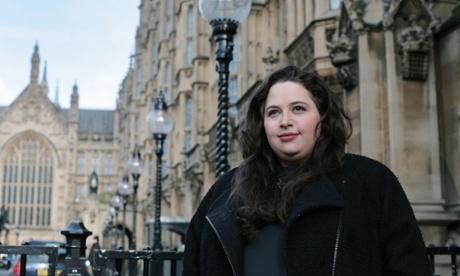
My colleague Hannah Devlin has been speaking to Rachel Kean, 26, a woman who has been waiting for today’s vote for the past five years - since learning that her family is affected by mitochondrial disease.
Sat alongside her mother in the public gallery of the House of Commons, Kean was among those waiting most anxiously for the outcome of today’s vote. When the result came in, the scene was one of jubilant whoops and tears of joy.
“This is the light at the end of the tunnel,” said Kean, who discovered that she was affected by defective mitochondria five years ago when her maternal aunt died of complications linked to the disease. “This has changed all our lives for the better. Just like that, things have changed.”
Kean, a postgraduate student at Manchester University, said that knowing she had a family history of mitochondrial defects and that she would pass on the risk of serious illness to her own children had been a “great burden” to live with.
However, the burden had always been lightened by the knowledge that a scientific solution was on the horizon, she said. “Finding out my family history was incredibly difficult, but the silver lining was that at the time this [research] was going on. Now, for the first time, there’s hope.”
She was “absolutely ecstatic” that parliament had listened to the voices of patients, who for the first time will be able to spare their own children the potentially devastating impact of mitochondrial disorders.
“Seeing first hand the suffering that mitochondrial disease causes, I think this is bigger than just the next generation,” she said. “These are horribly cruel diseases with no treatment and no cure, which we could prevent.”
Her one regret is that the advance has come too late to help many of those affected by the disease. “I’m thinking about my aunt and how she would have been the most wonderful mother,” she said. “She lost so many children and if she’d been here today, she’d have had that chance.”
MPs who did not vote
And here is the list of MPs who did not vote.
Conservative MPs
Absent from the vote were 47 Conservative MPs. They were: Richard Bacon (Norfolk South), Tony Baldry (Banbury), Greg Barker (Bexhill & Battle), Angie Bray (Ealing Central & Acton), James Brokenshire (Old Bexley & Sidcup), Geoffrey Cox (Devon West & Torridge), David Davis (Haltemprice & Howden), Stephen Dorrell(Charnwood), James Duddridge (Rochford & Southend East), Iain Duncan Smith (Chingford & Woodford Green), George Eustice (Camborne & Redruth), Jonathan Evans (Cardiff North), Dr Liam Fox (Somerset North), Lorraine Fullbrook (South Ribble), Ben Gummer (Ipswich), Philip Hammond (Runnymede & Weybridge), Matthew Hancock (Suffolk West), Richard Harrington (Watford), Kris Hopkins (Keighley), Bernard Jenkin (Harwich & Essex North), Chris Kelly (Dudley South), Ian Liddell-Grainger (Bridgwater & Somerset West), David Lidington(Aylesbury), Jonathan Lord (Woking), Mary Macleod (Brentford & Isleworth), Patrick McLoughlin (Derbyshire Dales), Esther McVey(Wirral West), Francis Maude (Horsham), Theresa May (Maidenhead), Paul Maynard (Blackpool North & Cleveleys), Andrew Mitchell (Sutton Coldfield), David Morris (Morecambe & Lunesdale), David Mundell(Dumfriesshire, Clydesdale & Tweeddale), Dr Andrew Murrison (Wiltshire South West), Stephen O’Brien (Eddisbury), Priti Patel (Witham), Mark Pritchard (Wrekin, The), Simon Reevell (Dewsbury), Andrew Rosindell (Romford), Alok Sharma (Reading West), Mark Simmonds (Boston & Skegness), Edward Timpson (Crewe & Nantwich), Paul Uppal (Wolverhampton South West), Shailesh Vara (Cambridgeshire North West), Martin Vickers (Cleethorpes), Robert Walter (Dorset North) and Rob Wilson (Reading East).
Lib Dem MPs
Five Liberal Democrats did not take part: Gordon Birtwistle (Burnley), Lynne Featherstone(Hornsey & Wood Green), Charles Kennedy (Ross, Skye & Lochaber), David Laws (Yeovil) and John Pugh (Southport).
Labour MPs
There were 68 Labour abstentions: Diane Abbott (Hackney North & Stoke Newington), Rushanara Ali (Bethnal Green & Bow), Willie Bain (Glasgow North East), Joe Benton (Bootle), Hazel Blears (Salford & Eccles), David Blunkett (Sheffield Brightside & Hillsborough), Gordon Brown (Kirkcaldy & Cowdenbeath), Sarah Champion (Rotherham), Vernon Coaker (Gedling), Rosie Cooper (Lancashire West), Mary Creagh (Wakefield), Jon Cruddas (Dagenham & Rainham), John Cryer (Leyton & Wanstead), Margaret Curran (Glasgow East), Nic Dakin (Scunthorpe), Thomas Docherty (Dunfermline & Fife West), Jim Dowd (Lewisham West & Penge), Jack Dromey (Birmingham Erdington), Michael Dugher (Barnsley East), Maria Eagle (Garston & Halewood), Julie Elliott (Sunderland Central), Bill Esterson (Sefton Central), Frank Field (Birkenhead), Caroline Flint (Don Valley), Yvonne Fovargue (Makerfield), Hywel Francis (Aberavon), Mary Glindon (Tyneside North), Roger Godsiff (Birmingham Hall Green), Helen Goodman (Bishop Auckland), Andrew Gwynne (Denton & Reddish), Mark Hendrick (Preston), Stephen Hepburn (Jarrow), Kelvin Hopkins (Luton North), Sian James (Swansea East), Major Dan Jarvis (Barnsley Central), Helen Jones (Warrington North), Barbara Keeley (Worsley & Eccles South), Sadiq Khan (Tooting), David Lammy (Tottenham), Mark Lazarowicz (Edinburgh North & Leith), Ivan Lewis (Bury South), Gregg McClymont (Cumbernauld, Kilsyth & Kirkintilloch East), Andy McDonald (Middlesbrough), Alison McGovern (Wirral South), Catherine McKinnell (Newcastle upon Tyne North), Michael Meacher (Oldham West & Royton), Jessica Morden (Newport East), Jim Murphy (Renfrewshire East), Pamela Nash (Airdrie & Shotts), Teresa Pearce (Erith & Thamesmead), Yasmin Qureshi (Bolton South East), Jamie Reed (Copeland), Steve Reed (Croydon North), Geoffrey Robinson (Coventry North West), Lindsay Roy (Glenrothes), Chris Ruane (Vale of Clwyd), Joan Ruddock (Lewisham Deptford), Anas Sarwar (Glasgow Central), Virendra Sharma (Ealing Southall), Andrew Smith (Oxford East), Owen Smith (Pontypridd), Valerie Vaz (Walsall South), Joan Walley (Stoke-on-Trent North), Dave Watts (St Helens North), Chris Williamson (Derby North), Mike Wood (Batley & Spen), Shaun Woodward (St Helens South & Whiston) and David Wright (Telford).
Others
Also absent were Plaid’s Jonathan Edwards (Carmarthen East & Dinefwr), DUP MPs Nigel Dodds (Belfast North), Ian Paisley Junior (Antrim North), David Simpson (Upper Bann), SDLP MP Dr Alasdair McDonnell (Belfast South), independent Eric Joyce (Falkirk) and Respect’s George Galloway (Bradford West).
Tellers
The tellers for the ayes were Gavin Barwell (Croydon Central) and John Penrose (Weston-super-Mare), while the tellers for the Noes were Peter Bone (Wellingborough) and Philip Hollobone (Kettering).
MPs who voted in favour of mitochondrial donation
Here are the MPs who voted in favour. Again, I’ve taken it from the Press Assocation.
Conservative MPs
There were 170 Conservatives in favour of the regulations, including prime minister David Cameron and chancellor George Osborne.
The others were: Nigel Adams (Selby & Ainsty), Adam Afriyie (Windsor), Stuart Andrew (Pudsey), James Arbuthnot (Hampshire North East), Harriett Baldwin (Worcestershire West), Stephen Barclay (Cambridgeshire North East), John Baron (Basildon & Billericay), Richard Benyon (Newbury), Sir Paul Beresford (Mole Valley), Andrew Bingham (High Peak), Nicola Blackwood (Oxford West & Abingdon), Crispin Blunt (Reigate), Nick Boles (Grantham & Stamford), Peter Bottomley (Worthing West), Karen Bradley (Staffordshire Moorlands), Graham Brady (Altrincham & Sale West), Andrew Bridgen (Leicestershire North West), Steve Brine (Winchester), Robert Buckland (Swindon South), Aidan Burley (Cannock Chase), Alistair Burt (Bedfordshire North East), Dan Byles (Warwickshire North), Alun Cairns (Vale of Glamorgan), Neil Carmichael (Stroud), James Clappison (Hertsmere), Greg Clark (Tunbridge Wells), Kenneth Clarke (Rushcliffe), Geoffrey Clifton-Brown (Cotswolds, The), Damian Collins (Folkestone & Hythe), Stephen Crabb (Preseli Pembrokeshire), Tracey Crouch (Chatham & Aylesford), David Davies (Monmouth), Caroline Dinenage (Gosport), Jonathan Djanogly (Huntingdon), Nadine Dorries (Bedfordshire Mid), Alan Duncan (Rutland & Melton), Philip Dunne (Ludlow), Michael Ellis (Northampton North), Jane Ellison (Battersea), Tobias Ellwood (Bournemouth East), Graham Evans (Weaver Vale), Michael Fabricant (Lichfield), Michael Fallon (Sevenoaks), George Freeman (Norfolk Mid), Mike Freer (Finchley & Golders Green), Sir Edward Garnier (Harborough), Mark Garnier (Wyre Forest), David Gauke (Hertfordshire South West), Nick Gibb (Bognor Regis & Littlehampton), Robert Goodwill (Scarborough & Whitby), Michael Gove (Surrey Heath), Richard Graham (Gloucester), Helen Grant (Maidstone & The Weald), Damian Green (Ashford), Justine Greening (Putney), Dominic Grieve (Beaconsfield), Andrew Griffiths (Burton), Sam Gyimah (Surrey East), William Hague (Richmond (Yorks)), Robert Halfon (Harlow), Stephen Hammond (Wimbledon), Greg Hands (Chelsea & Fulham), Mark Harper (Forest of Dean), Rebecca Harris (Castle Point), Simon Hart (Carmarthen West & Pembrokeshire South), Sir Alan Haselhurst (Saffron Walden), Chris Heaton-Harris (Daventry), Gordon Henderson (Sittingbourne & Sheppey), Charles Hendry (Wealden), Nick Herbert (Arundel & South Downs), George Hollingbery (Meon Valley), John Howell (Henley), Jeremy Hunt (Surrey South West), Nick Hurd (Ruislip, Northwood & Pinner), Margot James (Stourbridge), Sajid Javid (Bromsgrove), Robert Jenrick (Newark), Gareth Johnson (Dartford), Jo Johnson (Orpington), Andrew Jones (Harrogate & Karesborough), Simon Kirby (Brighton Kemptown), Greg Knight (Yorkshire East), Kwasi Kwarteng (Spelthorne), Mark Lancaster (Milton Keynes North), Andrew Lansley (Cambridgeshire South), Pauline Latham (Derbyshire Mid), Jessica Lee (Erewash), Phillip Lee (Bracknell), Charlotte Leslie (Bristol North West), Oliver Letwin (Dorset West), Brandon Lewis (Great Yarmouth), Julian Lewis (New Forest East), Peter Lilley (Hitchin & Harpenden), Tim Loughton (Worthing East & Shoreham), Peter Luff (Worcestershire Mid), Karen Lumley (Redditch), Jason McCartney (Colne Valley), Stephen Metcalfe (Basildon South & Thurrock East), Maria Miller (Basingstoke), Nigel Mills (Amber Valley), Anne Milton (Guildford), Penny Mordaunt (Portsmouth North), Nicky Morgan (Loughborough), Anne-Marie Morris (Newton Abbot), James Morris (Halesowen & Rowley Regis), Stephen Mosley (Chester, City of), David Mowat (Warrington South), Sheryll Murray (Cornwall South East), Brooks Newmark (Braintree), Sarah Newton (Truro & Falmouth), Caroline Nokes (Romsey & Southampton North), Jesse Norman (Hereford & Herefordshire South), Matthew Offord (Hendon), Guy Opperman (Hexham), Richard Ottaway (Croydon South), Jim Paice (Cambridgeshire South East), Neil Parish (Tiverton & Honiton), Owen Paterson (Shropshire North), Claire Perry (Devizes), Stephen Phillips (Sleaford & North Hykeham), Eric Pickles (Brentwood & Ongar), Daniel Poulter (Suffolk Central & Ipswich North), Mark Prisk (Hertford & Stortford), Dominic Raab (Esher & Walton), John Redwood (Wokingham), Sir Malcolm Rifkind (Kensington), Andrew Robathan (Leicestershire South), Hugh Robertson (Faversham & Kent Mid), Amber Rudd (Hastings & Rye), Laura Sandys (Thanet South), Grant Shapps (Welwyn Hatfield), Alec Shelbrooke (Elmet & Rothwell), Keith Simpson (Broadland), Chris Skidmore (Kingswood), Chloe Smith (Norwich North), Henry Smith (Crawley), Julian Smith (Skipton & Ripon), Nicholas Soames (Sussex Mid), Anna Soubry (Broxtowe), Caroline Spelman (Meriden), Mark Spencer (Sherwood), Sir John Stanley (Tonbridge & Malling), Andrew Stephenson (Pendle), Bob Stewart (Beckenham), Rory Stewart (Penrith & The Border), Mel Stride (Devon Central), Julian Sturdy (York Outer), Hugo Swire (Devon East), Justin Tomlinson (Swindon North), David Tredinnick (Bosworth), Elizabeth Truss (Norfolk South West), Andrew Tyrie (Chichester), Ed Vaizey (Wantage), Theresa Villiers (Chipping Barnet), Charles Walker (Broxbourne), Robin Walker (Worcester), Dame Angela Watkinson (Hornchurch & Upminster), Mike Weatherley (Hove), Heather Wheeler (Derbyshire South), Chris White (Warwick & Leamington), John Whittingdale (Maldon), Bill Wiggin (Herefordshire North), David Willetts (Havant), Gavin Williamson (Staffordshire South), Dr Sarah Wollaston (Totnes), Tim Yeo (Suffolk South), Sir George Young (Hampshire North West) and Nadhim Zahawi (Stratford-on-Avon).
Lib Dem MPs
The Liberal Democrat wing of the coalition provided 46 ayes in the free vote. They were: Danny Alexander (Inverness, Nairn, Badenoch & Strathspey), Norman Baker (Lewes), Sir Alan Beith (Berwick-upon-Tweed), Tom Brake (Carshalton & Wallington), Annette Brooke (Dorset Mid & Poole North), Jeremy Browne (Taunton Deane), Malcolm Bruce (Gordon), Paul Burstow (Sutton & Cheam), Lorely Burt (Solihull), Vincent Cable (Twickenham), Sir Menzies Campbell (Fife North East), Alistair Carmichael (Orkney & Shetland), Nick Clegg (Sheffield Hallam), Michael Crockart (Edinburgh West), Edward Davey (Kingston & Surbiton), Tim Farron (Westmorland & Lonsdale), Don Foster (Bath), Andrew George (St Ives), Stephen Gilbert (St Austell & Newquay), Duncan Hames (Chippenham), Sir Nick Harvey (Devon North), David Heath (Somerton & Frome), Martin Horwood (Cheltenham), Simon Hughes (Bermondsey & Old Southwark), Mark Hunter (Cheadle), Julian Huppert (Cambridge), Norman Lamb (Norfolk North), John Leech (Manchester Withington), Stephen Lloyd (Eastbourne), Michael Moore (Berwickshire, Roxburgh & Selkirk), Tessa Munt (Wells), Alan Reid (Argyll & Bute), Bob Russell (Colchester), Adrian Sanders (Torbay), Sir Robert Smith (Aberdeenshire West & Kincardine), Andrew Stunell (Hazel Grove), Ian Swales (Redcar), Jo Swinson (Dunbartonshire East), Mike Thornton (Eastleigh), John Thurso (Caithness, Sutherland & Easter Ross), David Ward (Bradford East), Steve Webb (Thornbury & Yate), Roger Williams (Brecon & Radnorshire), Stephen Williams (Bristol West), Jenny Willott (Cardiff Central) and Simon Wright (Norwich South).
Labour MPs
The 156 Labour MPs in favour were: Debbie Abrahams (Oldham East & Saddleworth), Bob Ainsworth (Coventry North East), Douglas Alexander (Paisley & Renfrewshire South), Heidi Alexander (Lewisham East), Graham Allen (Nottingham North), Mr Jon Ashworth (Leicester South), Ian Austin (Dudley North), Adrian Bailey (West Bromwich West), Ed Balls (Morley & Outwood), Kevin Barron (Rother Valley), Hugh Bayley (York Central), Dame Margaret Beckett (Derby South), Dame Anne Begg (Aberdeen South), Hilary Benn (Leeds Central), Luciana Berger (Liverpool Wavertree), Clive Betts (Sheffield South East), Roberta Blackman-Woods (Durham, City of), Tom Blenkinsop (Middlesbrough South & Cleveland East), Paul Blomfield (Sheffield Central), Ben Bradshaw (Exeter), Kevin Brennan (Cardiff West), Lyn Brown (West Ham), Nicholas Brown (Newcastle upon Tyne East), Russell Brown (Dumfries & Galloway), Chris Bryant (Rhondda), Karen Buck (Westminster North), Richard Burden (Birmingham Northfield), Andy Burnham (Leigh), Liam Byrne (Birmingham Hodge Hill), Alan Campbell (Tynemouth), Ronnie Campbell (Blyth Valley), Martin Caton (Gower), Jenny Chapman (Darlington), Katy Clark (Ayrshire North & Arran), Ann Clwyd (Cynon Valley), Ann Coffey (Stockport), Michael Connarty (Linlithgow & Falkirk East), Yvette Cooper (Normanton, Pontefract & Castleford), Jeremy Corbyn (Islington North), Stella Creasy (Walthamstow), Alex Cunningham (Stockton North), Jim Cunningham (Coventry South), Simon Danczuk (Rochdale), Alistair Darling (Edinburgh South West), Wayne David (Caerphilly), Ian Davidson (Glasgow South West), Geraint Davies (Swansea West), Gloria De Piero (Ashfield), John Denham (Southampton Itchen), Frank Dobson (Holborn & St Pancras), Frank Doran (Aberdeen North), Stephen Doughty (Cardiff South & Penarth), Angela Eagle (Wallasey), Clive Efford (Eltham), Louise Ellman (Liverpool Riverside), Natascha Engel (Derbyshire North East), Chris Evans (Islwyn), Paul Farrelly (Newcastle-under-Lyme), Jim Fitzpatrick (Poplar & Limehouse), Paul Flynn (Newport West), Mike Gapes (Ilford South), Barry Gardiner (Brent North), Sheila Gilmore (Edinburgh East), Kate Green (Stretford & Urmston), Lilian Greenwood (Nottingham South), Nia Griffith (Llanelli), Peter Hain (Neath), David Hamilton (Midlothian), Fabian Hamilton (Leeds North East), Harriet Harman (Camberwell & Peckham), Tom Harris (Glasgow South), Dai Havard (Merthyr Tydfil & Rhymney), John Healey (Wentworth & Dearne), David Heyes (Ashton Under Lyne), Julie Hilling (Bolton West), Margaret Hodge (Barking), Sharon Hodgson (Washington & Sunderland West), Jim Hood (Lanark & Hamilton East), George Howarth (Knowsley), Tristram Hunt (Stoke-on-Trent Central), Huw Irranca-Davies (Ogmore), Glenda Jackson (Hampstead & Kilburn), Cathy Jamieson (Kilmarnock & Loudoun), Alan Johnson (Hull West & Hessle), Diana Johnson (Hull North), Graham Jones (Hyndburn), Kevan Jones (Durham North), Dame Tessa Jowell (Dulwich & West Norwood), Elizabeth Kendall (Leicester West), Ian Lavery (Wansbeck), Christopher Leslie (Nottingham East), Emma Lewell-Buck (South Shields), Andy Love (Edmonton), Ian Lucas (Wrexham), Steve McCabe (Birmingham Selly Oak), Kerry McCarthy (Bristol East), Siobhain McDonagh (Mitcham & Morden), John McDonnell (Hayes & Harlington), Pat McFadden (Wolverhampton South East), Ms Liz McInnes (Heywood & Middleton), Ann McKechin (Glasgow North), Iain McKenzie (Inverclyde), Fiona Mactaggart (Slough), Khalid Mahmood (Birmingham Perry Barr), Seema Malhotra (Feltham & Heston), John Mann (Bassetlaw), Ian Mearns (Gateshead), Ed Miliband (Doncaster North), Andrew Miller (Ellesmere Port & Neston), Austin Mitchell (Great Grimsby), Madeleine Moon (Bridgend), Graeme Morrice (Livingston), Grahame Morris (Easington), Meg Munn (Sheffield Heeley), Ian Murray (Edinburgh South), Lisa Nandy (Wigan), Fiona O’Donnell (East Lothian), Chi Onwurah (Newcastle upon Tyne Central), Sandra Osborne (Ayr, Carrick & Cumnock), Toby Perkins (Chesterfield), Bridget Phillipson (Houghton & Sunderland South), Lucy Powell (Manchester Central), Nick Raynsford (Greenwich & Woolwich), Rachel Reeves (Leeds West), Emma Reynolds (Wolverhampton North East), Jonathan Reynolds (Stalybridge & Hyde), Linda Riordan (Halifax), John Robertson (Glasgow North West), Steve Rotheram (Liverpool Walton), Andy Sawford (Corby), Alison Seabeck (Plymouth Moor View), Barry Sheerman (Huddersfield), Dennis Skinner (Bolsover), Andy Slaughter (Hammersmith), Angela Smith (Penistone & Stocksbridge), Nick Smith (Blaenau Gwent), John Spellar (Warley), Jack Straw (Blackburn), Graham Stringer (Blackley & Broughton), Gisela Stuart (Birmingham Edgbaston), Gerry Sutcliffe (Bradford South), Mark Tami (Alyn & Deeside), Gareth Thomas (Harrow West), Emily Thornberry (Islington South & Finsbury), Jon Trickett (Hemsworth), Karl Turner (Hull East), Derek Twigg (Halton), Stephen Twigg (Liverpool West Derby), Chuka Umunna (Streatham), Tom Watson (West Bromwich East), Alan Whitehead (Southampton Test), Phil Wilson (Sedgefield), David Winnick (Walsall North), Rosie Winterton (Doncaster Central), John Woodcock (Barrow & Furness) and Iain Wright (Hartlepool).
Other MPs
Also supportive were Elfyn Llwyd (Dwyfor Meirionnydd) and Hywel Williams (Arfon) from Plaid Cymru, and four MPs from the SNP: Stewart Hosie (Dundee East), Angus Robertson (Moray), Eilidh Whiteford (Banff & Buchan) and Pete Wishart (Perth & Perthshire North).
Green Caroline Lucas (Brighton Pavilion), Alliance MP Naomi Long (Belfast East), Independent Mike Hancock (Portsmouth South) and UKIP’s Douglas Carswell (Clacton).
MPs who voted against mitochondrial donation
Here are the MPs who voted against mitochondrial donation. I’ve taken the list from the Press Association.
Conservative Ministers
The ministers who opposed the measures were: Defence Minister Julian Brazier, Defence Minister Mark Francois, Justice Secretary Chris Grayling, Transport Minister John Hayes, Treasury Minister Andrea Leadsom, Justice and Home Office Minister Mike Penning, Justice Minister Andrew Selous, International Development Minister Desmond Swayne, Attorney General Jeremy Wright.
Other Conservative MPs
The other Conservative opponents were: Peter Aldous (Waveney), David Amess (Southend West), Steven Baker (Wycombe), Guto Bebb (Aberconwy), Henry Bellingham (Norfolk North West), Jake Berry (Rossendale & Darwen), Brian Binley (Northampton South), Bob Blackman (Harrow East), Fiona Bruce (Congleton), Conor Burns (Bournemouth West), Simon Burns (Chelmsford), David Burrowes (Enfield Southgate), Bill Cash (Stone), Rehman Chishti (Gillingham & Rainham), Christopher Chope (Christchurch), Therese Coffey (Suffolk Coastal), Oliver Colville (Plymouth Sutton & Devonport), Glyn Davies (Montgomeryshire), Philip Davies (Shipley), Nick de Bois (Enfield North), Jackie Doyle-Price (Thurrock), Richard Drax (Dorset South), Charlie Elphicke (Dover), Nigel Evans (Ribble Valley), David Evennett (Bexleyheath & Crayford), Mark Field (Cities of London & Westminster), Richard Fuller (Bedford), Roger Gale (Thanet North), Cheryl Gillan (Chesham & Amersham), John Glen (Salisbury), Zac Goldsmith (Richmond Park), James Gray (Wiltshire North), Oliver Heald (Hertfordshire North East), Damian Hinds (Hampshire East), Mark Hoban (Fareham), Adam Holloway (Gravesham), Sir Gerald Howarth (Aldershot), Stewart Jackson (Peterborough), David Jones (Clwyd West), Marcus Jones (Nuneaton), Daniel Kawczynski (Shrewsbury & Atcham), Jeremy Lefroy (Stafford), Edward Leigh (Gainsborough), Jack Lopresti (Filton & Bradley Stoke), Karl McCartney (Lincoln), Anne McIntosh (Thirsk & Malton), Stephen McPartland (Stevenage), Anne Main (St Albans), Mark Menzies (Fylde), Bob Neill (Bromley & Chislehurst), David Nuttall (Bury North), Eric Ollerenshaw (Lancaster & Fleetwood), Mark Pawsey (Rugby), Andrew Percy (Brigg & Goole), Chris Pincher (Tamworth), John Randall (Uxbridge & Ruislip South), Jacob Rees-Mogg (Somerset North East), Laurence Robertson (Tewkesbury), David Ruffley (Bury St Edmunds), David Rutley (Macclesfield), Lee Scott (Ilford North), Sir Richard Shepherd (Aldridge-Brownhills), John Stevenson (Carlisle), Iain Stewart (Milton Keynes South), Gary Streeter (Devon South West), Graham Stuart (Beverley & Holderness), Robert Syms (Poole), Sir Peter Tapsell (Louth & Horncastle), Andrew Turner (Isle of Wight), Ben Wallace (Wyre & Preston North), James Wharton (Stockton South) and Craig Whittaker (Calder Valley).
Lib Dem MPs
Liberal Democrat Environment Minister Dan Rogerson opposed the measure. He was joined by four backbenchers: John Hemming (Birmingham Yardley), Greg Mulholland (Leeds North West), Sarah Teather (Brent Central) and Mark Williams (Ceredigion).
Labour MPs
The 31 Labour MPs opposed were: Dave Anderson (Blaydon), Gordon Banks (Ochil & Perthshire South), Tom Clarke (Coatbridge, Chryston & Bellshill), David Crausby (Bolton North East), Tony Cunningham (Workington), Brian Donohoe (Ayrshire Central), Gemma Doyle (Dunbartonshire West), Robert Flello (Stoke-on-Trent South), Pat Glass (Durham North West), Tom Greatrex (Rutherglen & Hamilton West), David Hanson (Delyn), Meg Hillier (Hackney South & Shoreditch), Kate Hoey (Vauxhall), Susan Elan Jones (Clwyd South), Mike Kane (Wythenshawe & Sale East), Sir Gerald Kaufman (Manchester Gorton), Michael McCann (East Kilbride, Strathaven & Lesmahagow), Jim McGovern (Dundee West), Anne McGuire (Stirling), Shabana Mahmood (Birmingham Ladywood), Gordon Marsden (Blackpool South), Alan Meale (Mansfield), George Mudie (Leeds East), Paul Murphy (Torfaen), Albert Owen (Ynys Mon), Stephen Pound (Ealing North), Frank Roy (Motherwell & Wishaw), Jim Sheridan (Paisley & Renfrewshire North), Gavin Shuker (Luton South), Stephen Timms (East Ham) and Keith Vaz (Leicester East).
Other MPs
Also against were two SNP, Angus MacNeil (Na h-Eileanan an Iar) and Mike Weir (Angus), two SDLP, Mark Durkan (Foyle) and Margaret Ritchie (Down South), independent Sylvia Hermon (North Down), and Ukip’s Mark Reckless (Rochester and Strood).
I’ve amended an earlier post to say that Mark Reckless was the Ukip MP who voted against the mitochondrial transfer regulations, not Douglas Carswell. (See 4.55pm.)
There’s a great anecdote told about Enoch Powell. In the middle of some argument, an exasperated colleague said: “Enoch, we’re not living in the 18th century.” Powell replied: “But we are living in the 18th century.”
He may have been right. Or perhaps it would have been more accurate to say we’re still living in the 13th century, because the House of Lords has just announced the results of a contest held under what must be the world’s most eccentric parliamentary byelection procedure.It’s like something from the age of Henry III.
This is the system used to choose hereditary peers to replace those who die or retire. The people who vote are hereditary peers in the Lords and the only people who can stand are hereditary peers who are not members of the House of Lords.
A joint byelection was held to replace two crossbench hereditaries who retired. The number of candidates, 18, almost outnumbered the electorate, the 28 crossbench hereditaries in the House who were allowed to vote. Lord Thurlow and the Earl of Kinnoull were elected, and as a result they will take their seats in parliament.
The full details are here.
Result of probably last by-election of the Parliament - Lord Thurlow & Earl of Kinnoull elected to House of Lords: http://t.co/kfUGdtR9rV
— Labour History Group (@LabourHistory) February 3, 2015
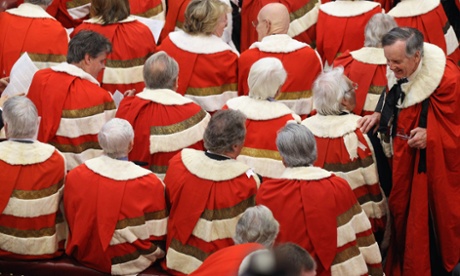
Most of those voting against mitochondrial transfer were Conservatives, according to the Press Association.
More than 80 Conservative MPs voted against regulations to allow IVF babies to be created with three people’s DNA, while 47 of the party also stayed away from the Commons for the historic vote.
Some 31 Labour MPs joined the 81 Tory opponents, as did five Liberal Democrats.
Also opposed were two members of the SNP, two from the SDLP, one independent and Ukip MP Mark Reckless.
Several ministers, including Justice Secretary Chris Grayling, voted against the measure which was carried by a majority of 254.
UPDATE AT 5.18PM: The Press Association has published a correction. Mark Reckless was the Ukip MP who voted against the regulations, not Douglas Carswell. I’ve amended the copy above.
Updated
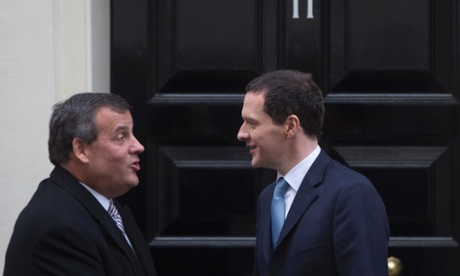
Chris Christie, the New Jersey governor and possible Republican presidential candidate, had lunch with George Osborne at Number 11 today. “We had a lot of fun,” he said as he left, according to the BBC.
Here’s a short afternoon reading list.
Duncan thinks a majority is within grasp if the Tories and their leader campaign with “a bit of passion with a bit of vigour, with what I call the tingle factor. We need the tingle factor in politics.”
I ask again: does the PM have what it takes? Does he have that “tingle factor”? “If he pushes the button and goes for it, yes he does. He did it over Scotland. He’s quite good when he gets angry.” Duncan chuckles.
“Conventional wisdom is that we live in a non-ideological age,” he adds. “I think that’s an error.”
So non-ideological Cameron is the right man to lead the Tories in an ideological age? Really?
“He’s capable of it,” says Duncan. “And he is the best of the bunch.”
I’ve beefed up some of the earlier posts with more direct quotes from the debate. You may need to refresh the page to get them to appear.
And here is some reaction to the vote.
From Dr Jeremy Farrar, director of the Wellcome Trust
Families who know what it is like to care for a child with a devastating disease are best placed to decide whether mitochondrial donation is the right option for them.
We welcome this vote to give them that choice, and we hope that the House of Lords reaches a similar conclusion so that this procedure can be licensed under the UK’s internationally-admired regulatory system.
This is a vote of confidence in the patients, scientists, doctors and ethicists who have worked hard for a decade to explain this complex research to politicians, the public and the media, and in the exemplary process for reviewing scientific, ethical and public opinion led by the Human Fertilisation and Embryology Authority.
From Robert Meadowcroft, chief executive of the Muscular Dystrophy Campaign
We have finally reached a milestone in giving women an invaluable choice, the choice to become a mother without fear of passing on a lifetime under the shadow of mitochondrial disease to their child. Today, MPs have responded to the broad public support for mitochondrial donation IVF, which follows years of ethical, scientific and public consultations.
There are currently no means to treat devastating mitochondrial diseases, which can cause muscle wastage, loss of vision, stroke-like episodes and a premature death. Preventing inheritance, where possible, remains our only option, and that is why we have invested in and wholly support this pioneering technique.
The next step is for us to make sure peers are armed with the full facts surrounding mitochondrial donation IVF ahead of a debate in the House of Lords. It is absolutely crucial that they fully understand what is at stake for women affected by this condition.
Some MPs who supported the regulations have been tweeting about it.
I'm voting in support of mitochondrial donation #mitoaware
— Luciana Berger (@lucianaberger) February 3, 2015
I'm off to support mitochondrial donation in the vote in the House of Commons now #mitoaware
— Chuka Umunna (@ChukaUmunna) February 3, 2015
Standing at the entrance to the lobby encouraging MPs to vote yes. Looking good! Lots of MPs asking 'which way for science?' #fb #mitoaware
— Julian Huppert (@julianhuppert) February 3, 2015
Voting 'yes' for new ways to deal with mitochondrial disease; sound science behind it, strong rules around it ...big Commons vote in favour
— John Healey MP (@JohnHealey_MP) February 3, 2015
Glad to vote in favour of mitochondrial donation in parliament today. vote won 382:128
— Kate Green (@KateGreenSU) February 3, 2015
JUST VOTED IN FAVOUR OF MITOCHONDRIAL DONATION REGS WHICH HAVE BEEN PASSED BY 383-128 VOTES-GOOD NEWS FOR PARENTS CARRYING TERRIBLE DISEASE
— Tim Loughton MP (@timloughton) February 3, 2015
Listened carefully to the arguments around Mitochondrial donations. Voted in favour!
— Sam Gyimah MP (@SamGyimah) February 3, 2015
I voted in favour of the Statutory Instrument relating to Mitochondrial Donation, which passed by 382 to 128 on a free vote.
— Dan Byles MP (@danielbyles) February 3, 2015
Pleased to have supported SI allowing Mitochondrial donation in HoC -cheer erupted from public gallery when it passed 383 to 128 #mitoaware
— Angela Eagle (@angelaeagle) February 3, 2015
I haven’t seen any tweets from MPs who voted against.
David Cameron did vote for the regulations.
Downing St: Prime Minister has voted in favour of what some have described as 'three parent babies.'
— Chris Mason (@ChrisMasonBBC) February 3, 2015
And here’s one mother who will be happy.
This is Kathryn Kitto with daughter Poppy telling me why she wants MPs to back #mitochondrial donation. pic.twitter.com/rnwghKn7pu
— Vicki Young (@VickiYoung01) February 3, 2015
In the public gallery there were cheers when the vote was announced.
MPs have backed plans to allow scientists to create babies using DNA from 3 people. Cheers in public gallery as result announced.
— Vicki Young (@VickiYoung01) February 3, 2015
The regulations still have to be approved by the House of Lords but, with secondary legislation of this kind, it is extremely unusual for peers to oppose it when it has been passed by the elected House. There are rumours that some peers may try to force a division, but the prospect of the Lords now voting against the regulations is thought to be very slim.
MPs back mitochondrial donation regulations by a majority of 254
MPs have backed the mitochondrial donation regulations by 382 votes to 128 - a majority of 254.
Updated
Peter Bone and Philip Hollobone, the two tellers for the noes, are back in the chamber. That means they’ve counted all their MPs. The tellers for the ayes aren’t there yet, which is means they’re still counting. So it looks as though the regulations have been passed.
The tellers for the ayes are Gavin Barwell and John Penrose.
The tellers for the noes are Peter Bone and Philip Hollobone.
All four of them are Conseratives.
MPs are now voting.
We’ll get the result in about 15 minutes.
It is a free vote. Those who have taken soundings expect the regulations to go through comfortably, but you can never be sure with a vote like this.
Jane Ellison, the health minister, is winding up now.
She says the regulations are not ultra vires. And they do not run counter to the EU clinical trial directive, she says.
Those MPs who said this was rushed were wrong, he says. These regulations can only apply to serious mitochondrial disease, she says.
And the slippery slope argument is wrong. She looked back at the arguments raised when parliament approved IVF. People warned about a slippery slope then. But those fears have not materialised, she says.
I’ve been topping up some of the earlier posts from the debate with direct quotes. You may need to refresh the page to get those to come up.
In a blog for Coffee House Isabel Hardman has posted more details about what John Bercow said at the start of the debate criticising ministers for not allowing more time for debate. (See 2.02pm.) She says Bercow had a point.
That MPs have time to discuss something before making up their mind to vote seems particularly important on a free vote, and even more important given this is a subject that few in the Commons can claim a great deal of expertise on. Dr Julian Huppert, who has already intervened in the debate to offer some important details on the proposals, claims to be the only scientist in the Commons, while this House of Commons library briefing note says that 1.4 per cent of MPs in the main parties in the Commons, are doctors (it doesn’t list scientists).
And there seems little justification for refusing to extend the debate, given the Commons isn’t exactly jam-packed with legislation at the moment. It’s almost as though ministers would rather MPs voted based on their assumptions rather than at the end of a debate where their views might be challenged.
Paul Burstow, the Lib Dem former health minister, says today’s vote does not open the door to mitochondrial transfer as a matter of routine. The HFEA would only approve applications on a case by case basis.
He urges MPs to support the regulations.
Updated
Jim Shannon, the DUP MP, says these regulations contradict the EU clinical trial directive. They would be illegal, he says.
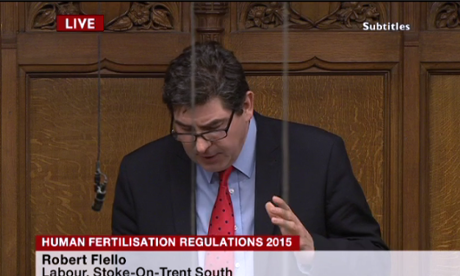
Labour’s Robert Flello says he fears that, even if these regulations are approved, parents will be disappointed because it will turn out that procedure does not work.
The procedure amounts to genetic modification, he says. That is what the HFEA says.
Julian Huppert, the Lib Dem MP, says why Flello thinks that, to avoid having people’s hopes dashed later, we should dash them today.
Flello says there are other objections.
He says he thinks the government is trying to rush this through because it thinks the EU legislation on clinical trials is going to be tightened up.
Trying to push through these regulations in no time at all is a “nonsense”, he says. We should get this right, and give this proper parliamentary scrutiny.
This is completely untested. The government is proposing to go straight to treatment.
Sir Edward Leigh, a Conservative, says he is opposing the regulations on the grounds of ethics, safety and parliamentary procedure.
It is a new step, it will affect the germ line, mitochondria is inherited, it is not just another organ of the body. It is a fatal and important step. As my colleague said earlier - where do we stop? If we believe that sadly given the nature of the human condition there are these appalling diseases, where does it stop? What further modifications will we make?
Updated
Labour’s Liz McInnes, a former NHS biochemist, says it would be unethical not to approve the regulations. She urges MPs to back them.
There are 37 genes in mitochondrial DNA which is less than 0.01% of our total DNA. Altering the mitochondria will not alter a child’s characteristics inherited from its biological parents, but it may provide a way to prevent a debilitating and sometimes fatal disease.
The spectre of designer babies can be dismissed here - there is no possibility using this technique of being able to select certain characteristics. It will simply allow mitochondria to function normally and for the child to be free of mitochondrial disease.
Updated
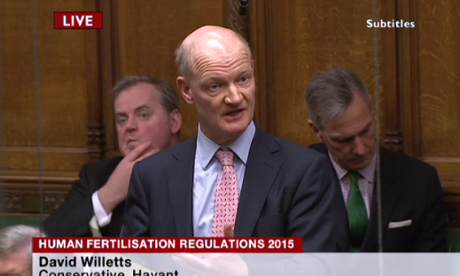
David Willetts, the Conservative former science minister, says this procedure would meet a real human need. There are parents now having children with mitochondrial disease who know that this could be avoided.
In previous legislation, the Commons has decided that changing human nature should be a red line. These regulations do not cross that red line.
On health and safety, he says this is sometimes being used a cover by people who object to the procedure on process.
No one has been able to show that this is unsafe, he says.
Some MPs ask why Britain is doing this when no other country has legalised this. That’s because British scientists are conducting world-leading research, he says.
John Bercow, the Commons Speaker, says the time limit is being cut to four minutes for backbench speeches.
John Hemming, the Lib Dem MP, says he is opposing the regulations. He thinks they are too risky. They could pave the way for further DNA modification, he says.
Updated
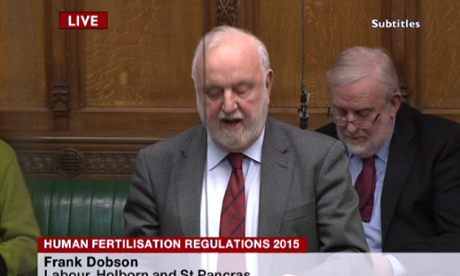
Frank Dobson, the Labour former health secretary, is speaking now. He says he has a strong sense of deja vu. The arguments being used today echo those used before Louise Brown became the first test tube baby in 1978, he says.
The same arguments were heard when Enoch Powell tried to ban genetic research, and when parliament debated the Warnock report.
MPs are wondering whether this is safe and if it will work. But those questions apply to any new scientific procedure, he says.
He says scientists have been trying to tackle mitochondrial disease for 20 years. They have not found a cure. So they have decided prevention is better than cure.
It is a credit to this country, and to this house, that the Human Fertilisation and Embryology Authority was set up.
There is no sign that the HFEA has led to “slippery slope”, he says.
The parents want this to happen, he says. There is some uncertainty. But the experts think this will work, and we should take note.
(Dobson sounded quite chooked up during that, as if he were close to tears. But it was the best speech of the debate so far.)
Updated
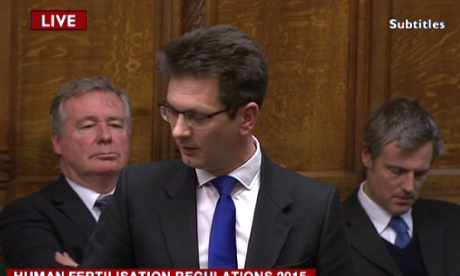
Steve Baker, a Conservative, is speaking now. He approaches this with great humility, he says. Partly because he remembers a very moving meeting with a family with a child with mitochondrial disease, he says. And partly because he is not an expert.
Science advances by trial and error, he says.
There will always be uncertainty in any scientific procedure, he says.
He says Luciana Berger asked if there was a reason to withhold approval. The reason is that this procedure might do harm. That is why he will vote against, he says.
Labour’s Graham Stringer asks Baker if he accepts that we should balance that uncertainty against the absolute certainty that parents of children with mitochondrial disease will continue to suffer.
Baker says we are not discussing a cure for those who are currently living.
A Labour MP intervenes: “Isn’t prevention better than cure?”
Baker accepts this, but he says this is a matter of conscience.
He says some people have been engaged in “semantic sophistry”. But, as far as he he concerned, this is genetic modification, he says.
We each of us have our own particular DNA identity, this procedure may change only a tiny part of it, but change it it certainly does. I’ve already discussed the uncertainty and having changed it we just cannot know what the future consequences will be and I think with great sorrow, knowing the families will be affected, with great sorrow I say that when it comes to human beings this degree of uncertainty cannot be borne by my conscience and I shall be voting against the regulations.
Updated
Andrew Miller, the Labour MP and chair of the science committee, says if we accepted the arguments used by critics, procedures like organ donation would not be allowed.
Of course the Commons will want to put limits on this procedure. But that is what the regulations do, he says.
In all cases where there are risks one needs to look at the risks versus the benefits. And I put it to this House that the benefits to those - about 2,500 families - affected by mitochondrial disease up and down this nation, they deserve the support of this House because of the potential benefits. Yes, of course, we’ve got to assess the risks as we do with all risks but they’ve got to be done in a rational and balanced way.
If this were about designer babies, he would be opposed.
Updated
Bruce says the government is at risk of infringement procedures being brought against it if these regulations proceed.
If we approve this procedure, where will it lead?
Bruce says a ComRes poll shows that 41% of people are opposed, and only 20% are in favour.
And another survey on the Daily Telegraph website today also shows that the public are opposed, she says.
(This provokes some laughter. Website polls are not scientific, and normally not taken seriously. A recent YouGov poll [pdf] found that 40% of respondents were in favour of the procedure, and 30% were opposed.)
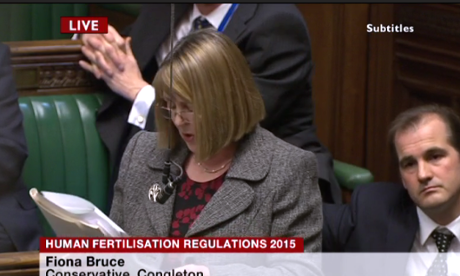
Fiona Bruce, a Conservative MP, is speaking now. She says she is concerned about the safety of the procedure. One of the procedures, pronuclear transfer, allows the destruction of at least two embryos.
One of these procedures we are asked to approve today, pronuclear transfer, involves the deliberate creation and destruction of at least two human embryos, and probably in practice many more, in order to create a third embryo which it is hoped will be free from human mitochondrial disease. Are we happy to sacrifice two early human lives to make a third?
(Ian Sample’s explainer is essential at this point.)
She says it will also involve the permanent alternation of the genetic code. The implications of this cannot be predicted, she says.
This is about the principle of genetically altering, indeed genetically creating, a human being and no matter how well meaning the motives - and my heart goes out to the families with mitochondrial disease - this technique will not cure it.
This technique will involve the permanent alteration of the human genetic code ... This is something, this alteration, will be cast down generations, the implications of this simply cannot be predicted, but one thing is for sure: once this alteration has taken place, once the genie is out of the bottle, once the procedures we are being asked to authorise go ahead, there will be no going back for society, and certainly not for the individuals.
She says there have been no clinical trials for this process. So, if MPs agree this, won’t they be approving experimentation on children.
If we pass these regulations today, the technique will be applied to the creation of children without clinical trials. In other words that we will be approving uncontrolled - because there will be no controls - uncontrolled experimentation on children.
Labour’s Robert Flello says there cannot be clinical trials because that would be illegal under EU legislation.
Bruce says that is right.
Updated
John Bercow, the Speaker, says he is imposing a six-minute limit on backbench speeches.
Updated
Berger says the regulations make it clear that a mitochondrial donor would not be treated as a parent.
The process has been subject to extensive review, she says.
She says there would have to be a “leap of faith” by those using it for the first time.
Sir Edward Leigh, a Conservative, says the American Food and Drug administration has not authorised this procedure. The FDA also banned thalidomide, even though it was legalised in the UK. “The rest is history,” he says.
Berger says the FDA has written a letter to the British press saying that its position has been misrepresented.
We must not delay any further, she says.
Updated
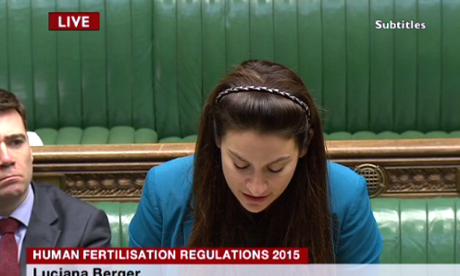
Luciana Berger, the shadow health minister, says legalising these techniques would enable use to eliminate mitochondrial disease. That would “break the chain of misery” affecting families, she says.
We have within our reach the possibility of eradicating mitochondrial disease and families who have been blighted by it for generations, families who have endured a disease for which there is no cure. They have suffered daily battles with painfully debilitating symptoms and have sadly lost their children prematurely. Families who have had to face up to the risk and perhaps the certainty that to be a parent must come at the expense of a difficult and, in too many cases, painful life for their children. Not only would children born through such techniques be free of these conditions, but so would their children and grandchildren, breaking a chain of misery that would have otherwise ruined generations of lives.
Robert Flello, the Labour MP, for the second time mentions Chinese research questioning the safety of the procedure.
Berger says further research has been carried out subsequent to that.
Labour’s Brian Donohoe asks if Berger thinks that this process amounts to genetic modification.
Berger says she does not accept that.
Updated
Ellison recommends the briefing note on mitochondrial transfer produced by the Human Fertilisation and Embryology Authority (pdf).
It is a very respected regulator, she says.
These regulations would also bring in to place important safeguards through the HFEA’s own licencing procedures. For a licence to be issued to a provider of mitochondrial donation, they would first have to demonstrate that they could carry out the procedure safely and effectively. Each provider would need to be licensed and treatment for each patient would be approved on a case-by-case basis. Such decisions would be based on the scientific evidence and advice submitted to the licensing committee.
The HFEA are highly respected across the globe as a model for the regulation of fertility and embryology treatments and research. Many other countries do not have this framework in place.
She says legalising these techniques will improve people’s lives. They are “the light at the end of a very dark tunnel”, she says. She urges MPs to support them.
Updated
Bill Cash, a Conservative, says there are series legal arguments saying the regulations are ultra vires (ie, illegal). He says it is claimed that are contrary to EU regulations.
Ellison says the EU regulations cover clinical trials. This procedure is different, she says.
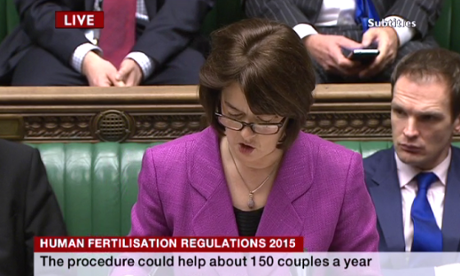
Jane Ellison says the regulations would allow the two techniques used in mitochondrial transfer.
You can read the regulations that MPs are debating here (pdf).
Ellison pays tribute to the work of the Lily Foundation, which supports those who have lost children to mitochondrial disease.
Ellison says scientists in Britain are leading the way in this technology.
Robert Flello, a Labour MP, says pioneering work on this has been done in China. That led the Chinese to ban these procedures, he says.
Ellison is aware of that.
David Burrowes, a Conservative, says the procedure amounts to genetic modification.
Will you accept, as scientists I understand do broadly accept, that the procedures are cell nuclear transfer? That’s what regulations four and seven do and make clear. By that they very implicitly do explicitly alter the nuclear DNA in the egg and therefore one has to agree an honest clear definition is what we’re dealing with is genetic modification.
Ellison says she does not accept that description.
No, I can’t accept that description. I recognise you have objections to the procedure but I don’t recognise your description and no nuclear DNA is affected by this. Mitochondrial DNA is different.
Updated
Jane Ellison, the health minister, is opening the debate.
She explains why mitochondria do.
She says there has been extensive consultation with the public on this.
There have been three reports into the safety of mitochondrial replacement techniques, she says.
And she quotes a scientist saying this process has been subject to more review than any other technology.
Bercow says more time should have been set aside for the debate
The debate is about to start.
But, before it does, David Burrowes, a Conservative, makes a point of order to ask why just 90 minutes has been set aside for the debate.
John Bercow, the Commons Speaker, says he sympathises with the point. But it was up to the government to suggest an extension to the debate, he says. Ministers did not do that.
- Bercow suggests more time should have been set aside for the debate.
Bercow says 18 MPs want to speak in the debate.
Updated
MPs will soon start their debate on whether to change the law to allow mitochondrial transfer.
Here’s the Guardian’s preview story. And here’s how it starts.
MPs will vote on Tuesday in a historic Commons debate that could see Britain become the first country in the world to permit IVF babies being created using biological material from three different people.
Health ministers have indicated they believe mitochondrial donation to stop genetic disease being passed on to babies is an “important scientific advance that holds out great hope for families in this country and around the world”.
David Cameron’s official spokesman said the prime minister was “a strong supporter” of mitochrondrial donation and was expected to vote in favour of the change. “He’s very likely to vote. He certainly wants to take part in this vote and will be very clearly in favour,” he said.
However, up to 60 MPs are preparing to try to delay the motion, arguing it has been rushed. The fiercest critics of the technique argue that it is tantamount to creating “three-parent babies”.
MP Julian Huppert, a longtime supporter of the change, said a number of MPs in favour of the amendment had been trying to make sure their fellow MPs would turn out so it would pass but there was anxiety about whether enough supporters would attend the vote.
Lunchtime summary
-
William Hague has been criticised by some Conservatives after he unveiled plans to give English MPs a veto over English-only legislation. Echoing a complaint made by Ukip, some Tories have described the plans as a fudge and argued instead for a full ban on Scottish MPs voting on English-only legislation. Hilary Benn, the shadow communities secretary, said Labour’s plans, which would give English MPs the power to amend English-only bills while ensuring the Commons as a whole retained the final say, were more sensible. Benn said:
There’s no hiding the fact that what William Hague has come forward with today is not what his backbenchers were expecting. David Cameron has played fast and loose with the future of the United Kingdom ever since his speech just minutes after the referendum result. As the party of the Union, only Labour will devolve real power and resources from Whitehall to all parts of England and only a Labour government will be in a position to deliver the change we need for the whole of the United Kingdom.
Hague said he would try to hold a vote on his plans before the election, but he said this had not been agreed yet. However, he indicated that the Conservatives would make this a key issue in any possible coalition talks.
-
Boris Johnson, the Conservative mayor of London, has criticised Boots’ decision to move its HQ from the UK to cut its tax bill. On his LBC phone-in, he said it was “disappointing” that Boots did not pay more tax. But he said Stefano Pessina, the Boots boss, was right to criticise Labour’s economic policies. (See 10.29am.) Labour’s Chuka Umunna said David Cameron should back Johnson.
The mayor of London is right to set himself apart from the prime minister and make it clear he finds it disappointing when firms do not join the overwhelming majority of British businesses in making a fair contribution to the Exchequer. Rather than playing party politics on this issue, it would be welcome if the prime minister and chancellor joined the mayor and us in presenting a united front on this issue.
Asked about Johnson’s comments, Cameron’s spokesman said:
It is absolutely right that companies that enjoy the benefits of operating in the UK must pay their full and fair share of taxes on the profits that they make in the UK. The government has made important changes in this area, most recently in the autumn statement with the diverted profits tax, which is specifically designed to deal with multi-national companies that may seek to use artificial structures to divert profits away from the jurisdiction in which those profits are made.
Asked whether his comments would apply to the decision of stationers Smythson - where Cameron’s wife Samatha is employed as a consultant - to locate in Luxembourg, the spokesman said: “The government’s job is to set out and ensure we have in place the robust, vigorously-enforced tax rules that we have. I don’t comment on the tax affairs of individual companies.”
- Ed Balls, the shadow chancellor, has said business leaders who have criticised Labour are not representative of business as a whole. (See 11.55am.)
- Balls has said a Labour government would fast-track plans to establish an independent commission to examine major infrastructure projects, amid concerns that decisions on vital schemes had been “ducked and delayed”. As the Press Association reports, he said he would like the national infrastructure commission set up as soon as possible, with its first full report produced by mid-2017. He also insisted that Labour would take a “swift decision” on whether to expand Heathrow, claiming it was not an issue that could be kicked into the long grass again.
-
Downing Street has said that Cameron strongly supports the plan to change the law to allow mitochondrial replacement and that he intends to vote for it this afternoon. Cameron’s spokesman said:
It is a free vote. The prime minister is a strong supporter of this and I would expect him to vote in favour of the change.
Updated
My colleague Nicholas Watt has written a good feature about the Conservatives’ election campaign. It’s just been launched and you can read it here.
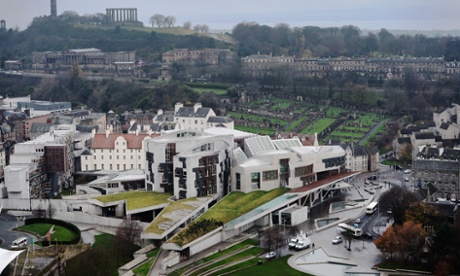
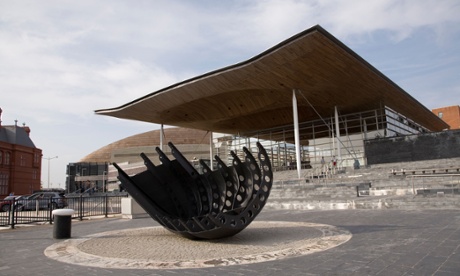
The SNP and Plaid Cymru are both arguing that William Hague’s English votes for English laws (Evel) proposals reinforce the case for further devolution.
This is from Stewart Hosie, the SNP’s deputy leader.
Until income tax - for example - is devolved in full, it is illogical and wrong for anyone to carve Scottish MPs out of important decision making
Paradoxically William Hague has actually made the case today for full fiscal devolution - where Scotland takes full responsibility for growing the economy, and not this half way house which offers minimal economic powers while resulting in a loss of voting rights.
And this is from Elfyn Llwyd, Plaid’s Westminster leader.
In principle, Plaid Cymru is supportive of English Votes for English Laws, but these reforms must not come about in isolation.
We have long argued for all nations of the UK to be treated on the basis of equality - both in terms of funding and powers.
If Evel goes ahead it must go hand in hand with home rule all round and the Barnett formula must be replaced in order to address the chronic underfunding of Wales.
It is high time the old and outdated ‘England and Wales’ unit was swept away and for our nation to be handed the proper tools to pass robust legislation and administer justice in a manner which serves the best interests of the Welsh people.
Ukip says Hague’s Evel plan will bring ‘chaos’
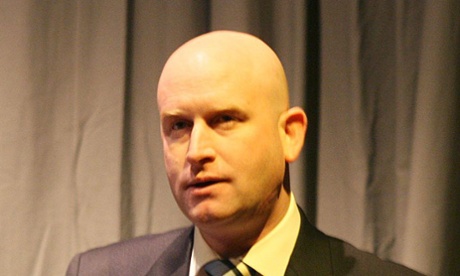
Paul Nuttall, Ukip’s deputy leader, has accused William Hague of a climb down over English votes for English laws. Ukip want pure Evel, as you might call it - a total ban on Scottish MPs voting on English-only legislation.
Here’s an extract from his statement.
It is likely that after the General Election there will be more SNP members of parliament sitting in Westminster whose concern will be Scotland and not what is best for England. In that situation these plans would add layers of process and confusion to legislating and lead to back room deals being made far away from the voters eyes.
Why are the Tories are climbing down for English only votes? Is there already a back room stitch-up?
Cameron has spoken of English votes for English laws but these proposals will fail to deliver anything but chaos.
Updated
Taking questions after his speech, William Hague hinted that English votes for English laws would be a priority in any possible coalition talks after the election.
Hague hints Evel will be priority in coalition negotiations -- PM "feels very strongly" about topic + will pursue in "any" circumstances.
— Ben Riley-Smith (@benrileysmith) February 3, 2015
Here’s an extract from his article.
To appreciate the problem, consider the following scenario. Labour, with a majority in the UK as a whole but not in England, propose a law to restrict bin collections to once a month. English MPs could block such a law from applying to England. But if the Conservatives, with a majority of English MPs, then tried to introduce a Bill guaranteeing weekly bin collections in England, Labour would be allowed to use its UK-wide majority, including Scottish and Welsh MPs, to vote the law down – even though it would not affect those MPs’ constituents. In short, England would still not be self-governing.
This isn’t a fantasy scenario – Labour are openly hostile to the idea of true English Votes on English Laws, a hostility born of the fact that it would deny them powers which they would otherwise use. The SNP and Plaid Cymru have made clear that they intend to vote on English matters such as health in future. Hague’s proposal would leave them the opportunity to do so.
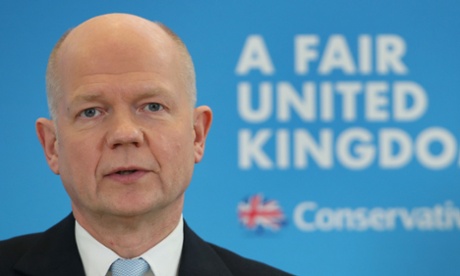
William Hague's Evel speech - Summary
William Hague has has now delivered his English votes for English laws speech. It is not available online yet, but I’ve seen the text. Here are the key points.
- Hague confirmed that his plans would give English MPs a veto on English-only legislation (or English/Welsh MPs a veto on English/Welsh legislation). He is adopting the third option proposed by the Conservatives in the command paper on English votes for English laws published in December (details here - see 3).
-
He said this plan had three advantages.
First, the control of the detail of legislation and an effective veto are essential to giving real effect to English Votes for English Laws. With such procedures in place any government will know it cannot impose legislation on England without taking full account of the views of a majority of MPs from England.
The second is that it is an option that maintains the integrity of the United Kingdom Parliament. Parliament would continue to function with Members deliberating and voting together. Scottish, Welsh and Northern Irish MPs would continue to participate and vote at Second Reading, Report and Third Reading. But they would not be able to pass a motion concerning only England without the support of English Members. So crucially, this option enhances the Union, as Westminster will clearly remain a UK Parliament.
Third, it is the option most easily employed to bring democracy and accountability to a wide range of issues. For example, we recognise that the level of spending on health or local government in England is a legitimate matter for all MPs, as there are consequential effects on spending in the rest of the UK. But it is unarguable that the distribution of spending within England is a matter that applies only to England.
- He said Labour was refusing to address the English votes for English laws issue “because they want to keep open the possibility of being propped up by Scottish Nationalists in government while betraying the voters of England.” He described the plans that have been put forward by Labour as “the weakest of all options for addressing English votes on English laws”.
- He confirmed that this meant income tax rates for England would be decided by English MPs.
- He said the Commons Speaker would decide what counted as English-only legislation, on advice from the clerks.
-
He said, without English votes for English laws, the SNP might be able to hold a Westminster government to ransom.
Nicola Sturgeon has said that it would be “perfectly legitimate” for SNP MPs to vote on English matters – even though English MPs have no say over corresponding matters in Scotland – and that through that they could “win big gains for Scotland.”
So if English Votes for English Laws is not implemented, there is the real prospect of England being held to ransom by the demands of the SNP or Scottish Labour MPs.
Updated
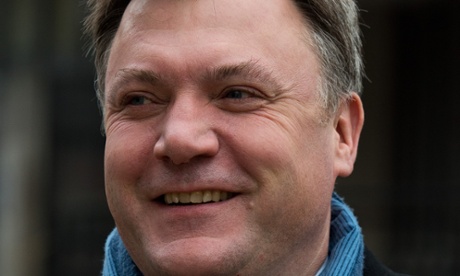
Balls says tycoons attacking Labour not representative of business as a whole
The Daily Telegraph and the Daily Mail are both splashing on stories about business leaders attacking Labour.
In the Telegraph, business leaders accuse Ed Miliband of trying to shut down political debate.
Britain’s most senior business leaders have accused Ed Miliband of attempting to shut down debate of his policies ahead of the election by making “personal attacks” on his critics.
Sir Ian Cheshire, who ran the DIY chain B&Q, spoke out alongside a number of the country’s most respected business leaders after Mr Miliband rounded on Stefano Pessina, the chief executive of Boots, after he said a Labour Government would be a “catastrophe” for Britain.
Sir Nigel Rudd, one of Britain’s leading industrialists, said the highly personal attacks “stifled debate” and “made people think twice about voicing their opinions”.
And, in the Mail, Stuart Rose describes Miliband as a “1970s throwback”.
The man who restored Marks & Spencer’s fortunes today accuses Ed Miliband of being a ‘1970s throwback’ who has wrecked Britain’s pro-business consensus.
Stuart Rose claims Labour’s ‘business-bashing’ could curb investment and lead to ‘shuttered shop fronts, empty high streets and lengthening dole queues’.
His intervention, in an article for the Daily Mail, is especially significant because he was handpicked by Gordon Brown to advise him directly as prime minister.
At Labour’s infrastructure conference this morning, Ed Balls, the shadow chancellor, said that those business leaders criticising his party were not representative of business as a whole. He said:
The reality is there’s going to be some issues in any society which become very divisive politically, and understandably. The level of taxation that you levy at any point of time, there will always be different views on that, and whether or not we should have a health service which is predominantly free or whether people pay. These are big political issues.There are always going to be some people in every community, including the business community, who take a political view.
There will be some identified Labour-supporting business people who take a Labour view, and there will be some Conservative-supporting business people who take a very Conservative view - and they might even end up becoming Conservative ministers or Conservative peers.
My sense is that the vast majority of business people don’t particularly take the Labour view or the Conservative view, the view they take is ‘what is the best way forward for our country in the next 10, 20, 30 years which will support the jobs and the growth that I want to create through my business’ and they want to work with the government of the day and they want us to try and take a long-term view.
Latest polling and predictions
For the record, here are today’s YouGov GB polling figures.
Labour: 35%
Conservatives: 33%
Ukip: 14%
Lib Dems: 7%
Greens: 6%
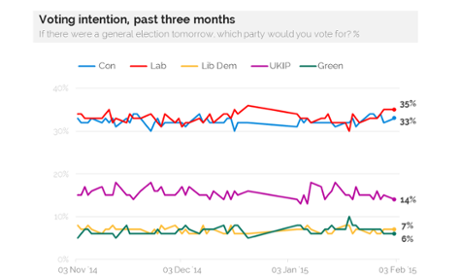
According to Electoral Calculus, this would leave Labour the biggest party, but 14 seats short of a majority.
And here are election predictions from a variety of organisations.
Elections Etc: Conservatives 282, Labour 280, SNP 40, Lib Dems 24, Ukip 3
Election Forecast: Labour 285, Conservatives 283, SNP 35, Lib Dems 24, Ukip 2
Prof Paul Whiteley: Labour 291, Conservatives 281, Lib Dems 48
(These are all academic forecasts, based on models that using current polling data and make allowance for how polls shift in the run up to an election.)
May 2015: Labour 286, Conservatives 275, SNP 38, Lib Dems 24, Ukip 4
Guardian: Labour 273, Conservatives 273, SNP 49, Lib Dems 28, Ukip 5
(These are based on current polling, taking into account Lord Ashcroft’s seat by seat polling.)
Electoral Calculus: Labour 298, Conservatives 265, Nationlists 50, Lib Dems 16, Ukip 1
(This is just based on current polling.)
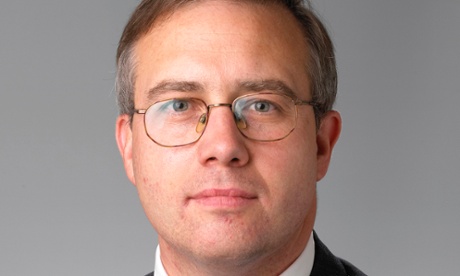
Another Conservative MP, John Baron, has criticised William Hague’s English votes for English laws plans. Baron set out his objections in an article for politics.co.uk. Here’s an excerpt.
Evel is a separatist measure, regardless of the options. But at least Hague’s approach is the least separatist of all. It is the least divisive. I expect the SNP to be a separatist party – such is their raison d’être. But I don’t expect the Conservative and Unionist party to follow suit. Blocking all non-English MPs from voting on English-only matters would in particular play into the hands of the separatists.
We need a course of action which causes least harm, whilst we take time to explore ways of bringing the Union closer together. We need to remember that the vast majority of the people of our Union want to stay united. Pursuing policies which can be best exploited by the SNP is not the best way to serve that Union.
When discussing the matter at a recent party meeting, a number of us made the point that, in supporting a ‘veto vote’ for English MPs that nevertheless gives the whole Commons the final say, we should remember asymmetry has traditionally been the price England pays to ensure Scotland stays in the Union. During the 19th century and early 20th century we decided not to pay that price when it came to Ireland – and the Union suffered as a result.
Bird flu found in chicken farm in Hampshire
Bird flu has been found on a chicken farm in Hampshire. But it is just a “low severity” strain, the risk to public health is judged “very low” and there is no food risk, according to the Department for Environment, Food and Rural Affairs.
Liz Truss, the environment secretary, made the announcement in a Commons written answer (pdf).
The chief veterinary officer has confirmed a case of avian flu in a chicken breeding farm in Hampshire. Tests have confirmed the case as a low severity H7 strain of the disease, a much less severe form than the H5N8 strain found at a Yorkshire duck farm in November; there are no links between the two cases. Initial laboratory results indicate that this is likely to be the H7N7 subtype.
The advice from Public Health England is that the risk to public health is very low, and the Food Standards Agency has said there is no food safety risk for consumers.
To ensure that the disease does not spread, we have taken immediate and robust action. A 1 kilometre poultry movement restriction zone is in place around the premises and the chickens on the premises are to be culled as part of our well established procedures for responding to avian flu.
Whilst we are never complacent about such an important issue, we have a strong track record of controlling and eliminating outbreaks of avian flu in the UK. We are working closely with operational partners, devolved administration colleagues and the industry to deal effectively with this outbreak.
And here are tweets from a couple of commentators on the Hague plans.
From Anthony Painter from the RSA thinktank
Hague's suggested reforms- another small step on UK's journey from a majoritarian to consensual democracy. Can we go a bit quicker please?
— Anthony Painter (@anthonypainter) February 3, 2015
From the politics professor Tim Bale
#EVEL: at least 'veto' begins with the letter V, I guess. Otherwise, Hague's plan got little going for it. Over-promising. Under-delivering.
— Tim Bale (@ProfTimBale) February 3, 2015
William Hague’s English votes for English laws plans are not universally popular in Tory circles.
Andrew Bridgen, a Conservative MP, told BBC News just now that, although the plans were “better than nothing”, they would create further problems. Bridgen wants pure English votes on English laws (ie, an outright ban on Scottish MPs voting on English matters). Bridgen said:
It is better than nothing, but it is not without its problems, and I think it will be exploited by Alex Salmond and the SNP to our detriment. You’ve got a Conservative party absolutely desperate to preserve the union with the best of intent, however I do not think we will appease the nationalists. We’ve had a very bad record of this and I think this will lead to big problems down the line which we will see.
I’ve taken the quote from PoliticsHome.
And this is what Tim Montgomerie, the ConservativeHome founder and Times columnist, posted on Twitter this morning.
I have no idea what Hague's English vote proposal means. He seems to have turned an election winning theme into a messy compromise #r4today
— Tim Montgomerie ن (@montie) February 3, 2015
Labour challenges Cameron and Osborne to back Johnson over Boots' tax affairs
Boris Johnson’s comments about Boots and tax (see 10.29am) have gone down well with the Labour party. This is from a Labour source.
Boris Johnson has just joined criticism of tax avoidance by the Boots chief. Will the prime minister and the chancellor, who have spent so long posturing on this issue, do the same?
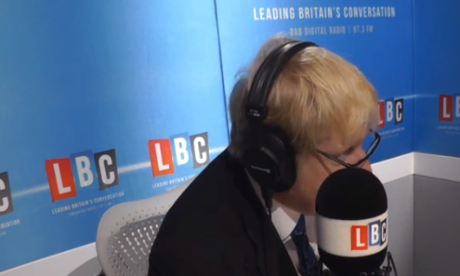
Boris Johnson had a couple of almost contradictory messages on his LBC phone-in. Weighing into the row about whether Stefano Pessina, the Boots boss, was entitled to attack Labour from his tax exile abroad, Johnson said he was. But then he came over a bit Ed Milibandish and said it would be nice if Boots paid a bit more tax in the UK.
Here are the main points.
-
Johnson said Stefano Pessina, the Boots boss, was right to attack Labour’s economic policies. Executives like Pessina were entitled to speak out, he said, and people should listen to what they say. Johnson also said it was true to say that Labour did not understand wealth creation.
I think the head of Boots is perfectly entitled to his view. I think too often, we have a lot of nervousness in great corporations about speaking out on political issues.
Capitalists typically will be wary of any kind of uncertainty. They won’t want to offend any politicians because they will be worried they may get in and start persecuting them, so I think it’s quite refreshing to see some tycoon actually saying what he thinks.
I think it is absolutely true that if you look at the modern Labour Party, they have no interest in wealth creation. They don’t understand that in order to have a strong, healthy society, you have got to support the businesses that create the tax revenue and employ people and put bread on the table for people, otherwise you can’t begin to pay for the poorest and neediest, for the welfare state and hospitals and everything else.
It think, actually, you should listen to what the guy from Boots has to say.
-
He said Pessina’s decision to move the Boots HQ out of the UK for tax purposes was “disappointing”.
I have to say I find it disappointing that he does not cough up for Britain. That is my view ... I think it is a good thing if companies that earn great sums in Britain should pay their taxes in Britain. That is something I’ve said before in the case of many other companies.
But he said he understood why Pessina took that decision.
Well, he is doing his best by the likes of his shareholders and by the interests of the company. These guys, I’m afraid, have a fiduciary duty to their shareholders to minimise their obligations ... It is, in business terms, it is what he has to do.
-
He appeared to rule out running for office in the US. (Johnson was born in America, and holds joint British/US citizenship, which would make him eligible to run for president.)
It’s perfectly true that I was born in America. There was nothing I could do about it, I wanted to be close to my mother at the time and there she was. However, I haven’t lived there since I was five years old and, much though I admire America and admire and love American culture, I think my life and career is here in Britain and I want to see what more I can do here. The short answer is I live in Britain, I want to stick in Britain - this is my home, this is my country.
William Hague has been everywhere this morning.
William Hague has just done his 7th broadcast interview of the morning on "English Votes" #treadmill #timeforacuppa
— norman smith (@BBCNormanS) February 3, 2015
Mostly he was confirming the plans briefed overnight, but two new lines did emerge from the interviews.
-
Hague said that, under his plans, Scottish MPs would in some circumstances still be able to vote on English health matters.
If we’re proposing to change the level of health spending in England that does have an effect on Scotland, that is for all MPs to vote on. But if we’re voting on how to share out the health spending in England, that should require the agreement of the English members of parliament.
-
He said he would like to introduce his changes before the general election, but that this was “unlikely” to happen.
In an ideal world I would like to see this passed before the coming election so that it was ready for whatever the result of the election is. The other parties don’t support this proposal.
The Liberal Democrats have a different proposal of their own kind. The Labour party don’t want to talk about this at all. So it is unlikely that we’ll be unable to pass any such thing before the election, but this will be in the manifesto of the Conservative party in the coming general election. And the Conservative government will have as a very high priority bringing in these rules.
Boris Johnson is doing his LBC phone-in. He has just defended Stefano Pessina’s decision to move the Boots HQ out of the UK for tax purposes, saying he was doing his best for his shareholders, although, confusingly, he also said it would be nice if Boots did pay a bit more tax.
I’ll post the quotes soon.
#UKGENERALELECTION2015 93 DAYS TO GO
— General Election (@UKELECTIONS2015) February 3, 2015
English votes for English laws is back. William Hague, the leader of the Commons, has firmed up the Conservative party’s plans and he will unveil them in a speech this morning. Here’s Patrick Wintour’s preview story. And here’s how it starts.
Scottish MPs at Westminster will be prevented from voting on income tax changes and any other tax measures devolved to the Scottish parliament under Conservative plans to be announced on Tuesday.
The plans – to be laid out in a speech by the Leader of the House, William Hague – will also give MPs representing constituencies south of the border a complete power of veto over laws that affect only their country, so giving Scottish MPs at Westminster merely a residual debating role on such laws. The proposals go further than anything adopted by the Conservatives before but Hague will argue that his reforms “are a fundamental matter of fairness” and are necessary to prevent the weakening of the United Kingdom.
Hague has been speaking about his plans in morning interviews. I will summarise the key points shortly.
Then, this afternoon, we’ve got the Commons debate and vote on mitochondrial transfer - or “three-parent baby” technology, as it is erroneously called.
Here’s the agenda for the day.
9am: Ed Balls, the shadow chancellor, speaks at a Labour UK infrastructure conference.
11.30am: Hague gives his speech on English votes for English laws.
2.30pm: Alistair Carmichael, the Scottish secretary, gives evidence to the Scottish affairs committee on the Smith Commission plans.
Around 4pm: MPs begin the debate on mitochondrial transfer. It will last for 90 minutes.
As usual, I will be also covering all the breaking political news from Westminster, as well as bringing you the most interesting political comment and analysis from the web and from Twitter. I will post a summary at lunchtime and another in the afternoon.
If you want to follow me on Twitter, I’m on @AndrewSparrow





.jpg?w=600)