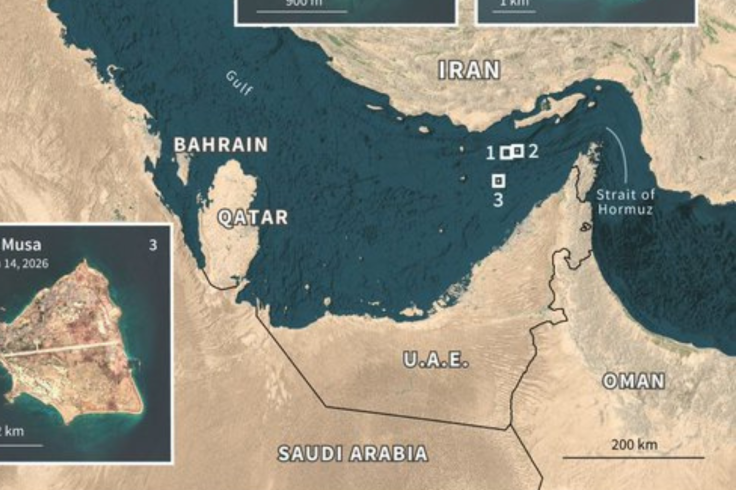
Iran declared the Strait of Hormuz closed on 20 June 2026 and UK drivers could feel it at the pump within weeks. The 21-mile waterway between Iran and Oman carries a fifth of the world's oil and when it jams, British petrol prices follow.
Tehran says it shut the Strait because Israel had broken its agreement with the United States. Washington disputes it: US Central Command says Iran doesn't control the Strait and that commercial traffic is still flowing, with dozens of ships transiting the day of the announcement. The strait had already been effectively closed for much of the year after February's conflict, briefly reopening in mid-June before Tehran declared it shut again.
Iran's top joint military command announces that the Strait of Hormuz is now closed due to US and Israeli "violations" of the Memorandum of Understanding.https://t.co/ESuKHh0lxi
— PedroConrado Richter (@pedrorichter) June 20, 2026
Why should a driver in Lipa or Leeds care about a waterway they couldn't find on a map? Because so much of the world's oil passes through it that a blockage there moves the global crude price, and Britain pays whatever that price becomes.
A Fifth of the World's Oil Through One Gap
The US Energy Information Administration puts the flow through Hormuz at around 20 million barrels a day in 2024, roughly 20% of global supply. Most oil comes from Saudi Arabia, Iraq, the UAE, Kuwait, and Qatar, and pipelines can bypass only a fraction. When the Strait closes, the global crude price climbs, and Britain pays the going rate.
History has shown us this scenario before. When the wider conflict kicked off on 28 February 2026, the House of Commons Library recorded petrol rising 12 pence a litre in three weeks. Diesel jumped 25.
How Fast the Crude Price Can Move
According to the EIA, Brent crude opened 2026 at $61 a barrel and ended the first quarter at $118, the steepest quarterly rise on record (adjusted for inflation) since 1988. The Strait is contested again now, but talks are ongoing in Switzerland and after peaking in April, Brent has retreated to around $80 a barrel (£59) as tanker traffic recovered.
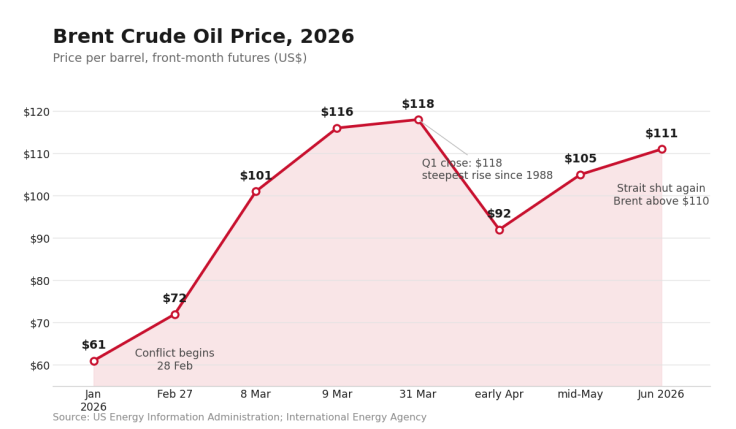
Could it climb again? The Brookings Institution thinks so if the closure holds, modelling Brent at $120 and, once emergency buffers run dry, towards $150. The 32 member states of the International Energy Agency released 400 million barrels from their reserves, but that's only about four days of global demand. It buys time, not a solution.
What It Costs to Fill Up
GOV.UK data for early June 2026 puts the average UK petrol price at 158.74p a litre and diesel at 184.11p, about £7.22 and £8.37 a gallon respectively, figures last seen in the summer of 2022.
A year ago it was cheaper: petrol averaged 132.32p a litre in mid-May 2025, diesel 139.20p. Unleaded has already gone up more than 26p, adding roughly £14 to a typical 55-litre fill since last spring.
The Tax Relief With an Expiry Date
There's a tax angle too, though for now it cuts the other way. The 5p-a-litre fuel duty cut had been due to start unwinding in September, but in May 2026 the government extended the freeze to the end of December because of the conflict and rising pump prices. Duty is now set to rise 3p on 1 January 2027, with the rest withdrawn by 1 March. Drivers face no increase this autumn, but the relief has an expiry date.
And it doesn't end at the pump. Around a third of Britain's energy comes from liquefied natural gas, much of it shipped through or near the same region. Gas-fired power stations usually set the electricity price, so when gas tightens, your electricity bill creeps up too.
What You Can Do About It
You can't reopen a strait, but you can stop overpaying. Since February 2026, every UK retailer has had to report its prices within half an hour under the Fuel Finder scheme, and the gap between two nearby stations can run to 20p a litre or more.
A comparison app will find the cheapest nearby forecourt, and small independents can often undercut supermarkets. Beyond that, drive gently, and cut unnecessary journeys.
The cameras will stay on the negotiating table in Switzerland. Your wallet should watch the Strait. If Iran follows through and talks break down, pressure on UK pump prices will rise again quickly.