Unlike the other Asean members, Thailand must directly shoulder whatever fallout emerges from Myanmar's domestic developments. Bangkok has already endured and adapted to the new situation with its western neighbour. It has not been easy, as Thailand's own internal situation has not been entirely stable.
Bilateral ties, as well as relations with ethnic armed groups straddling the volatile border, have been subject to the same political uncertainty. Of late, new and unprecedented security challenges have surfaced, prompting Thailand to undertake serious soul-searching over its policies and measures towards Myanmar.
Now, with a majority government under Prime Minister Anutin Charnvirakul, Thai-Myanmar relations are being recalibrated more comprehensively, taking into account shifts both inside Myanmar and at the border.
The latest shake-up of the security apparatus, with the setting up of a "frontier cabinet" including key players, shows Mr Anutin's determination to tackle longstanding border intransigence holistically, with more sophisticated diplomacy as a pragmatic security tool.
In the short run, the government's top priority is to bring Myanmar back into the Association of Southeast Asian Nations (Asean) family after five years of absence. The question remains whether Nay Pyi Taw has done enough to warrant such support.
Differing viewpoints within the bloc surfaced during the 48th Asean Summit. Subsequently, there was also Myanmar's uncharacteristic outburst in response to Asean discussion critical of the bloc's continuing restrictions and interference. Nay Pyi Taw evidently lacks genuine self-reflection.
In Cebu, during the foreign ministers' meeting and later at the summit level, the Myanmar quagmire was widely discussed, especially the Thai proposal to recalibrate engagement with Nay Pyi Taw.
The idea had been in the making for some time, dating back to the first Anutin government early last year. Sihasak Phuangketkeow has consistently sought to keep engaging Myanmar by helping it reconnect through humanitarian assistance.
Now, the new military-backed government has been installed in Nay Pyi Taw after an election widely condemned by the international community.
Thailand, however, has quietly acknowledged the new government following Mr Sihasak's visit. He recently told the Daily News that Myanmar's election was not perfect, but that Thailand must move on with the current government because numerous challenges along the Thai-Myanmar border need immediate attention.
He reiterated that without Myanmar, Asean would not be as strong as before. However, if Myanmar becomes isolated, it could turn into an arena for superpower competition. Thailand believes that bringing Myanmar back into the fold will further strengthen Asean and reinforce its centrality.
This perception, however, clashes with the views of human rights and democracy groups, which argue that Asean's current Myanmar policy lacks teeth and moral authority. Since the coup, the military junta has killed 5,350 civilians according to the UN Human Rights Office, and forced 3.3 million people into internal displacement. Nearly a quarter have crossed the border into Thailand.
Thailand's quick acceptance of the post-election government in Myanmar reflects its desire to re-engage in order to protect its own interests, because border problems arise daily, ranging from online scams and narcotics trafficking to pollution and trade disruptions.
Worst of all, over the past five years, some areas adjacent to the Thai border have become lawless zones where transnational crime groups have taken over and run illegal businesses ranging from scam centres and narcotics to illegal logging and mining.
Currently, despite the volatile Thai-Cambodian border, the government is treating Thai-Myanmar issues as urgent matters, with more than 6 million Myanmar people taking refuge in Thailand. Only around 2.3 million have been legally registered and brought under the Thai social safety net.
Bangkok is hoping that Myanmar can gradually move toward national reconciliation. Thai officials have stressed that communication channels will remain open with both the government and ethnic minorities along the border.
Thailand has made clear that improved Asean ties with Myanmar are conditional. As the Asean chair has emphasised, Nay Pyi Taw needs to do more to implement the Five-Point Consensus. At the Cebu meeting, some Asean leaders felt Myanmar had made only "minimum progress" -- they want to see Nay Pyi Taw seriously implement the 5PC.
Mr Sihasak has called on his Asean colleagues to support an informal in-person meeting with the newly appointed Foreign Minister, Tin Maung Swe, on the sidelines of the Asean annual meeting in July. Asean has yet to decide whether the proposed in-person or virtual meeting will take place.
This could pose another diplomatic challenge, as Asean celebrates 35 years of engagement as a dialogue partner with Russia in Kazan from June 17–19. President Vladimir Putin has reportedly issued letters of invitation to all 11 member countries, including his Myanmar counterpart, Min Aung Hlaing. This could affect the participation of several Asean leaders.
At present, over half of the Asean members have not clearly indicated whether they are prepared to accept the election outcome. For the time being, Malaysia has emerged as the most prominent opponent of Nay Pyi Taw's reintegration. In Cebu, Prime Minister Anwar Ibrahim also said Asean was considering more "effective and aggressive" engagement with Myanmar guided by the 5PC.
Without full cooperation from Myanmar, Thailand's immediate challenges from transnational crime, human trafficking, narcotics and water pollution will remain difficult to manage, let alone resolve through joint mechanisms.
The Thai-Myanmar border remains the weakest link in Thailand's border security architecture. Truth be told, in recent months, some armed ethnic groups along the 2,401-kilometre frontier have become more assertive as Thai-Myanmar ties grow friendlier and more cooperative.
As such, Thailand is facing a new Catch-22 as Nay Pyi Taw seeks a clear-cut policy on engagement. Without inclusive dialogue involving the conflicting parties and other stakeholders, a political solution will remain elusive. Nay Pyi Taw has offered peace talks to all ethnic groups in conflict, with a July 31 deadline. So far, none of the resistance groups has come forward.
Only eight ethnic armed groups joined Myanmar's Nationwide Ceasefire Agreement in 2015. Major armed groups such as the Kachin Independence Army and the United Wa State Army refused. Other smaller armed groups continue to battle the Tatmadaw, which has intensified aerial attacks to gain more territory and security leverage.
Bangkok has offered to facilitate peace talks among Myanmar's stakeholders. Several representatives of ethnic armed groups have expressed concern over their safety. It is pivotal that Thailand's proposal receives broader backing from fellow Asean members. Otherwise, its efforts to serve as a bridge between Asean and Nay Pyi Taw could unravel.
Before the bloc's upcoming foreign ministerial meeting, shuttle diplomacy will intensify among Asean members to sharpen the bloc's demands. Asean has persistently called on Myanmar to halt violence, allow more access for humanitarian assistance, release political prisoners and pursue inclusive dialogue. It would be a boon for Nay Pyi Taw if Daw Aung San Suu Kyi, who is under house arrest, were freed.
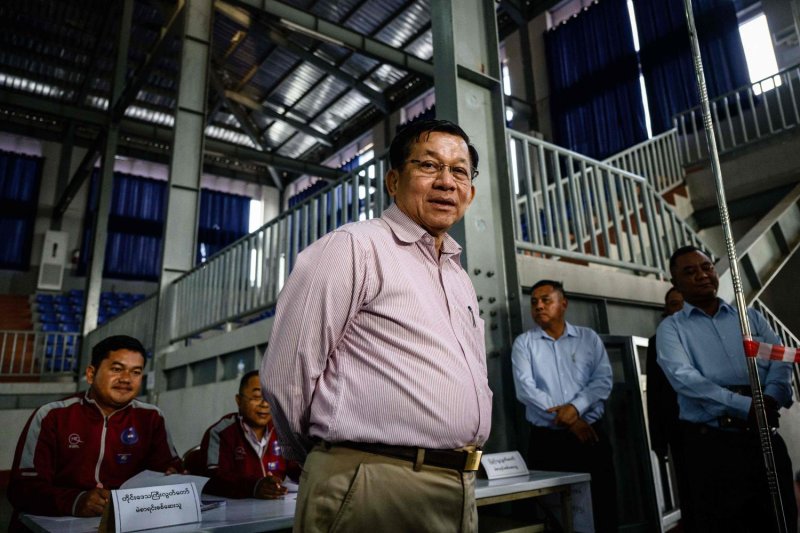
In his inaugural address to Myanmar's parliament after assuming the presidency in April 2026, Min Aung Hlaing publicly signalled that his government wanted to normalise ties with Asean and effectively return to the Asean fold. His wish will come to nought if he continues to play the familiar chess game of using the bloc to legitimise his regime.
The space for progress on Asean-Myanmar ties is narrowing. If Myanmar fails to resume its seat in the bloc under the Philippine chair, the prospect of reunion is doomed.