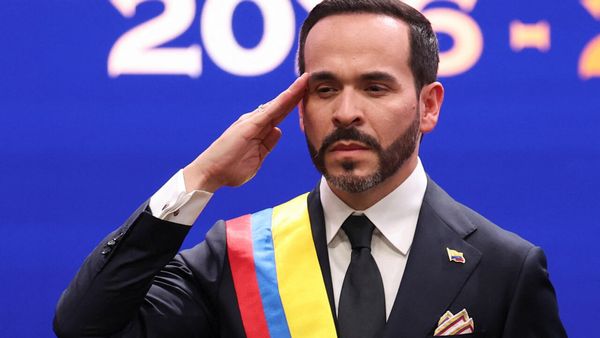
D4vd could face the death penalty in California after prosecutors said he meets the legal criteria for capital punishment in a murder case involving 14-year-old Celeste Rivas Hernandez.
According to court filings and statements from the Los Angeles County District Attorney's Office obtained by FOX KTVU, the case, which is now moving through the early stages of court proceedings in Los Angeles, hinges on whether special-circumstance charges ultimately lead prosecutors to seek the death penalty.
The reports come after a preliminary hearing in which prosecutors outlined the charges and legal basis they believe could make the case eligible for the death penalty. D4vd, whose legal name is David Anthony Burke, has pleaded not guilty to murder and related offences. His legal team has maintained his innocence.
California law only allows the death penalty in limited cases where 'special circumstances' are proven. These can include allegations such as murder during another felony, killing a witness, or financial motive, alongside aggravating factors that elevate the case beyond standard murder charges.
Death Penalty Eligibility In California Explained
Prosecutors in Los Angeles have charged Burke with murder alongside multiple special circumstance allegations, which is what places the case in capital punishment territory. These allegations, as outlined in court documents, include claims that the killing involved witness-related factors and other aggravating circumstances that could allow a jury to consider the death penalty if the case reaches trial. However, even when those criteria are met, the decision to seek capital punishment is not automatic.
Los Angeles County District Attorney Nathan Hochman has said a final determination on whether to pursue the death penalty will be made later in the proceedings. That decision typically comes after further review of the evidence and an internal prosecutorial assessment.
California has not carried out an execution in two decades, and while the death penalty remains legal in the state, its use has been increasingly limited in practice. A moratorium on executions has also effectively stalled its application, even in cases where it is technically available.
In court filings, prosecutors allege the case meets the threshold for the most serious category of homicide under state law. The defence has rejected those allegations and entered a plea of not guilty, setting the stage for what could become a lengthy and closely watched legal battle.
But it's worth noting that in California, people sentenced to death can still face capital punishment in law, but in practice, executions have been paused for years. The method used is lethal injection, although the state has also kept older methods like gas or the gas chamber in its statutes as historical or fallback options that are no longer used. What actually matters today is that executions are not being carried out at all because of a statewide pause ordered by Governor Gavin Newsom.
That pause began in 2019, when Newsom issued an executive moratorium that halted executions and effectively shut down the machinery of the death penalty while he is in office. The state also closed the execution chamber at San Quentin and withdrew its lethal injection protocol. Since then, inmates on death row have remained in prison, but none have been executed.
So legally, California still has the death penalty on the books. But operationally, it is frozen.
What Happens Next In The D4vd's Trial
At this stage, the case is still in pre-trial proceedings. That means no jury has been selected, no evidence has been tested in a full court examination, and no final decision has been made on sentencing exposure.
If prosecutors decide to pursue the death penalty, the case would move into a capital trial structure, which is significantly more complex than a standard murder trial. It involves separate phases for guilt and sentencing, with jurors required to consider both conviction and potential punishment.
If the death penalty is not pursued, the maximum sentence would typically be life imprisonment without the possibility of parole, depending on the final charges upheld in court.
The legal process is also likely to involve extensive evidentiary disputes. Prosecutors have pointed to digital records, timelines, and alleged communications as part of their case, while the defence is expected to challenge the interpretation and admissibility of key evidence.