
Keio University Prof. Souichi Ohta spoke with The Yomiuri Shimbun about recent wage negotiations and the Japanese labor market. The following is an excerpt from the interview.
The Yomiuri Shimbun: Why aren't wages rising sufficiently?
Ohta: In this year's shunto annual wage negotiations between labor and management, the government asked the business community for a 3 percent wage increase. Some companies said they would grant 3 percent hikes on March 14, the day for responding to demands. Yet amid the growing labor shortage and recovery in corporate earnings, the overall increase in wages cannot be called sufficient. The causes for this are complex.
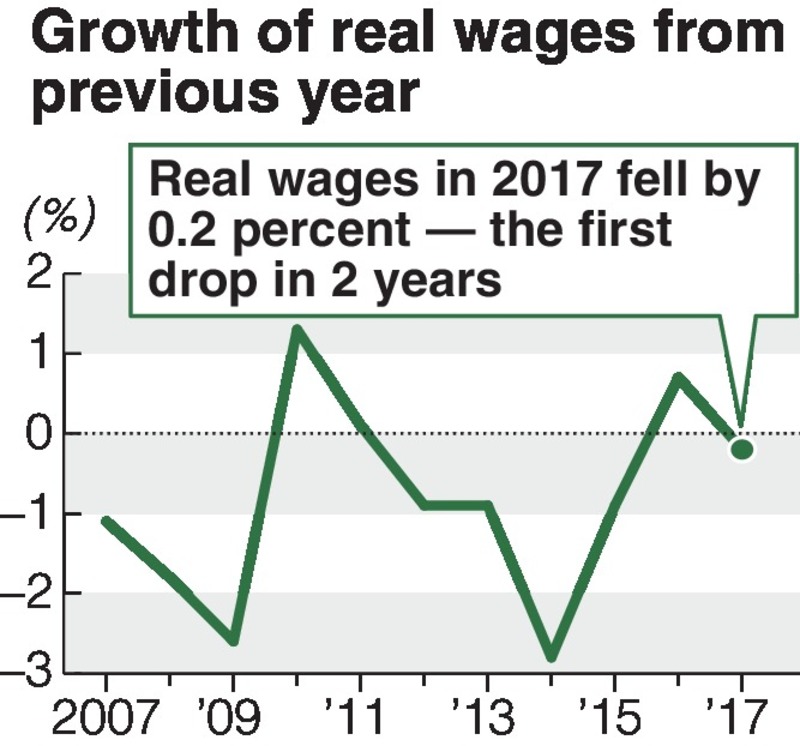
In 2017, real wages, which reflect fluctuations in the cost of living relative to wage increases, fell by 0.2 percent from the previous year. This was the first decrease in two years.
A: Statistically, we can see an increase in nonregular workers driven mainly by elderly people. Specifically, baby boomers -- who comprise a large portion of Japan's population -- often see wage decrease when they remain at their companies as part-time workers upon reaching the retirement age. This brings down overall average wages.
Female workers are also increasing, but since their pay scale tends to be lower than that of men, this also brings down average wages.
The generational wage gap is also an issue, as the wage levels of workers aged 40 to 44, who began their careers during the bleak employment environment of the post-bubble recession, are lower than before.
People in this age group should have high wage levels, but comparatively few of them have joined companies with a thorough job training system. Many could not secure full-time positions and resorted to nonregular employment like part-time or dispatch work, and received fewer opportunities to develop their skills.
Wage increases are actually sluggish not only in Japan, but in the United States and Europe as well. It seems that sluggish wage increases are linked to low-priced "capital goods" that replace human work, as represented by the spread of cheap personal computers. From this perspective, technological innovation has decreased stable income-earning opportunities for the middle class.
'Employment over wage hikes'
Q: What changes are happening in labor unions?
A: Changes in Japan's labor unions are influencing the slow increase in wages for full-time employees.
When Japan's economy was continuously growing at a high rate, labor unions in the automobile, electronics and other industries unified beyond individual corporations to produce certain results.
But after the bubble economy burst, the performances of individual companies in the same industrial labor unions greatly diverged, and they had greater difficulty banding together to achieve wage increases on the same level.
One major change has been that labor unions are also feeling uneasy about the increasingly tough economic environment, so they have begun asking management to maintain employment while holding back on wage increases.
If a company raises its wages above those of other companies in the same industry, it may lose competitiveness due to increased costs, which ultimately threatens their employment. Companies keep each other in check within their industries, which makes it difficult to demand high wage increases.
The government-initiated wage negotiations are regarded as a push from the outside to solve such situations.
Q: The government's goal is for high wage increases that lead to greater consumption and a positive economic cycle that also boosts prices.
A: However, even with government demands, it is not easy to achieve wage increases through negotiations between labor and management. For example, in many cases, labor and management typically look at past price increase rates when negotiating wage increase levels for the following year. Since the current rate of increase in prices is low, there is little basis to demand high wage increases.
Contrary to the government's aims, it can be said that the current lack of price increases is actually causing wages to stagnate.
There is concern that the increased social insurance fees and other burdens the government is demanding of companies could also suppress wages and recruitment. This is because companies consider these greater burdens as part of their personnel expenses.
Labor market reform needed
Q: Can high wage increases be achieved in the near future?
A: In many Japanese companies, both labor and management consider it important for wages to increase and employees to achieve stable livelihoods in the long run.
If we raise wages now just because the economy has recovered, will we be able to cope with a future recession? The more a company's labor and management perceive such risks, the greater the difficulty of aggressively raising wages. The uncertain state of Japan's future economy is a major factor preventing high wage increases.
Even looking at the entire labor market, I think it is unlikely that wages will explosively rise just because the labor shortage has become tighter. This is because more women and elderly people are expected to start working in the future, and nursing care robots and other technology that solve personnel shortages may also be developed.
To achieve high wage increases, we need to put Japan's economy on track to grow even as the population decreases, and spread awareness that it is okay to significantly increase wages.
Of the "three arrows" of the Abenomics economic policy package, it is especially important to steadily advance growth strategies. We need to push for corporate research and development, and increase workers' productivity through technological innovation. It's important to ensure that increased productivity is channeled into wage hikes.
Q: Is there a problem with the labor market, too?
A: Labor market reform is also an urgent task. Japanese companies' current recruitment and personnel system, which includes the practice of hiring many new university graduates at once, was formed during a period of rapid growth when there were many young people.
But now, we need a society where people can use their abilities regardless of their age. If we create an environment in which people who reluctantly accepted a job in their youth can transfer to jobs where they can hone their skills, it will be easier for wages to increase.
It is essential for companies to revise their recruitment systems to attract a more diverse workforce, and for the government and private sector to collaborate to create a larger market for changing careers.
--This interview was conducted by Yomiuri Shimbun Staff Writer Makoto Miyazaki.
(From The Yomiuri Shimbun, March 15, 2018)
--Souichi Ohta / Keio University Prof.
Ohta, 53, graduated from the Kyoto University Faculty of Economics in 1987 before obtaining a PhD from the University of London. He took up his current position in 2005 after serving as a professor at the Nagoya University Graduate School. He specializes in labor economics.
Read more from The Japan News at https://japannews.yomiuri.co.jp/