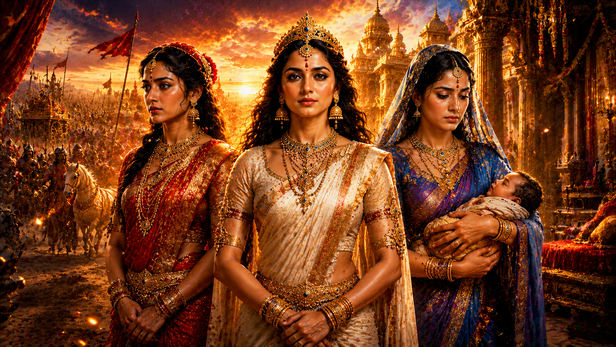
When people think of a woman with multiple husbands in the Mahabharata, only one name usually comes to mind Draupadi.
But what if Draupadi was not the only one? Hidden within ancient traditions and lesser-known stories are women whose lives were even more surprising. Some were said to have seven husbands. Others had ten. One woman's story involved multiple marriages that unfolded across different phases of her life. These fascinating characters rarely appear in mainstream discussions, yet their stories challenge many assumptions about ancient Indian society.
Beyond the Story of Draupadi
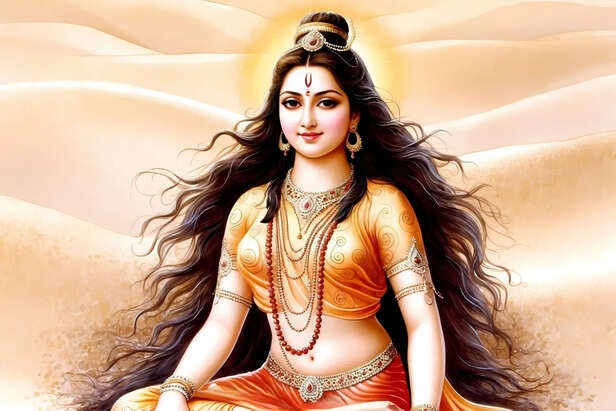
Draupadi was not the only extraordinary woman.
Draupadi's marriage to the five Pandavas is one of the most discussed events in the Mahabharata. Because of its uniqueness, many people assume she was the only woman associated with multiple husbands. However, ancient traditions mention other women whose stories are far less known. Their names rarely appear in popular retellings, yet they offer a fascinating glimpse into forgotten chapters of Indian mythology. These accounts remind us that history and mythology often contain far more complexity than the simplified versions we usually hear.
The Mystery of Jatila
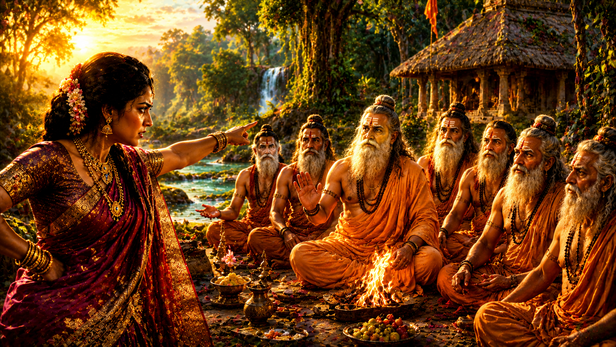
A forgotten figure surrounded by mystery.
According to certain traditions, Jatila is described as the daughter of Sage Gautama. Some accounts suggest that she was married to seven husbands, often identified with the revered Saptarishis. While details vary across traditions, her story remains one of the most unusual in ancient literature. Unlike many famous mythological figures, Jatila's narrative survives mainly through scattered references. This has made her one of the most mysterious women associated with polyandrous traditions in Indian mythology.
The Enigma of Varkshi
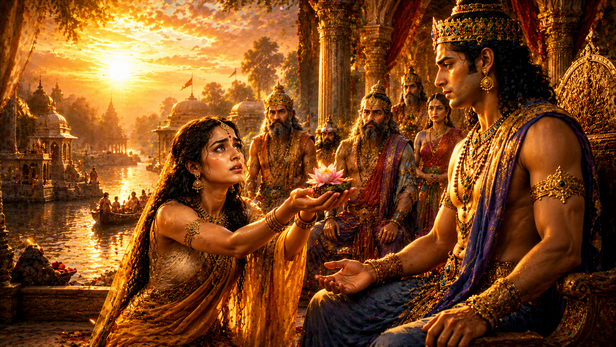
A name rarely mentioned in popular discussions.
Even less known than Jatila is Varkshi, a figure mentioned in certain traditional accounts. According to these narratives, she had ten husbands. While detailed descriptions of her life are difficult to find, the references themselves spark curiosity. Why was such a remarkable story not preserved more prominently? Historians and scholars often note that many regional traditions contain characters who gradually disappeared from mainstream storytelling. Varkshi remains one of those intriguing figures whose story survives only in fragments.
Madhavi's Extraordinary Journey
Madhavi, the daughter of King Yayati, occupies a unique place in ancient literature. Unlike Draupadi, whose husbands were simultaneous, Madhavi's marriages occurred at different stages of her life. Her story is deeply connected to duty, sacrifice, and royal obligations. She was known for possessing a rare divine blessing that played a central role in her journey. Through a series of marriages connected to larger political and spiritual goals, Madhavi's life became one of the most remarkable narratives in ancient Indian tradition.
Why These Stories Matter Today
These stories are not merely curiosities from the past. They reveal that ancient societies were often more diverse and complex than modern stereotypes suggest. The existence of such narratives reminds us that mythology cannot always be understood through simple rules or assumptions. Different eras, kingdoms, and traditions followed different customs. Exploring these forgotten stories broadens our understanding of history and encourages us to look beyond popular narratives.
The Difference Between Myth and Interpretation
One important aspect of studying ancient literature is recognizing that different traditions preserve different versions of the same story. Some accounts are widely accepted, while others survive through regional texts, oral traditions, and lesser-known references. This is why scholars often approach such stories with careful analysis. Understanding the source of a narrative is just as important as understanding the narrative itself. These variations make Indian mythology rich, layered, and endlessly fascinating.
The Forgotten Women History Overlooked
Draupadi became famous because her role shaped the Mahabharata itself. Yet figures like Jatila, Varkshi, and Madhavi remind us that many extraordinary women remain hidden in the shadows of history. Their stories challenge expectations, inspire curiosity, and encourage deeper exploration of ancient traditions. Sometimes the most fascinating discoveries are not found in the most famous chapters, but in the forgotten pages that few people take the time to read.
Unlock insightful tips and inspiration on personal growth, productivity, and well-being. Stay motivated and updated with the latest at My Life XP.
Frequently Asked Questions (FAQs)
1. Was Draupadi the only woman in ancient Indian literature with multiple husbands?No. While Draupadi is the most famous example, some lesser-known traditions mention other women such as Jatila and Varkshi, who are also associated with having multiple husbands.
2. Who was Jatila?
According to certain traditional accounts, Jatila was a woman said to have had seven husbands. Some traditions identify her as the daughter of Sage Gautama and connect her story with the Saptarishis.
3. Who was Varkshi?
Varkshi is a lesser-known figure mentioned in some traditional narratives. These accounts describe her as having ten husbands, though detailed information about her life is limited.
4. Who was Madhavi?
Madhavi was the daughter of King Yayati and a significant character in ancient Indian literature. Unlike Draupadi, her marriages occurred at different times rather than simultaneously.
5. Did Madhavi have multiple husbands at the same time?
No. According to the traditional narrative, Madhavi married different kings at different stages of her life. Her story is different from Draupadi's polyandrous marriage.