- Certain versions of the Ford Mustang Mach-E, Tesla Model Y and Tesla Model 3 carry lithium-iron-phosphate (LFP) batteries.
- These are meant to be more affordable, longer-lasting batteries that also carry some range and charging tradeoffs.
- But they also have different charging needs than the more common nickel-manganese-cobalt (NMC) batteries on other EVs. Here's what you should know.
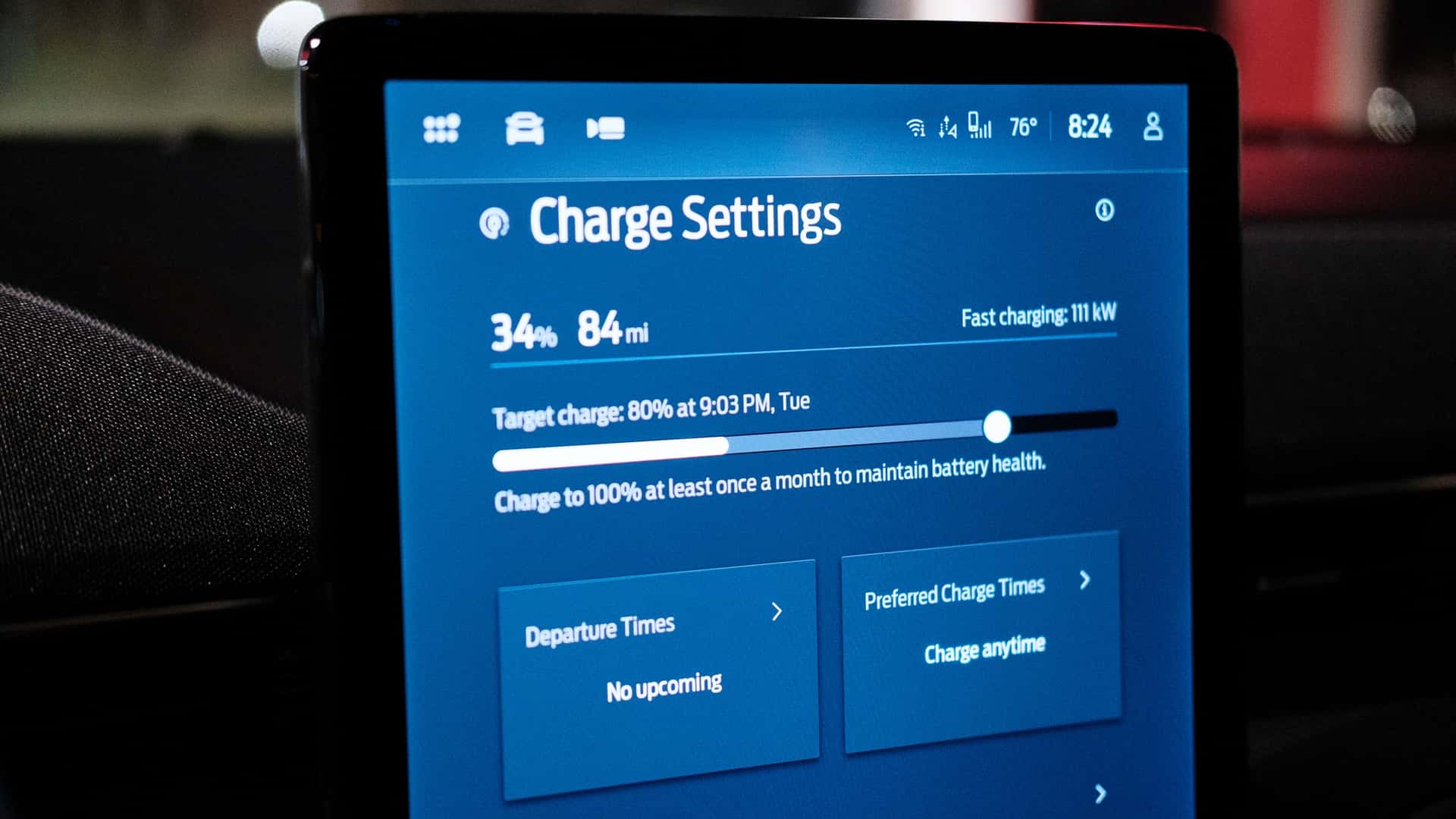
When I recently spent time in a 2025 Ford Mustang Mach-E, I noticed an interesting message on the central screen when I went to charge the car. "Charge to 100% at least once a month to maintain battery health." In all my years of testing various electric vehicles, I don't think I'd ever seen an alert like that before—but then I also remembered what kind of battery was in this Mach-E.
The smaller 73-kilowatt-hour battery in my Mach-E Select tester is a lithium-iron-phosphate (LFP) battery. And that means it's going to have different needs, and behave a little differently, from the nickel-manganese-cobalt (NMC) batteries found in most modern EVs.

Until now, I hadn't really spent much time with LFP batteries. But my experience with the Mach-E sent me down a bit of a rabbit hole, and I learned a lot of things that EV owners should probably know too if they own one of these cars. Let's dig into what makes them special—and how to live with one.
What Is An LFP Battery?
An LFP battery is just another kind of lithium-ion battery, albeit one with different chemistry than most EVs you can buy in the U.S. and other markets. Instead of using nickel, cobalt, or manganese in the cathode—the negatively charged electrode by which electrons enter an electrical device—LFP uses iron phosphate.
If you don't understand the nuances of battery chemistry, don't worry too much. (I also wish I had paid more attention in my high-school science classes.) What you should understand is what these batteries are and do, and how they operate.
LFP batteries are interesting because they cost about 20% less to produce than other kinds of batteries. At a time when batteries are still the single most expensive part of any EV, that's a huge benefit to automakers trying to get electric cars to scale up quickly. It also means that cars with LFP batteries tend to be less expensive than their NMC counterparts. And without any nickel or cobalt, their materials don't need to be controversially sourced from places like the Congo.
You might think of LFP batteries as the four-cylinder engines of the EV world—they're cheap, tough little workhorses that are good at getting the job done. Their more stable chemistry means they tend to be less of a fire risk than other batteries (though that is statistically low in general, too.) They tend to be longer-lasting and more durable than other types.

The downside is that LFP batteries tend to carry less energy density—about 30% less overall, according to battery health company Recurrent, and that means less range than other chemistry types. They also don't perform as well in very cold temperatures.
Yet even with their materials, LFP batteries aren't entirely free of geopolitical challenges. While LFP batteries were invented in America, China's automakers and battery companies have taken this technology and run with it, so they utterly dominate the LFP battery supply chain. This is why Ford has to license the tech from Chinese battery giant CATL for its Michigan LFP battery factory, something that has proven controversial in that state and in Washington. (Furthermore, China's automakers are now going above and beyond with LFP technology—BYD's five-minute fast-charging EV uses an LFP battery, for example.)
What U.S. EVs Carry LFP Batteries?
In China, most EVs overwhelmingly use LFP batteries. They're less common in the U.S. market, although that is changing quickly as more and more automakers realize their benefits and figure out how to make them.
EVs with LFP batteries include the Mustang Mach-E in Select and Premium trims with the smaller Standard Range battery with up to 260 miles of range (the Extended Range battery is an NMC unit); the upcoming 2027 Chevrolet Bolt; eventually, a version of the Chevrolet Silverado EV; the Rivian R1S SUV and R1T truck, on the entry-level dual-motor Standard variant; and many Standard Range trims of the Tesla Model 3 and Model Y, especially ones with rear-wheel-drive. Ford's new Universal EV Platform vehicles, starting with a $30,000 pickup truck, will also use LFP batteries.
Did you pick up on the theme here? All of these LFP batteries are found on the more affordable trim levels, and the ones with less overall range. A higher-range battery (at least outside of China) will probably be NMC. But they bring tremendous cost-savings to the table and can get more people into electric driving for less money. Hyundai and Volkswagen are also working on LFP batteries for new models.
It's always good to know what kind of battery your EV carries. In Ford's case, if the eighth digit of your Mach-E's VIN is a 4 or a 5, it has an LFP battery. All others carry NMC units. On a Tesla, you should be able to tell on the central screen's charging tips page, or by checking "Additional Vehicle Information" in the software menus.
What Should I Know About Charging an LFP Battery to 100%?
Generally, most EVs should be charged to 80% or 90% regularly to maintain their overall battery health. I keep my Kia EV6, which has an NMC battery, at 80% nearly all of the time unless I am going on a longer drive.
LFP batteries work a bit differently. Several automakers say it’s best to charge your vehicle’s LFP battery to 100% periodically, at least once a week in the case of Tesla or once a month as per Ford. This is for the battery management system (BMS): the computer hardware that monitors battery performance, safety, and lifespan by overseeing things like voltage, current, temperature and other factors. By charging an LFP battery to 100% periodically, it helps to ensure the BMS is properly calibrated.
"Set the maximum charge level to 100% and charge to 100% at least once per month to maintain range accuracy," is what Ford recommends. "During regular use, you can increase the battery life by maintaining the state of charge at 100%."
Tesla has historically told LFP battery owners to "keep your charge limit set to 100%, even for daily use, and that you also fully charge to 100% at least once per week.” The latest version of Tesla's online user manual essentially defers to what's displayed on the central touchscreen, as guidance could change over time with software updates.
Recurrent's data indicates that LFP battery EV owners tend to charge to 90% and 100% much more than most EV owners do—those people tend to keep their batteries around 80% much of the time instead. "LFP batteries hold up better to high states of charge, meaning that regularly charging them to 100% may not cause as much degradation as it would with a different battery chemistry," Recurrent said last year. On the plus side, this will allow an EV owner to use "more" of their maximum range all of the time with an LFP battery.
However, that doesn't seem to be a uniform opinion these days. Last year, a study published in the Journal of Electrochemical Society indicated that repeated charging to 100% can harm LFP battery cells over time. Harmful compounds can form that damage the negative electrode, the study said, wearing down batteries over time.
But even that study admits that keeping your LFP battery charged to low levels is essentially useless, so it's best to be judicious about how often you go to 100%. And we have seen many examples of LFP-powered Teslas seeing minimal battery degradation after 100,000 miles, even when they're frequently charged to full.
Ultimately, we recommend doing what your user's manual or the EV itself tells you to do. If you have an LFP-powered EV, you won't be as beholden to the 80% rule as other drivers are. And even if you aren't interested in becoming a chemistry expert just to drive a car, it's good to know what kind of batteries your EV carries, and how best to care for them so they last a very long time.
Contact the author: patrick.george@insideevs.com