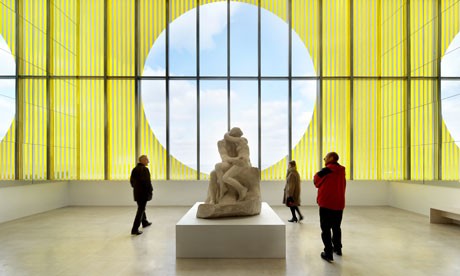
Rodin's The Kiss (1901-4) is currently on view at the Turner Contemporary gallery in Margate. As the pictures here show, it is an extraordinary setting. Exhibited in an airy space with a vast view of sea and sky behind it through a glass wall, Rodin's sculpture somehow looks bigger, more eternal than it usually does when it is exhibited as part of the Tate collection. On the sun-filled day when I saw it recently, powerful light illuminated the huge scale of the man's hand embracing his slender lover.
The isolated grandeur of this sculpture's display in Margate is a bit like the solitary splendour of Michelangelo's David in its immense niche in Florence, and it powerfully focuses attention on the greatness of Rodin. The gallery also has some robust erotic drawings by him shown within its Tracey Emin exhibition. So Margate is a good place to see the works of Rodin this summer. Why go to Paris?
Seeing Rodin, slightly unexpectedly, by the seaside makes me think. What is it that makes this sculptor so compelling? Rodin is our contemporary. The startling quality of The Kiss is that it does not seem confined to the world of sculptural forms that stand apart on plinths. These lovers could be any lovers. There is a simple reality to their depiction, a stark revelation of human facts. Rodin shares Michelangelo's sensual feel for sculpted surfaces, but he has a very modern directness. He flirts with the banality of life itself – a kiss is just a kiss.
Rodin is the father of modern sculpture – of sculpture that comes down from the plinth, that occupies or surrounds our own space: The Kiss leads to Richard Serra. Another casually contemporary aspect of Rodin is his faith in the multiple to circulate his images: the Tate version of The Kiss currently in Margate is one of three that were carved in his lifetime.
Yet he looks backward as well as forward. The Kiss is not pure visible fact, but a story that was conceived as part of an epic literary vision. These are intended by Rodin to be the adulterous lovers Paolo Malatesta and Francesca da Rimini who Dante encounters in Hell in his 14th-century poem The Divine Comedy. The statue is one of many works by Rodin that circulate around his masterpiece The Gates of Hell, a superabundant attempt to illustrate the first book of Dante's epic, Inferno. It's a very 19th-century project in the spirit of Romanticism. It is amazing that we can respond to The Kiss as a contemporary work of art when it also shares the illustrative instincts of a 19th-century painting like Ary Scheffer's Francesca da Rimini – an 1835 depiction of the same figures from Dante – in the Wallace Collection.
Perhaps the power of The Kiss in Margate lies in the Romantic void of sea and sky you see behind it. The operatic vista is the equivalent of showing the sculpture with Wagner playing loud. It reveals that, like Wagner's genius, Rodin immerses us in the twilight of Romanticism.