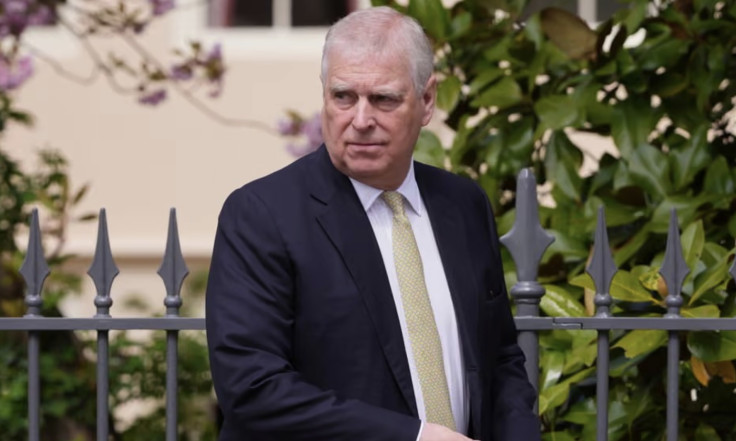
Ex-Prince Andrew's status as a Falklands War 'hero' fuelled a culture of entitlement that later curdled into years of sordid exploitation and abuse of privilege, royal biographer Tina Brown has claimed in a searing new essay published in London.
The fresh scrutiny of the ex-prince's conduct follows his fall from grace over his association with convicted child sex offender Jeffrey Epstein and a long-running civil case brought by Virginia Giuffre, which Andrew settled without admitting liability.
He has already been stripped of his military affiliations and patronages and stepped back from public duties; now, writers who have tracked his career are returning to the earlier decades that, they argue, made the current scandals grimly predictable.
How Ex-Prince Andrew's 'War Hero' Image Took Hold
In her FRESH H-LL Substack article, pointedly titled 'Can the Andrew File Get Any Worse?,' Brown argues that the problem began early. The former Vanity Fair and New Yorker editor says Andrew emerged from the 1982 Falklands conflict with a wildly inflated sense of his importance, stoked by tabloid patriotism and unquestioning press coverage.
He served as a Sea King helicopter co-pilot during the war. It was a supporting role, not a command. Yet Brown writes that the 'jingoistic newspaper accolades spread out on the breakfast table at Balmoral' after his return did lasting damage to his judgment.

Citing a friend from Andrew's early twenties, she says it 'wasn't just the Queen's favouritism' at work. The adulation he received as a supposed war hero, she argues, encouraged a 'farcically warped view of his own minimal abilities.'
According to Brown, that heady mix of maternal indulgence and media myth-making created a young man who expected the world to rearrange itself around his whims. A former associate told her that in his twenties, military helicopters were made available to him 'whenever he wanted,' including for jaunts to the St Andrews golf course.
The suggestion is not simply of a royal bending the rules, but of an institution willing to normalise the absurd.
From Trade Envoy To 'Sordid Exploitation'
Once appointed as the UK's special representative for international trade and investment, Andrew carried that sense of impunity into the diplomatic arena, Brown contends.
In the Substack piece, she recalls long-standing complaints from former civil servants that he was 'the bane of the Foreign Office,' allegedly 'running around the world with his rampant sceptre, telling toilet jokes' and spending taxpayers' money on extra hotel rooms for 'cavorting 'masseuses.'
None of those allegations has been tested in court, and Buckingham Palace has historically rejected claims that Andrew misused public funds. Even so, the portrait that emerges from Brown's writing, and from Andrew Lownie's biography Entitled which she draws on heavily, is not flattering.
Brown calls Lownie's expanded paperback edition 'his Prince Andrew defenestration' and says it shows 'we only know the tip of the iceberg' when it comes to the ex-prince's private behaviour.
In her telling, the cultivated aura of royal exception insulated him from consequence, encouraging what she later describes as 'decades of Andrew's sordid exploitation of women.'
The Epstein saga, in that light, appears less an aberration than a brutal exposure of an entrenched pattern.

Epstein, Sarah Ferguson And 'Rot At The Heart' Of The System
Brown goes further, pulling in Andrew's ex-wife, Sarah Ferguson, as part of what she casts as a shared moral freefall. She notes Lownie's reporting that Ferguson, beyond her 'toxic association' with Epstein, allegedly had 'regular sex trysts with baby-oil extortionist P. Diddy,' a claim Ferguson has denied. Brown treats this as a kind of grotesque escalation, half-joking about what might be left for a future edition of the book.
Underneath the dark humour is a blunt accusation. 'The grifting, the greed, the complete absence of self-discipline made them easy marks for a practised reprobate like Jeffrey Epstein,' she writes.
In her view, Andrew and Ferguson have come to 'symbolise a rot at the heart of the whole royal system, in which the monarchy's 'aura' allows its members absolute impunity.'
The charge is not narrowly legal. It is cultural. Brown is arguing that the institution's mystique, the same mystique that once turned a junior helicopter co-pilot into a national idol, gave cover to behaviour that, in any other setting, would likely have drawn sharper scrutiny far earlier.
Ex-Prince Andrew Under 'Criminal Investigation'
The stakes around those claims are no longer purely reputational. The article notes that Andrew Mountbatten‑Windsor was arrested on suspicion of misconduct in public office in connection with his links to Epstein and remains under active 'criminal investigation'.
As of May, he has not been formally charged with any offence and denies wrongdoing. Legal experts have long described the misconduct charge as complex and difficult to prove.
Brown is openly sceptical that the inquiry will deliver a clear-cut reckoning. She writes that 'misconduct in public office' is a hard-to-prove understatement of a charge that could somehow slip away,' and warns that, as with what she calls the 'noxious seepage from the Epstein files' in the US, a lack of accountability risks leaving 'unrectified' the years of alleged exploitation.
None of these allegations has yet been tested in a criminal court. Until that happens, if it happens at all, both the praise and the condemnation will rest on partial files, contested memoirs and the highly polished recollections of those who knew the ex-prince when the helicopters were always waiting.