
The Problem With Alcohol-Based Perfume in Indian Heat
Most synthetic perfumes sold in India use ethanol as their carrier. Ethanol evaporates fast, that's the point in a temperate climate, where the alcohol lifts the fragrance off the skin and into the air. In Indian heat, above 35°C, the evaporation happens so rapidly that the top notes disappear within 20 to 30 minutes of application. What you smell in the first burst is almost never what stays. Studies on fragrance volatility published in the International Journal of Cosmetic Science confirm that high ambient temperatures dramatically accelerate the evaporation of low-molecular-weight fragrance compounds, the very compounds that make up most synthetic top notes. By the time you've left home and reached the office, the scent has already peaked and declined.
Humidity compounds the problem. Synthetic fragrances are formulated with fixatives designed for dry-to-moderate moisture levels. In Mumbai in July, or Chennai in May, the air is already saturated. The fragrance cannot project into a humid atmosphere the way it would in Paris or Milan. It sits flat, diffuses weakly, and turns sharp on skin that's already warm and moist.
What Attar Chemistry Actually Does Differently
Attar, the traditional Indian perfume distilled through the deg-bhapka method in Kannauj, Uttar Pradesh, uses sandalwood oil as its base rather than alcohol. Sandalwood oil is a fixative by nature. Its primary aromatic compounds, alpha-santalol and beta-santalol, are high-molecular-weight sesquiterpene alcohols with extremely low volatility. They do not evaporate quickly. They bind to the skin's lipid layer and release fragrance slowly over hours, not minutes.
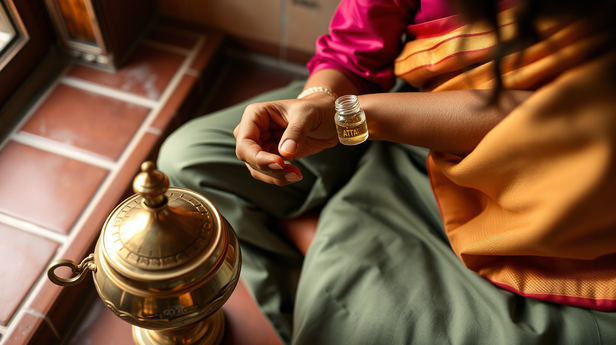
On warm Indian skin, this slow release becomes an advantage. Body heat acts as a gentle diffuser, pushing the fragrance upward continuously rather than in one sharp burst. The warmer the skin, the more consistently the attar performs, which is the opposite of what happens with synthetic perfume. Sweat, typically treated as the enemy of fragrance, actually helps here. The fatty acids in sweat interact with the sandalwood base and the natural floral or resinous compounds layered above it, creating a skin-specific scent that evolves rather than fades.
The Kannauj Distillation Method and Why It Matters
Kannauj in Uttar Pradesh has been distilling attars for several centuries. The deg-bhapka process involves passing steam through botanical material, rose petals, jasmine, kewra, marigold, bakhoor, and condensing the aromatic compounds directly into sandalwood oil in a receiver vessel submerged in cool water. No solvents. No synthetic fixatives. No aroma chemicals derived from petroleum.
The result is a fragrance molecule profile that is far more complex than any single synthetic compound. Rose attar from Kannauj contains over 300 identifiable aroma compounds, including geraniol, citronellol, and nerol, compounds that interact differently with different skin types and change character as they warm. A synthetic rose fragrance typically replicates four to six of these compounds. The rest of the complexity is gone. That complexity is precisely what gives attar its longevity and its capacity to smell different on different people.
Skin Type, pH, and Why Attar Is Designed for Indian Skin
Indian skin tends toward a slightly more acidic pH than the Northern European skin types that most French and British perfume houses historically formulated for. Skin pH affects how fragrance compounds behave after application. At a lower pH, certain synthetic musks and aldehydes, common in Western perfumes, can turn metallic or sharp. Natural attar compounds, particularly those derived from jasmine, rose, and oud, are chemically stable across a broader pH range and do not undergo the same acidic degradation.
Skin melanin content also plays a role. Melanin-rich skin retains heat more efficiently in direct sunlight, which means the slow-release mechanism of an oil-based attar performs even better on darker skin tones. The sandalwood base warms gradually and releases fragrance over a longer arc. This is not an aesthetic claim, it follows directly from the thermodynamic properties of the carrier oil and the skin's heat retention characteristics.
Synthetic Fragrance and the Sweat Problem
The most common complaint about synthetic perfume in Indian weather is that it smells sour or medicinal after a few hours. This happens because synthetic fragrance molecules, particularly the nitromusks and polycyclic musks used as base-note fixatives in mass-market perfumes, react with the lactic acid and urea in sweat. The reaction produces secondary compounds that were not in the original formula. The fragrance doesn't just fade, it actively changes into something unpleasant.
Attar's natural compounds do not produce this reaction at the same rate. The sesquiterpenes in sandalwood oil are chemically inert relative to sweat acids. The floral compounds layered above them are complex enough that even partial degradation still reads as recognisable fragrance. A rose attar that has been on skin for six hours in Chennai heat still smells like rose, softer, more intimate, closer to the skin, but not sour.
The choice between attar and synthetic perfume in the Indian climate is not a question of tradition against modernity. It is a question of which chemistry was built for the conditions it's being asked to perform in. Attar was developed over centuries in the same heat and humidity it still performs in. Synthetic perfume was engineered for a different body, a different sky, and a different kind of air.