
Home Depot’s (NYSE: HD) stock price decline is not yet over, with the Q1 results and guidance update failing to reinvigorate market confidence. The likely outcome is that this stock falls to the low end of its long-term trading range, where it becomes irresistibly attractive. Even now, trading near $300, the stock is at a nearly 3-year low, valued at the low end of its historical price-to-earnings range, and yielding a market-beating dividend with distribution growth forecast.
The takeaway for investors is that this market will still endure near-term pain, but the long-term outlook is robust, suggesting a market-beating total return could be easily achieved.
Home Depot’s dividend is central to this thesis. The company pays about 65% of its earnings, which is on the high side, but incredibly sustainable for this high-quality cash flow machine.
The company’s balance sheet is in a healthy condition, dividend coverage is ample, and earnings growth is expected.
The yield exceeds 3%, and the growth trajectory includes a mid-single-digit compound annual growth rate and eventual inclusion in the Dividend Aristocrat Index. Index inclusion is expected by the middle of the next decade.
Home Depot carries debt on its balance sheet, and the ratios are high on a face-value basis. However, debt ratios are affected by regular capital investments and shareholder returns, including share buybacks, which skew the data. Other metrics, including this year’s equity gains, reveal the strength of the company’s strategy and financial position. Equity increased by nearly 75% due to the accumulation of earnings and the integration of SRS Distribution, a move that strengthened its exposure to pro markets, expanded its verticals, and improved its logistics and fulfillment capabilities.
Home Depot Outperforms in Q1: Guides Weak
Home Depot had a solid Q1 with revenue growing by 4.9% to $41.77 billion. The top line outperformed expectations by 700 basis points (bps), on strength in comps and new stores. Comps increased by 0.6% systemwide, 0.4% in the core U.S. market, with ticket averages offsetting a traffic decline.
Among the problems is that 55 bps of the 60 bps in comp store growth was due to foreign exchange conversion, meaning the international business isn’t all that great. Margin news was another sticking point, with the company’s margin contracting across the board, resulting in declines in GAAP and adjusted earnings and tepid earnings per share (EPS). Adjusted EPS outperformed the consensus, but by a far narrower margin than on the top line.
Guidance is another factor driving the expected stock price decline and eventual market bottom. The company guided for growth, but to levels below the consensus estimate. This sets the market up for near-term weakness. A catalyst in an upcoming report, such as outperformance or other visible strengths, could reinvigorate the stock in time.
Analysts and Institutions Expected Weakness - And It’s Already Price Into the Market
Home Depot’s results aligned with analyst and institutional trends: analysts were trimming price targets right up to the day of the release, while institutions reverted to distribution in early Q2 2026.
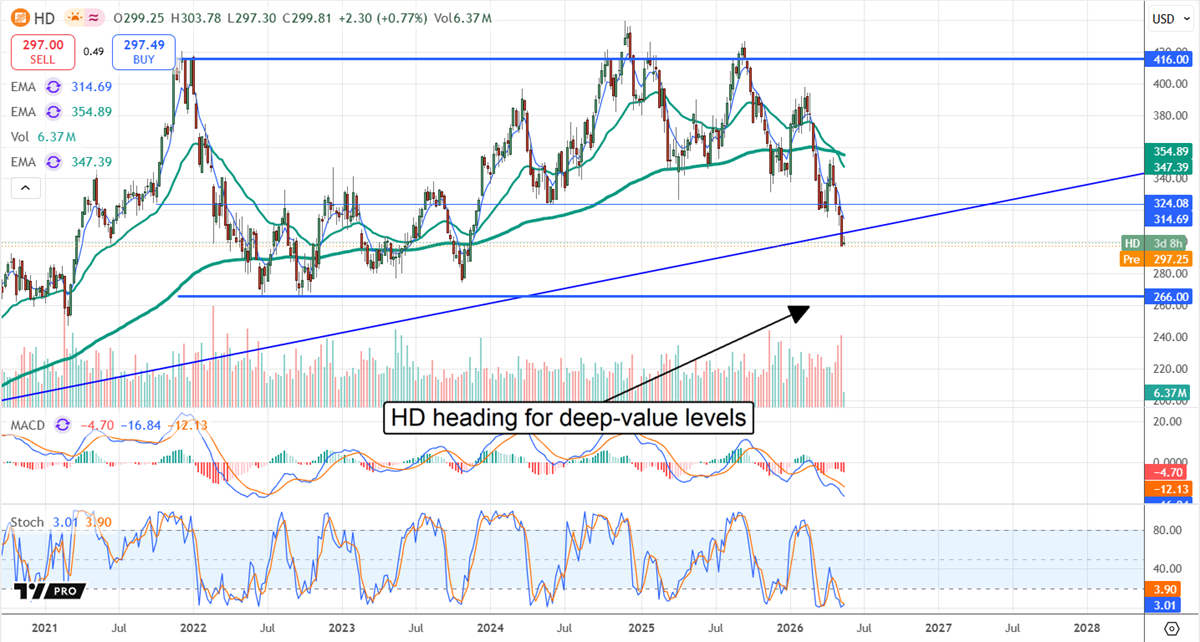
The balance of institutional activity hasn't been incredibly bearish, but institutional distribution is a difficult headwind to overcome in the absence of bullish catalysts. Analysts have also weighed on HD’s price, resetting price targets to lower levels. The low-end range of price targets puts this market above $300, which is critical support.
$300 aligns with a long-term uptrend line that is in danger of breaking. The market can move lower without breaking the trend, but a quick rebound and recovery must follow. If the market isn’t able to regain the upper side of its trend line quickly, the next move will be sideways. In this scenario, HD stock may trend sideways near the low end of its range until there is a fundamental shift in market dynamics, potentially including reduced inflation, an improved outlook for lower interest rates, and improving labor market conditions.
Home Depot’s biggest risk this year is interest rates and their impact on housing markets. The oil situation is driving inflation at all levels, pointing to an eventual rate increase by year’s end. Higher rates will negatively impact housing markets, refinances, home improvement projects, and Home Depot results. Long-term, Home Depot is well-positioned for an eventual housing market recovery; the only question is the timing. As it stands, long-term forecasts put HD’s stock price at around 5X earnings by the middle of the next decade, suggesting a 300% increase is possible.
The article "Why Home Depot’s Sell-Off Could Become a Huge Opportunity" first appeared on MarketBeat.