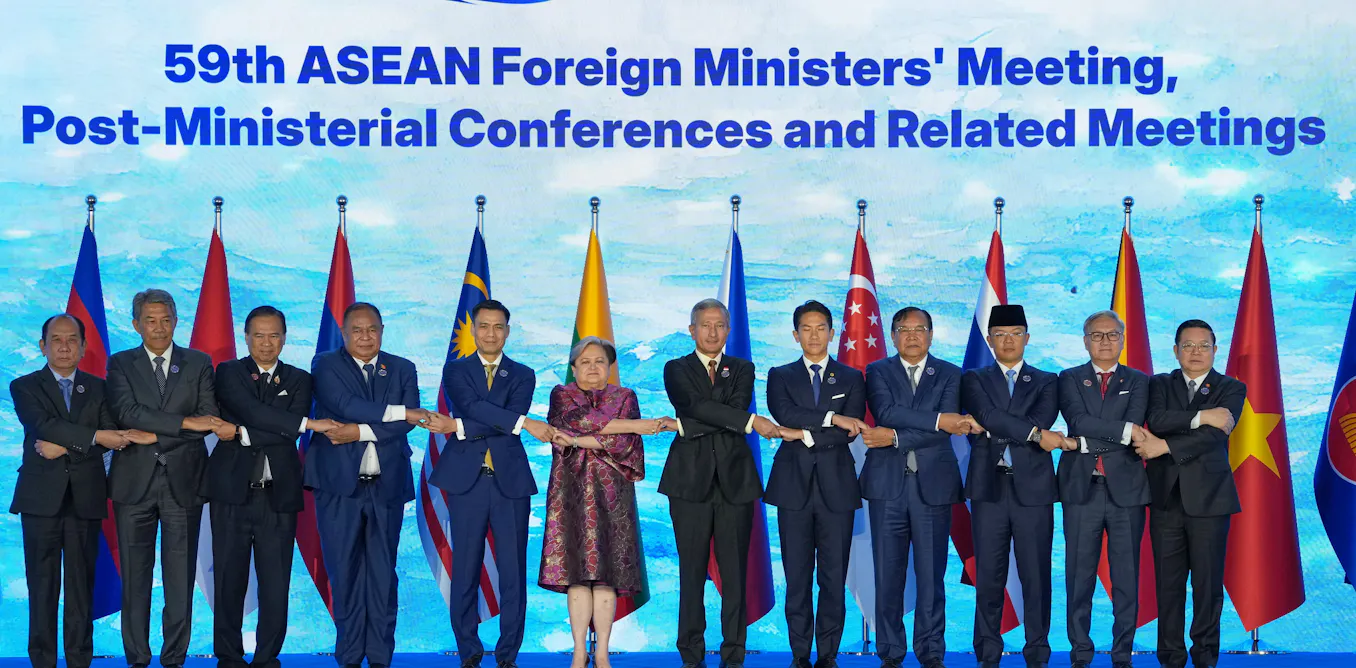
Every year, the foreign ministers of the 11 countries in the Association of Southeast Asian Nations (ASEAN) get together to talk regional business.
These meetings tend to attract some big names from outside the region, too. At this year’s meeting this week in Manila, US Secretary of State Marco Rubio, Chinese Foreign Minister Wang Yi and Russian Foreign Minister Sergey Lavrov will all attend.
Each power has its own reason to be there. The US wants to stay visible in a region that China has been courting. China wants to reassure its neighbours who are worried about its behaviour in the South China Sea, where run-ins with Philippine boats are now almost routine. And Russia wants to show it still has a seat at the table in the Asia-Pacific as its war in Ukraine grinds on.
Tellingly, Rubio and Lavrov have no plans to meet each other. Ukraine’s foreign minister, Andrii Sybiha, will also be in Manila, but no meetings with Rubio have been announced.
As in years past, one notable ASEAN diplomat has not been invited: Myanmar’s foreign minister.
However, the bloc is under pressure to try to resolve the five-year-long civil war in Myanmar. And last week, ASEAN foreign ministers took the controversial step of meeting face-to-face with their Myanmar counterpart, Tin Maung Swe, in Bangkok – their first engagement with Myanmar’s top diplomat since the 2021 coup.
Why ASEAN is engaging with Myanmar
Myanmar’s ruling military junta has been frozen out of ASEAN’s top-level meetings ever since it overthrew the democratically elected government, jailed its leader, Aung San Suu Kyi, and cemented its rule with attacks on civilians and mass arrests.
The junta has recently attempted to gain some international legitimacy by holding general elections that outside observers dismissed as neither free nor fair. In April, a parliamentary vote installed the coup leader, Min Aung Hlaing, as president.
Rights activists decried the meeting between Myanmar’s foreign minister and his ASEAN counterparts last week, but Philippine Foreign Secretary Theresa Lazaro defended the move, saying meaningful progress to ending the war required direct diplomacy.
Why does this meeting matter? Because it signals a shift in direction. One analyst described it as “diplomatic choreography” that could allow the junta leader, Min Aung Hlaing, to stand alongside ASEAN leaders at their November summit.
A panel of independent experts on Myanmar, the Special Advisory Council for Myanmar, said the Philippines’ handling of the meeting showed “a disastrous combination of timidity and poor judgement”.
The group accused ASEAN of rewarding the junta’s violence without securing a single concession in return. Indeed, as the Bangkok meeting was happening, airstrikes in Karen state reportedly killed two women and injured several others.
The big test for ASEAN now is whether it will stand behind its own “five-point consensus”, agreed to in 2021, aimed at ending the war. Critics fear engaging with Myanmar now could give the junta new leverage to continue ignoring the plan.
For engagement to actually work, ASEAN needs to treat all sides fairly, not just the generals.
Lazaro did meet with ethnic armed groups fighting the military the day after the Bangkok meeting with the Myanmar foreign minister.
But Myanmar’s opposition government-in-exile, the National Unity Government, wasn’t invited to that session. It apparently only got a brief online video call with Lazaro a couple days later.
Opponents of the regime also blame China for propping up the junta. Last month, Beijing called for the military government to have “full, equal, and constructive participation” in the ASEAN bloc. China’s foreign minister may seek to press the bloc further during the meeting in Manila this week.
Proof of life
Looming over all of this is a big unanswered question: is Aung San Suu Kyi alive and well?
Her son, Kim Aris, said recently he’s had only one letter from her, back in 2023, and nothing since. Her lawyers haven’t spoken to her since 2022.
This year, Aris has been conducting an international “proof of life” campaign, visiting Australia to meet with lawmakers and taking part in an 81-kilometre skateboard trip through London to coincide with her 81st birthday.
His demand is simple: independent proof that his mother is safe. The junta claims she’s in good health, that her 27-year sentence has been reduced, and that she’s now under house arrest. But it hasn’t offered any independently verifiable evidence that any of this is true.
If nobody outside the junta can even confirm she’s alive, it’s hard to see how a peace process can be taken seriously. Until ASEAN can get real answers about her welfare, its claims of progress with the junta will sound hollow.
Engaging with the junta isn’t wrong in itself. But three things need to happen for this engagement to mean anything.
All sides in the civil war need a seat at the table, not just the generals. All sides need to stop the violence, not just make promises about it. And the junta needs to provide independent evidence that Aung San Suu Kyi is alive.
Without all three, engagement won’t just fail to help. It could make things worse by giving the junta cover without asking for anything substantial in return.
This article was originally published on The Conversation. Read the original article.