
After the news that the United States had captured and removed Venezuelan President Nicolas Maduro and his wife, investor eyes are focused on the country’s crippled oil sector, which will now be restructured under the watchful eye of the United States.
Therefore, it’s not a big surprise that Chevron Corp. (NYSE: CVX) stock was up nearly 6% (5.8%) in mid-day trading on Monday, Jan. 5.
The company is the only U.S. oil company with an active presence in Venezuela, which puts it in a strong position for investors seeking opportunities in energy stocks, particularly in oil stocks.
Chevron’s Large Footprint in Venezuela
The company has five different exploration and drilling projects in the country that span 74,000 oil and gas acres. This puts Chevron in a primary position to help deliver heavy crude into the United States.
This is a case of what’s old becoming new again. Chevron has deepwater drilling operations in the Gulf of America. What makes this opportunity especially compelling is that Chevron isn’t just positioned upstream; it’s also uniquely prepared downstream.
Chevron’s Gulf Coast Refineries Create a Hidden Advantage
The company owns one of the most sophisticated refining systems on the U.S. Gulf Coast, anchored by its Pascagoula, Mississippi refinery, which is specifically designed to process heavy, sour crude like the grades produced in Venezuela. These barrels are more difficult and expensive to refine, which means fewer refineries can handle them efficiently.
Chevron can. That capability gives the company a structural advantage if Venezuelan production ramps back up, allowing Chevron to run discounted heavy crude through its system while capturing higher refining margins. In an industry where integration matters, Chevron’s ability to move Venezuelan crude from the wellhead to a U.S. refinery isn’t theoretical; it’s a competitive edge built over decades.
Why the Venezuela Opportunity Will Take Years to Materialize
However, this could be a case where investors may soon be selling the news. Chevron’s opportunity in Venezuela is real, but the company’s infrastructure has been severely eroded. It will take years and billions of investment dollars to increase production to prior levels of around 3 billion barrels a day.
Chevron has a head start, but it won’t be able to do it alone. But for the country to realize that potential assumes that the political and regulatory framework will inspire the confidence of other companies to make the necessary investments.
Wall Street Is Cautiously Optimistic on Chevron Stock
Heading into 2026, CVX stock had a consensus Hold rating. That made sense in the uncertainty surrounding the short-term direction of crude oil prices. Even after the Venezuela news, a barrel of crude oil is still trading for less than $60 a barrel.
A company like Chevron can still be profitable at those prices, but it doesn’t inspire investor confidence about future earnings. This is a catalyst that, in the short term, gives Chevron a first-mover advantage.
Interestingly, on Jan. 5, Citigroup (NYSE: C) lowered its price target for CVX stock to $179 from $185. That's still 9.5% above the price as of this writing. Plus, the analyst maintained a Buy rating on the stock.
Analyst sentiment was already turning before the first of the year. However, much of that optimism centered around the idea that, at some point in 2026, the price of crude oil will reverse.
CVX Stock Breaks Out, but Technicals Signal Near-Term Risk
Chevron has broken out to around 164.75, extending a clear intermediate uptrend, but doing so in a late-stage, almost vertical move that typically carries higher near-term risk than early breakouts. The latest surge comes on notably strong volume near 24 million shares, signaling institutional participation and adding conviction to the breakout, yet such volume spikes often coincide with short‑term exhaustion as buyers chase the move.
Momentum indicators underscore this stretched condition. MACD is firmly positive with the line well above both the signal line and the zero axis, confirming powerful upside momentum but also reflecting an acceleration that rarely persists without some cooling period. At the same time, the 14‑day RSI sits near 76, decisively in overbought territory, and prior peaks in this zone on the chart were followed by consolidations or pullbacks rather than continued straight‑line gains.
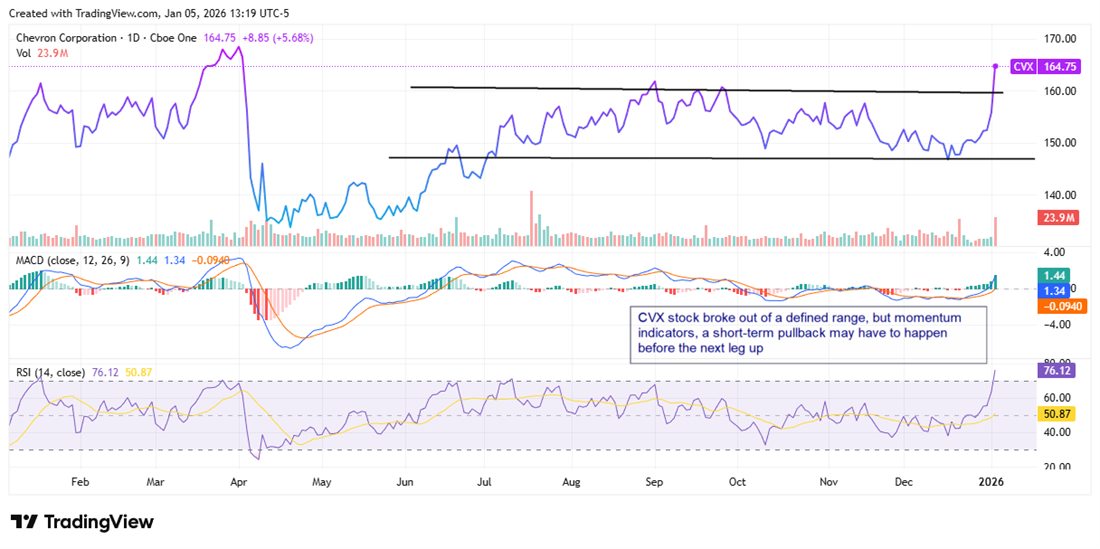
For investors already positioned, the technical backdrop favors holding while tightening risk controls or using trailing stops, treating any controlled dip toward recent breakout levels as a potential retest rather than an immediate trend failure. For new money, waiting for the RSI to ease and the price to either consolidate or pull back would likely offer a more attractive risk-reward entry.
Where Should You Invest $1,000 Right Now?
Before you make your next trade, you'll want to hear this.
MarketBeat keeps track of Wall Street's top-rated and best performing research analysts and the stocks they recommend to their clients on a daily basis.
Our team has identified the five stocks that top analysts are quietly whispering to their clients to buy now before the broader market catches on... and none of the big name stocks were on the list.
They believe these five stocks are the five best companies for investors to buy now...
The article "Why Chevron’s Venezuela Exposure Puts CVX Stock in Play for 2026" first appeared on MarketBeat.