
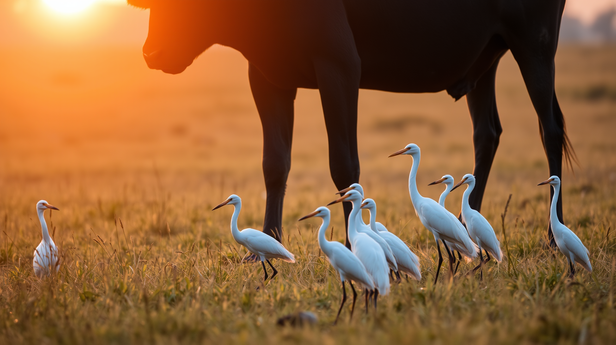
The Numbers Behind the Walk
A cattle egret foraging alone catches roughly one prey item per minute. Walking behind a large mammal, a buffalo, a cow, an elephant, that number jumps to 3.6 prey items per minute. The figure comes from a 1965 field study by H. Heatwole published in The Auk, and it has held up across decades of replication. The egret isn't being lazy. It is being precise.
The mechanism is straightforward. Buffalo weigh between 400 and 900 kilograms. Each step disturbs the grass and soil around it, flushing grasshoppers, beetles, frogs, and lizards into the open. The egret, walking just behind or beside the animal, picks them off before they can resettle. The buffalo loses nothing. The egret gains everything. This is the core of what ecologists call commensalism, one species benefits, the other is unaffected, though some researchers argue the relationship tips toward mutualism when egrets also pick ticks off the buffalo's skin and back.
What Makes This a Partnership, Not a Coincidence
The cattle egret, Bubulcus ibis, is one of the most geographically successful birds on the planet. Originally native to Africa and parts of Asia, it has colonised every continent except Antarctica, largely by tracking large mammals wherever they graze. In India, you see them in almost every agricultural state, white birds standing in rice paddies beside working cattle, or dotting the backs of buffaloes in Maharashtra and Punjab. Their spread followed domesticated livestock as farming expanded. The bird's entire ecological strategy is built around proximity to something large and heavy that walks.
This is not instinct in the loose, unexamined sense. Cattle egrets show learned site fidelity, they return to the same fields and the same herds. Young egrets observe older birds and adopt the same foraging positions. The behaviour is transmitted socially, not just genetically, which is why populations near dense livestock areas grow faster than those in regions with fewer large mammals.
Mutualism, Commensalism, and Where the Line Is
Ecologists classify interspecies relationships by who gains and who pays. In pure commensalism, one gains, one is neutral. In mutualism, both gain. In parasitism, one gains at the other's expense. The cattle egret partnership sits at the commensalism-mutualism border, and the ambiguity is instructive.
When the egret eats only the insects the buffalo disturbs, the buffalo is indifferent. When the egret climbs onto the buffalo's back and removes ticks, which it does regularly, the buffalo benefits. A single buffalo can carry hundreds of ticks, each drawing blood and potentially transmitting disease. Tick removal is genuine service. So the relationship is not fixed. It shifts based on what the egret is doing at any given moment, which is a more honest picture of how ecological relationships work in practice: not clean categories, but a spectrum that moves with behaviour.
Other Partnerships That Follow the Same Logic
The cattle egret and buffalo are the most visible example of this foraging strategy, but the logic repeats across species. Oxpeckers in Africa perform a nearly identical role on rhinoceroses and giraffes, eating ticks and parasites from the host's skin. In Indian forests, drongos follow sambar deer and wild boar for the same reason egrets follow buffalo, the large animal does the disturbance work, the smaller bird takes the reward. Honeyguides in sub-Saharan Africa lead honey badgers to beehives, then feed on the leftover wax and larvae after the badger breaks the hive open. Each case involves one animal's size or capability becoming a resource another animal has learned to exploit.
The common thread is asymmetry. One partner has something, mass, strength, the ability to break open a hive, that the other cannot easily replicate. The smaller or less powerful animal does not fight this asymmetry. It builds a livelihood around it. In ecological terms, this is niche construction: shaping your foraging behaviour around what another organism already does, rather than competing directly for the same resources.
Why These Relationships Are Stable Over Time
A partnership that costs one party significantly tends to break down. The cattle egret-buffalo relationship has persisted across thousands of years because the cost to the buffalo is near zero. The egret takes nothing the buffalo was using. It does not slow the buffalo, steal its food, or draw predators toward it. The buffalo's only investment is its own normal movement.
This low-cost structure is why commensalist and mutualist relationships are so common in nature. They don't require negotiation or sacrifice. They require only that one animal's ordinary behaviour creates an opening another animal is positioned to use. The egret didn't evolve to need the buffalo. It evolved a foraging style, walking, watching, striking fast, that happens to be maximally efficient when combined with a large, grass-disturbing mammal nearby. The buffalo was already there. The egret found the gap.
What the cattle egret teaches is not that animals are cooperative in some sentimental sense. It teaches that ecological relationships are built on arithmetic. When following something costs you nothing and feeds you three times better, you follow it. The tick-picking is almost a bonus, a second deal layered on top of the first, making the partnership harder to walk away from on both sides.