The cloth that embarrassed an empire
In 1921, Gandhi asked Indians to burn imported British mill cloth in public bonfires. This was not symbolism. It was a calculated economic strike: Lancashire's textile mills depended on Indian cotton exported cheaply, processed in England, and sold back to Indians at a profit. The handloom, which British colonial policy had systematically dismantled through punitive tariffs since the late 18th century, became the instrument of refusal. Khadi was not a fabric. It was a declaration that Indian hands could clothe Indian bodies without the permission of an empire.
The Swadeshi movement understood something that contemporary fast fashion has spent billions trying to make you forget: every purchasing decision is a vote on who gets to survive. When Indian weavers in Varanasi, Pochampally, and Chanderi were producing silk and cotton on pit looms, they were not practicing a hobby. They were running an industry. British industrial policy did not merely compete with them, it legislated them into poverty. The handloom revival Gandhi demanded was an act of economic restoration dressed as a spiritual one.
What the loom actually holds
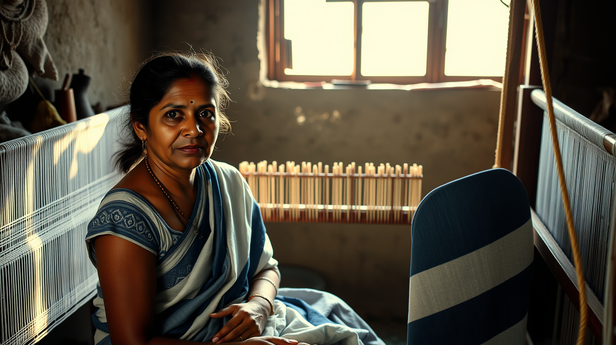
A single Banarasi silk sari can take a master weaver between fifteen days and six months to complete, depending on the intricacy of the zari work. The knowledge of how to thread a specific pattern, the angle of the warp, the weight of the weft, the sequence of the motif, lives in the body of the artisan, passed from parent to child across generations. It is not written down anywhere. When a weaver family abandons the craft, that specific pattern knowledge disappears. There is no digital archive that can recover it.
This is what you are actually holding when you pick up a handwoven cotton from Kutch or a Kanjivaram from Tamil Nadu. A skill that took decades to build, a design vocabulary that took centuries to develop, and a family's decision to stay in a profession that the market has made precarious. The fabric is the evidence of that decision. Feeling the weight of it in your hands and putting it back because a polyester print costs four hundred rupees less is a choice with consequences that run in one direction only.
The artisan and the algorithm
The Office of the Development Commissioner for Handlooms estimates that handloom weaving is the second-largest employment sector in rural India after agriculture, employing over 35 lakh weavers. The average monthly income of a handloom weaver sits well below the national minimum wage in most states. Meanwhile, the fast-fashion supply chain, which runs on power looms, synthetic dyes, and contracted factories, produces an imitation Jamdani print in forty-eight hours that a Dhaka or Murshidabad weaver would spend three weeks on.
The algorithm that surfaces that imitation print first in your shopping app is not neutral. It reflects investment in SEO, in influencer marketing, in sponsored placement, none of which the artisan cooperative in rural Andhra Pradesh can afford. The playing field was never level. The handloom sector competes against an industry that has industrialized the appearance of craft without its cost. When a fast-fashion brand releases a "block-print collection" produced on a digital printer, it is extracting the aesthetic of artisan labor and routing the profit away from artisans. You are paying for the look of someone's livelihood without any of it reaching them.
When you put it back on the shelf
There is a particular guilt that comes with standing in a handloom store and doing the math. The cotton ikat from Odisha is beautiful. It is also three times the price of the machine-printed version at the mall. You put it back. You tell yourself you will come back when you can afford it. This is a reasonable decision and also a political one, and the two things are not in conflict.
What is worth examining is the story you tell yourself about why you can afford a fast-fashion haul every season but not one handwoven piece per year. The resistance to handloom pricing is rarely about absolute budget. It is about what we have been trained to believe fabric should cost, which is to say, as little as possible, because the people who made it are invisible. The Indian craft sector does not need charity. It needs buyers who understand that the price of a handloom piece already does not fully account for the weaver's labor. It is not expensive. It is accurately priced in a market that has made exploitation the baseline.
The cotton you wear carries a political history whether you choose it or not. Gandhi spun khadi to make that history legible. The choice now is whether to read it.