

Throughout the blistering rally of the broader tech ecosystem, artificial intelligence represented the driving force. Suddenly, though, the catalyst that helped rapidly transform the economy is being blamed for its potential downfall. Given the staggering valuation spike that several companies have enjoyed, it's only natural that fears of an AI bubble have started to command the spotlight. What's more, the steep corrections of former Wall Street darlings have led to a rethink.
It’s not just empty rhetoric. Recently, billionaire Peter Thiel made headlines when he sold his entire stake in Nvidia Corporation (NASDAQ:NVDA), a company that is practically synonymous with generative AI. In addition, Thiel significantly cut his holdings in electric-vehicle manufacturer Tesla Inc. (NASDAQ:TSLA), amid growing concerns that machine intelligence may have grown too far, too fast. The divestiture happens to follow other high-profile exits, contributing to brewing anxieties.
Still, there is another narrative to consider. Some experts have offered a more nuanced take, pointing to data that suggests AI demand is actually quite robust. However, the problem is that demand is so overwhelming that it's applying incredible pressure on physical infrastructure — data centers, transformers, turbines — that simply can't scale fast enough.
In other words, the bubble might be focalized in impacting the low-hanging fruit of the AI ecosystem. Moving forward, the real winners of this innovation will not be those who merely participate, but rather those who execute — specifically, under resource constraints.
Nevertheless, a quick look at the social media landscape suggests that retail traders are inundated with messages about an imminent collapse. Generally speaking, crashes rarely happen when the market expects them to because the fear causes institutional hedging. It's this very hedging that causes option premiums (or implied volatility) to rise higher than normal.
For income-generating funds — especially those that write derivative contracts — the current environment represents a relevance booster.
The ProShares ETF: In recent years, exchange-traded funds have become an increasingly popular choice for investors seeking convenience, transparency and broad market access. Today, ETFs cover nearly every investment objective imaginable, from pure growth to income generation. As one of the most recognizable names in the industry, ProShares has played a significant role in that expansion.
Among its more notable offerings is the ProShares Nasdaq-100 High Income ETF (NASDAQ:IQQQ), a fund that has drawn attention for its deliberate emphasis on producing steady, meaningful income. A key characteristic that sets the IQQQ ETF apart is that it does not execute call-writing activity directly. Instead, the ETF uses total return swap agreements with major institutional counterparties. These counterparties are the ones implementing the daily covered-call strategy in practice, and the fund's results reflect the performance they deliver.
A central appeal of IQQQ is its attempt to combine high levels of income with the potential for competitive long-term returns, something few income-oriented strategies manage effectively. The underlying tradeoff is universal: if a product is consistently paying out elevated distributions, it must be giving up something in exchange.
For IQQQ, that "give-up" occurs on the upside, with the fund's cash flow being generated by effectively selling call options to other market participants. When someone else is granted the right to capture gains above a designated strike price, the fund receives immediate premium income. However, its participation in sharp rallies becomes naturally constrained. This concession is what allows the fund to pay its yield.
Fundamentally, IQQQ distinguishes itself in how it handles that constraint. Rather than operating on a monthly options cycle — which can sharply limit potential gains during multiweek surges — the ETF maintains exposure to daily call-writing activity. Under the swap structure, IQQQ can capitalize on short-lived volatility spikes far more effectively than via a monthly strategy. With each reset, the fund reopens its upside potential instead of remaining capped for an entire month.
This approach produces a more adaptable balance between income and growth, with the fund consistently collecting premium while sidestepping the rigid, fixed ceiling often associated with traditional covered-call products. Although the tradeoff between yield and appreciation remains, the daily structure softens it, offering investors a more flexible path toward income generation with some possibility for capital gains.
Beyond its mechanics, IQQQ has practical appeal for income-dependent investors. The ETF pays distributions monthly, which can align well with retirement planning, budgeting needs or supplemental cash flow goals. In an environment where traditional income vehicles may not deliver dependable returns, this predictability can be a notable advantage.
Even so, the risks should not be overlooked. IQQQ remains fully exposed to the performance of the Nasdaq-100, meaning a sharp downturn in large-cap tech can weigh on the fund just as heavily. Also, the use of swaps introduces counterparty risk, since the ETF relies on external institutions to execute the strategy accurately and remain financially stable.
And while the yield often appears attractive, it is never guaranteed. Distributions fluctuate based on market conditions, particularly shifts in implied volatility. If volatility retreats or the market experiences an extended pullback, payout levels can decline.
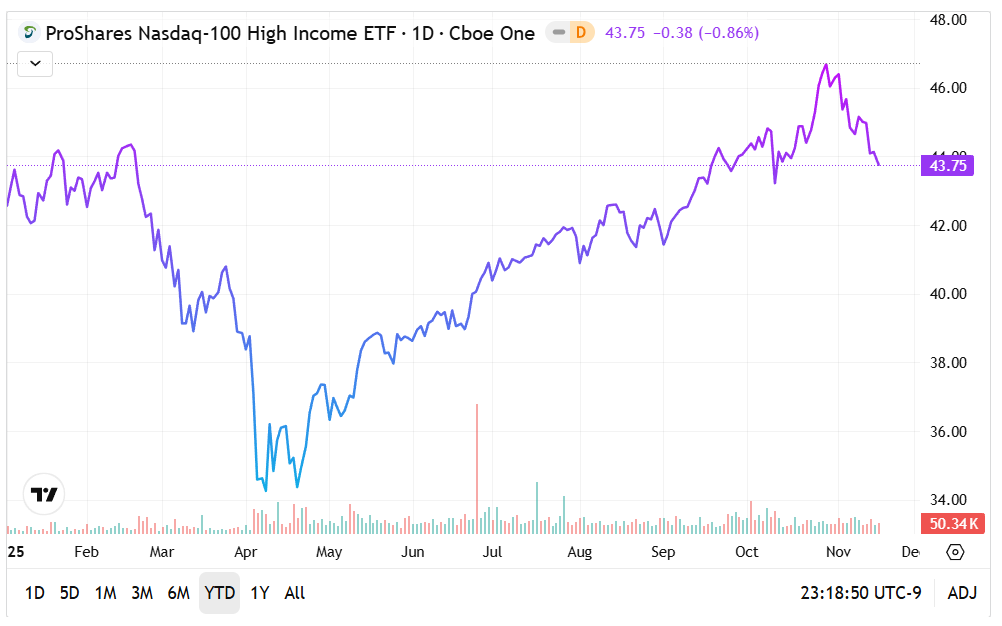
The IQQQ ETF: Since the start of the year, the IQQQ ETF gained roughly 3%. However, the trailing six months have been more productive, with the income fund moving up almost 13%.
- Recently, the price action of the IQQQ ETF slipped below its 20-day exponential moving average as it struggled for traction amid AI bubble fears.
- With the fund slipping below the 50-day moving average, there are near-term stability concerns. However, it's close enough to the $44 support level to mount a credible reversal.
- Volume continues to be light but stable, though there has been a noticeable decline in participation since early October.
For investors seeking a balanced approach to income, the IQQQ ETF offers an intriguing alternative solution, mainly because of the underlying call-writing strategy. Amid shifting sands in the equities market, it's helpful to consider various avenues for holistic returns.
Featured image from Shutterstock