AI is becoming more and more ubiquitous, and ChatGPT has become the poster child for its popularity.
In fact, a new OpenAI report has found that more than 40 million people globally turn to ChatGPT daily for health advice.
But why are Americans putting their health and wellbeing in the hands of a chatbot? Well, according to Axios, it's to navigate the "notoriously complex and opaque U.S. health care system".
When reporting on sleep issues, I always make sure to include expert insight from those who are qualified to give it. But, as millions of people worldwide seem to trust algorithms instead of real doctors, I decided to put ChatGPT to the test.
I asked both a board-certified sleep doctor and AI the same question: 'I wake up at 6.30am, so build me the perfect sleep routine to wake up with maximum energy.'
Here are the respective answers that ChatGPT and Dr Jade Wu of Mattress Firm gave me — plus who I think gave me the best advice.
My thoughts on ChatGPT's 'perfect' sleep routine
If you're in the apparent minority who's never used ChatGPT, let me fill you in. ChatGPT is a chatbot that can answer any questions or instructions you give it within a few seconds of hitting the send button.
The AI tool has become popular thanks to its human-like responses, detailed explanations, and ability to have a conversation with its user.
Small wonder why it's become popular with those seeking health advice.
However, when I typed the question 'I wake up at 6.30am, so build me the perfect sleep routine to wake up with maximum energy', I did spot some slip-ups and oversights in its answers.
Here are my main thoughts on its answer:
It gave me lots of tips — but most were generalizations
Chat GPT isn't magic. In fact, it just parrots the work of human beings.
It obtains every single answer it gives you from huge chunks of text from the internet, creating a mosaic of seemingly credible information from all corners of the web.
However, this amalgamation can result in Frankenstein-like answers that have a human-like veneer, but are way too general to give personalized, tailor-made advice.
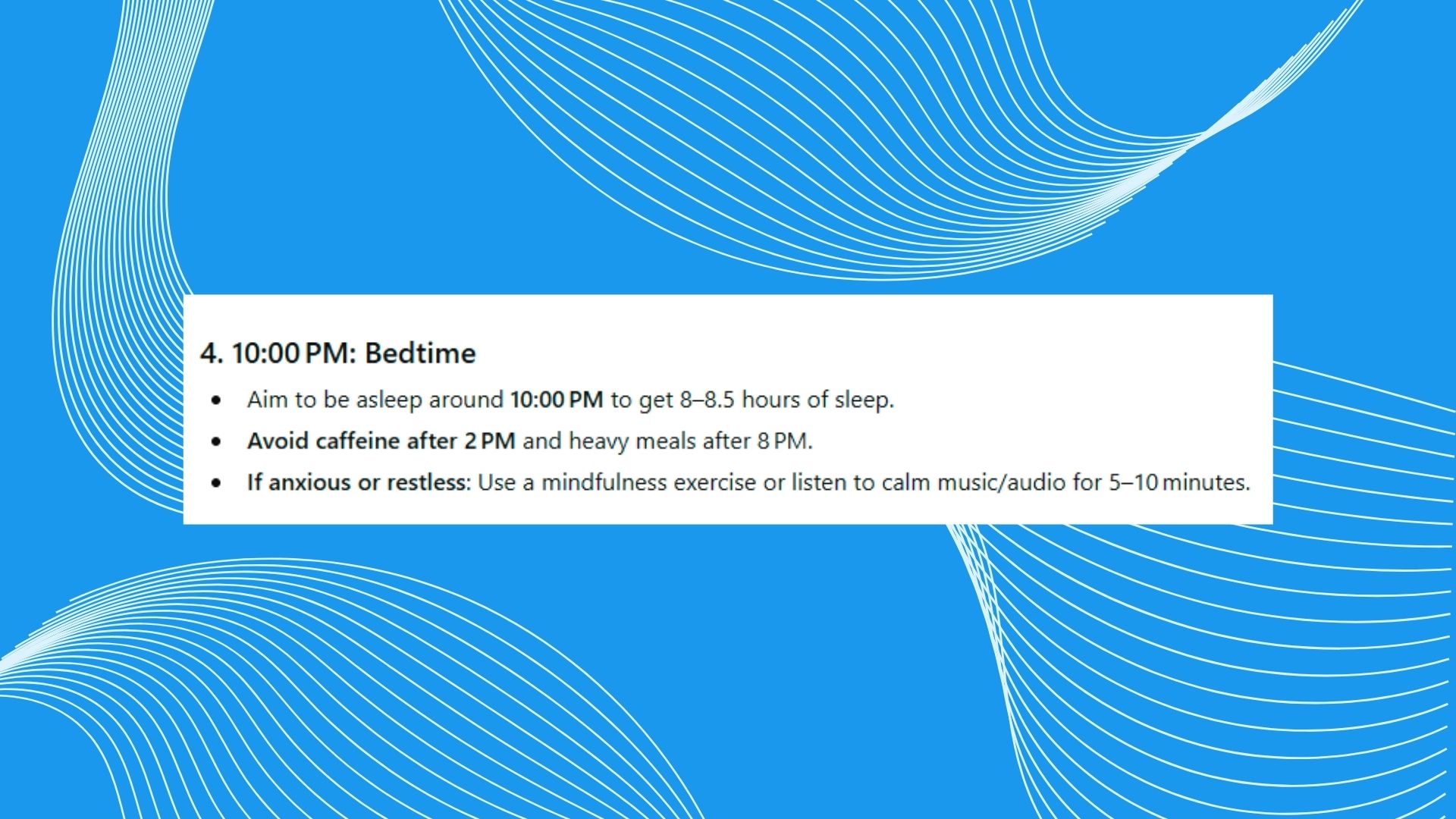
For example, for a 6.30am wake-up time, it suggests I go to bed at 10pm. Factoring in a sleep latency of up to 30 minutes, this means ChatGPT is promoting the apocryphal sleep myth that all adults need around eight hours a night. In reality, most benefit anywhere between seven to nine hours of sleep a night.
As Maryanne Taylor, a certified sleep consultant and founder of the Sleep Works once told Tom's Guide: “Some people are ‘long sleepers’ and function better on 8 hours +, while others are ‘short sleepers’ and do fine on 6-7 hours.”
Some answers don't provide enough context
In addition to telling me what time I should go to bed, ChatGPT kindly suggested I incorporate some light, relaxing activities.
Some of the activities it advised I try were pretty helpful, such as meditation, a warm bath or shower, light reading and journaling. I also agreed that skincare and teeth brushing should be done at least half an hour before bedtime.
However, there was an activity suggestion that failed to provide important context
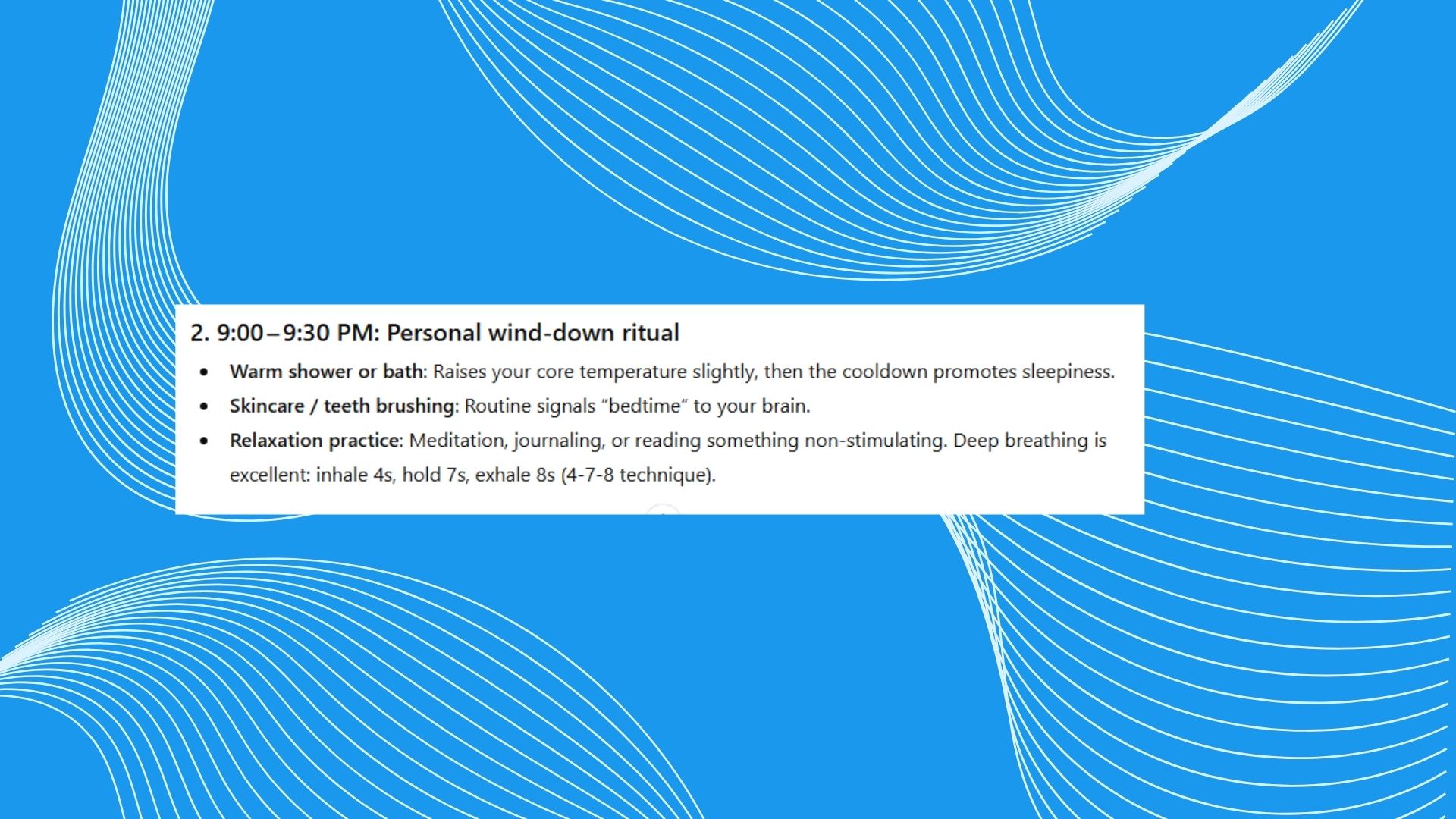
The 4-7-8 breathing technique is often promoted as a way to calm nighttime anxiety, but it comes with a caveat: It takes up to six weeks of twice-daily practice to notice a difference.
Without context, the advice suggests you only need to do the breathwork during bedtime for it to be effective, which will only waste time as it needs to be practised during the day, too.
I, and many of my colleagues, have tried it. One writer said she was disappointed that the 4-7-8 method didn't come naturally, another said she didn't think the 4-7-8 breathwork managed to soothe her anxiety.
And me? I began to think of the 4-7-8 method as nothing more than a chore that actually postponed sleep. This really isn't the quick fall-asleep-fast trick that ChatGPT 'thinks' it is.
Of course, I am being a little biased here, as there are plenty of people who swear by the method (certified sleep coach Claire Davies tried it and loved it), but these people likely only found the method to be effective after a few weeks of bidaily practice, which is preparation that AI inconveniently left out.
Some sleep advice was outdated
The majority ChatGPT's answers comes from data with a cutoff date, meaning a lot of information it gives you is from a few years ago.
This is highlighted in its suggestion that I set a screen curfew because "blue light suppresses melatonin." It also tells me to use blue-light filters.
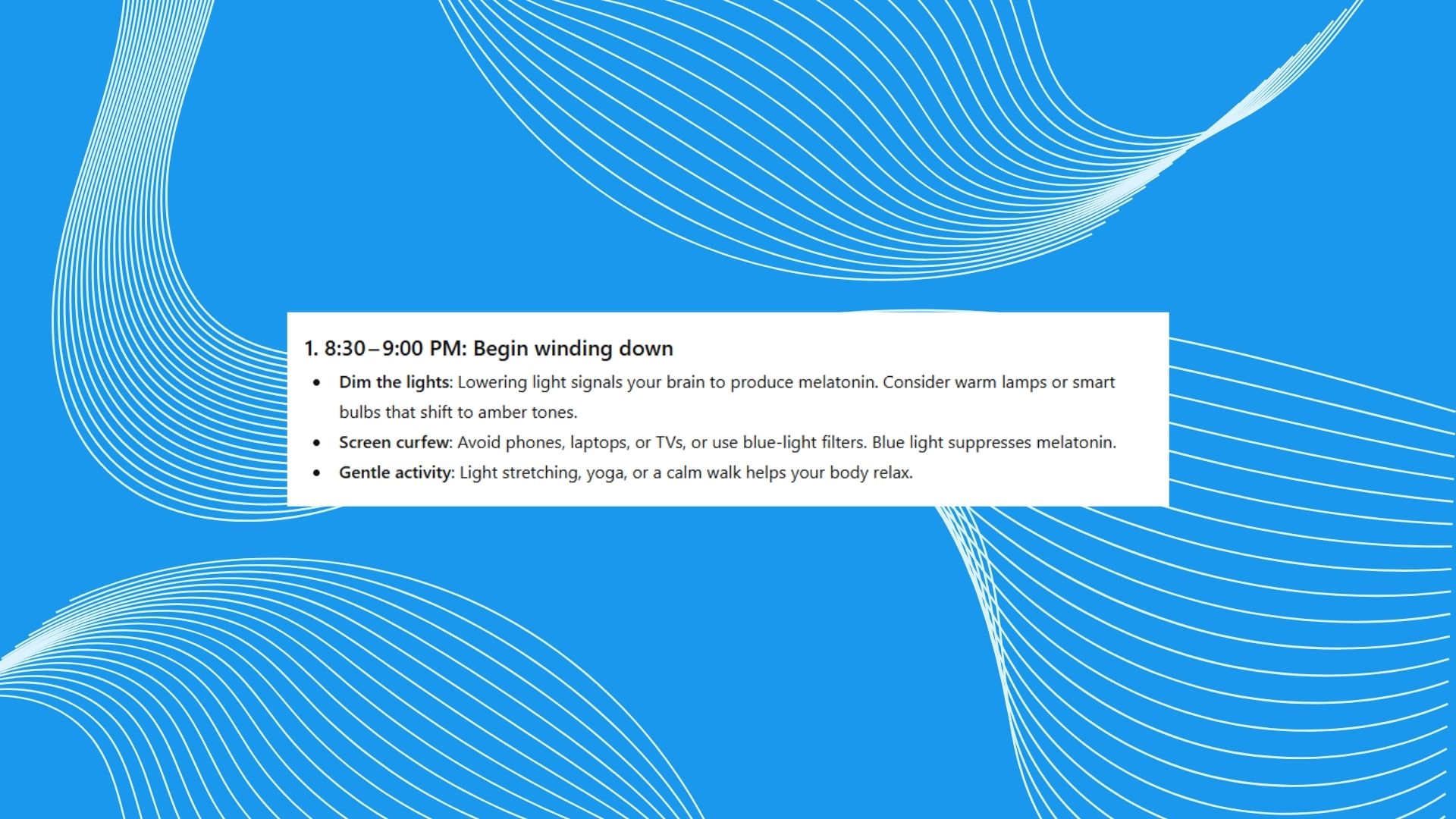
This warning comes from the widely-circulated 2014 Harvard study. However, research since has shown that the negative effect blue light has on sleep has been exaggerated, and that any impact it has on sleep onset latency is minimal.
Keep in mind though, there is still a body of evidence that argues how some people with specific mental health conditions, and with sensory processing issues, can be more susceptible to the effects of blue light pollution depending on length of exposure.
The takeaway? The ideal cutoff time for screen use depends on the individual, not a rigid one-hour-before-bedtime rule that ChatGPT is promoting.
My thoughts on Dr Wu's 'perfect' sleep routine
When finding an expert to pit ChatGPT against, I knew Dr Wu was the right call. She's a board-certified sleep psychologist and keynote speaker who helps professionals through rest.
Here's what she had to say when I asked her to build me the perfect sleep routine.
She acknowledged there's no one-size-fit-all routine
Dr Wu suggested that I dim the lights two hours before my bedtime and add "activities that allow you to enjoy being in your five senses" such as stretching or a warm bath.
However, she also acknowledged that there is no such thing as the ideal sleep routine.
"Consistency is the best foundation for having a good evening routine and daytime energy," she told me. "A good nighttime routine looks different for different people, but the foundation lies in winding down the mind and body."
She told me to ignore the 8 hours myth
You've probably been told (most likely from ChatGPT) that you need to get your eight hours of sleep, but it's really not that simple.
"Your ideal bedtime depends on how much sleep you need, which can change throughout your life and even night to night," the sleep psychologist said.
"Listen to your body for sleepiness signs and go to bed when you feel them — this should happen about the same time most evenings."
ChatGPT vs Sleep Doctor: The clear winner
Dr Jade Wu was excellent at giving me advice that didn't generalize or make assumptions. All ChatGPT seemed to be good at was repeating myths and outdated information.
While ChatGPT did produce some good advice hear and there, Dr Wu was the clear winner for me. Why? Well I think Dr Wu herself explained it best...
"The original question assumes that there is a 'perfect nighttime routine for maximum energy', while in reality, there is no such thing," she says. "It's possible that AI will take these things into account, but in some cases, it may not."