Today, construction is set to begin on Brisbane’s controversial Olympic stadium in Victoria Park.
The work comes almost five years after Queensland’s capital was awarded the 2032 Olympic and Paralympic games.
The decision to construct a new stadium in Victoria Park has angered many, including First Nations groups, who launched legal bids and staged protests to halt the development.
However, on Sunday night the park was closed to the public as the Queensland government prepares to begin construction.
But why is the site so special to First Nations groups, and could there have been a fairer course of action?
Why the controversy?
In March 2025, Queensland Premier David Crisafulli announced Victoria Park would be the site for the main venues of the Brisbane games.
Ongoing debate escalated when, in June 2025, the Queensland government passed legislation to exempt Olympic venues from major planning and environmental laws.
This effectively bypassed the park’s heritage listing.
By August that year, a First Nations group launched a legal bid to halt the development. Six more heritage applications followed.
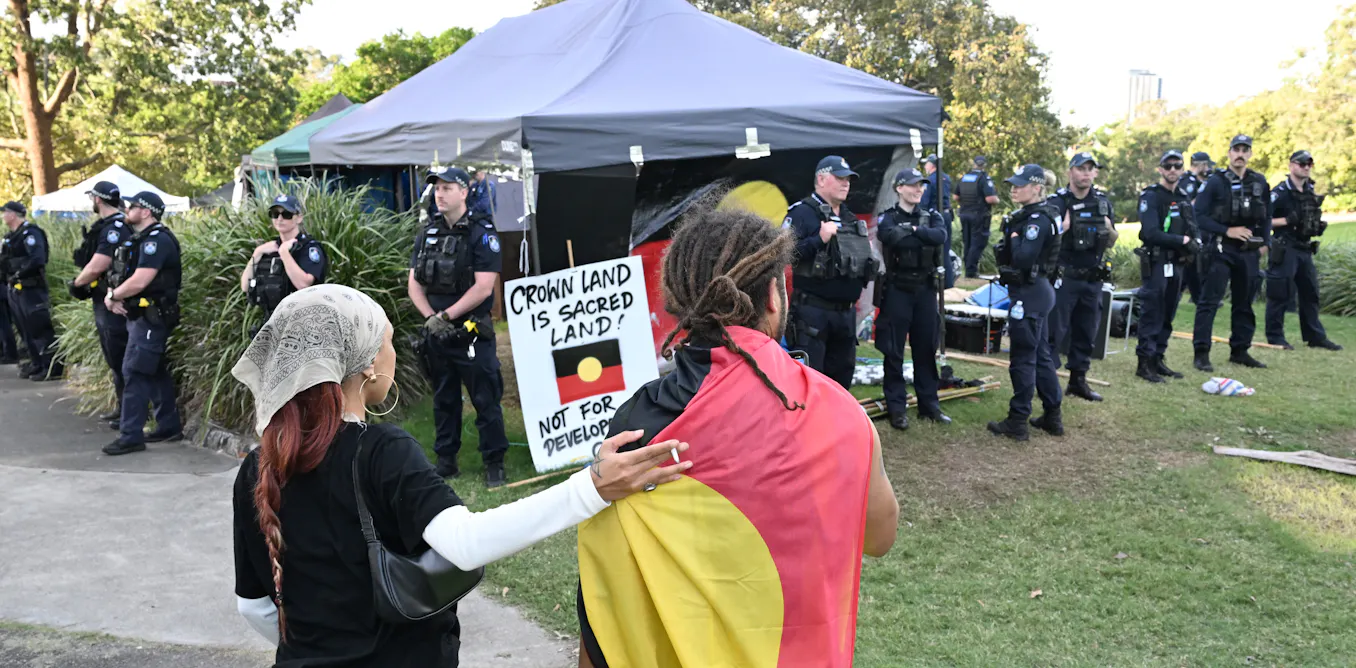
On April 5 this year, another First Nations group established a tent embassy in the park. It ran daily for months while diverse Indigenous cultural activities, tours, and talks were held in the park.
A large gathering and protest was held at the weekend before the government closed the site to the public. Several people were arrested.
What is the significance of Victoria Park?
Victoria Park is a large, state heritage-listed green space, meaning it’s protected under Queensland state heritage legislation.
As co-author Gaja (Aunty) Kerry Charlton expressed on behalf of the Elders of the Yagara Magandjin Aboriginal Corporation, there are strong Indigenous family connections with Victoria Park (which is also known variously as “York’s Hollow”, Barambin – “Windy Place” and Wallan – “Bream”):
Pre-colonial Victoria Park housed vibrant communities who hosted large gatherings like boras, ceremonies, seasonal festivals, celebrations, funerals, sporting tournaments and inter-tribal diplomatic procedures and Lore-Law. This site holds significant cultural heritage for us from then to now and for millennia.
The site was twice (in 1846 and 1849) burnt to the ground during skirmishes with police and soldiers. It continued to be used by Aboriginal groups well into the 1890s and again from the 1930s to 1960. There are Elders alive today who lived there.
Apart from Musgrave Park, it is probably the most significant Indigenous site in Brisbane. It was certainly Brisbane’s largest and most important First Nations camp and corroboree ground.
This was acknowledged in Victoria Park’s recently completed master plan:
for thousands of years, this area has been a central gathering point for groups with different knowledge systems and languages.
The park also comprises inner Brisbane’s last remaining sizeable green space, and it is one of the few inner Brisbane parks to retain some vestige of natural vegetation. Its springs are the only original, still functioning aquifer in the Brisbane region.
In 2024, Brisbane City Council claimed its commitment to “metamorphosing Victoria Park/Barrambin into a natural haven” – restoring the natural landscape, increasing the tree canopy and revitalising the wetlands and waterholes.
Heritage concerns add fuel to the fire
So, what would overriding all this heritage mean? It means setting aside heritage requirements to fast-track development.
The state government’s Olympic delivery plan promised to “integrate” the games within Victoria Park’s master plan.
It remains unclear how this could be possible alongside the objective of “transforming” the park into Queensland’s “biggest” sporting venue.
Adding gigantic stadiums, overpasses, associated infrastructure and increased traffic within an already busy intersection between three major schools, a hospital, the Brisbane Exhibition Grounds and a university, will likely erase most of the park.
Nevertheless, the revised master plan insists two-thirds of greenspace will somehow be retained.
Communities and conversations are crucial
Most Australian cities have a large central park. Victoria Park was Brisbane’s last remaining chance to retain a large park as an integral part of its CBD.
The original vision (and Master Plan) for Victoria Park was that it would become Brisbane’s cultural and environmental “breathing space”. Victoria Park’s traditional custodians were central to this.
As Gaja Kerry Charlton notes:
We, the YMAC Elders, support this submission for all of Victoria Park to be heritage listed to protect it as part of our Yagara cultural heritage and for the wider community to ensure such parklands remain for everyone to enjoy.
The Brisbane 2032 mantra claims it will promote “not just our sporting champions, but equality and inclusion for all.”
Brisbane 2032 should be an opportunity for growth, and in ways that might not be expected: learning how to do development differently.
Hopefully in making the games, we can truly preserve the cultural landscape Brisbane was built upon, instead of again building over our rich Indigenous heritage.
The key to this is to bring the communities back into conversation and be willing to hear their voices and innovate into contemporary planning and design processes.
This article was originally published on The Conversation. Read the original article.