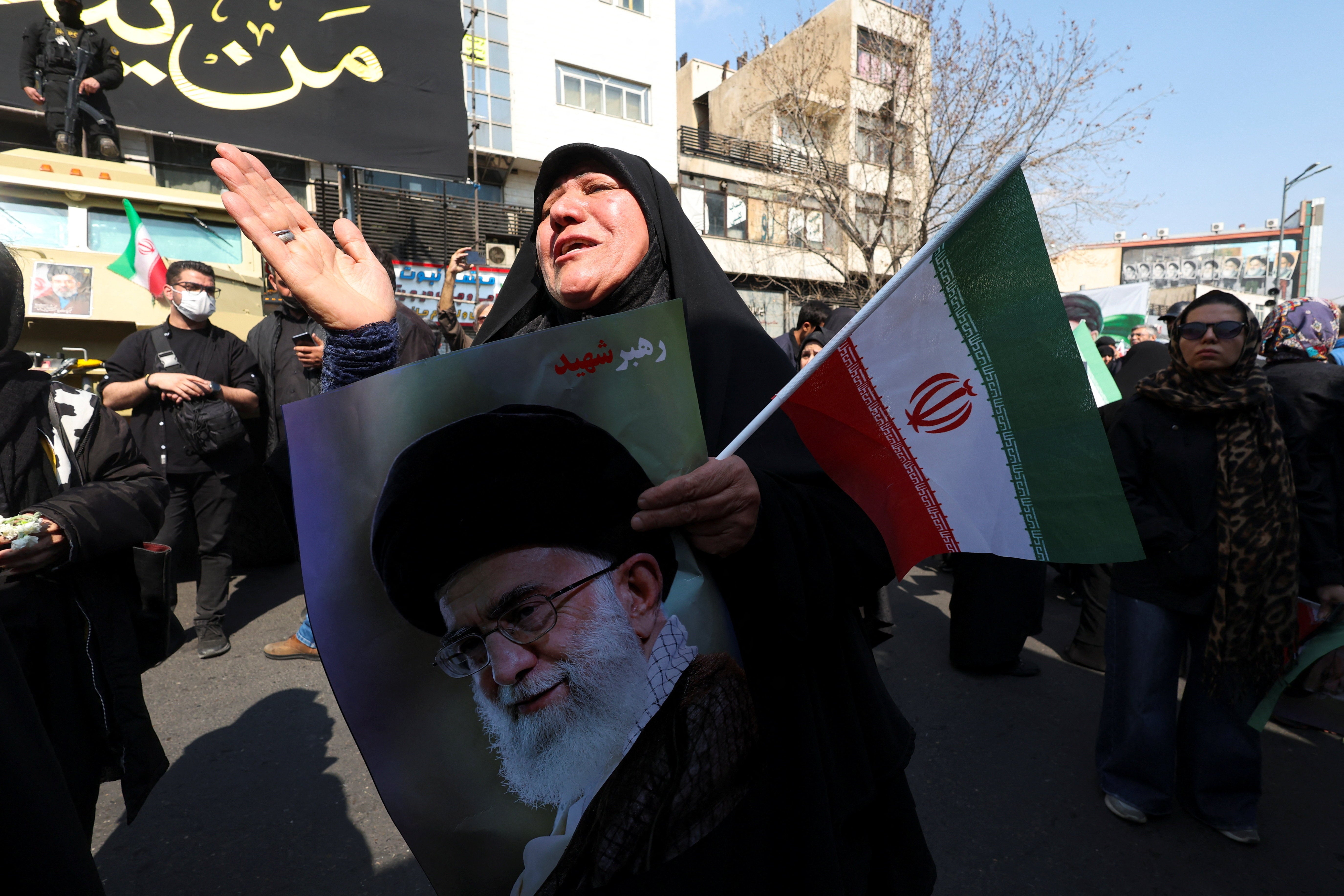
Weeks after Iran’s supreme leader Ayatollah Ali Khamenei was killed by US-Israeli strikes, Tehran’s future is still unclear.
The Middle Eastern war continues to rage with no immediate end in sight, and Khamenei’s son and successor, Mojtaba Khamenei, has not been seen in weeks amid reports he has been injured.
Tehran’s top security chief, Ali Larijani, and the Islamic Revolutionary Guard Corps’ Basij force commander, Gholamreza Soleimani, were both killed in quick succession last week.
Donald Trump has claimed Iran wants to make a deal to end the conflict, and said US envoy Steve Witkoff and his son-in-law Jared Kushner held talks with an unnamed Iranian leader on Sunday.
The Jerusalem Post later reported that the top official was Iran’s parliament speaker, Mohammad Bagher Ghalibaf.
Ghalibaf denied that any such negotiations have taken place, but reports claim he is being eyed as a potential leadership successor by Washington as Trump looks for someone he can deal with.
An unnamed Trump administration official told Politico that while no decisions had been made, the speaker was a “hot option”.
Below, we look at all we know about the politician.
Who is Mohammad Bagher Ghalibaf?
The 64-year-old former military officer is considered a hardliner, with a revolutionary ideology aligning with the current regime and the slain supreme leader Ayatollah Ali Khamenei.
Currently speaker of Iran’s parliament, a position he was appointed to in 2020, Ghalibaf is prolific on social media like his predecessor in the role, Ali Larijani, who went on to become Iran’s top security chief before he was killed in an Israeli strike on 17 March.
Ghalibaf cut his teeth within the Islamic Revolutionary Guard Corps (IRGC) at the early age of 19, rising quickly to command a combat division against Iraq by the age of 22.
Among his other experiences and accolades are leadership of the brutal Basij paramilitary force and leadership of the IRGC’s air force.

He led the crackdown against student protests across Iran in 1999 and boasted about “wielding sticks” against dissidents.
He was so emphatic in his opposition to the demonstrations that he co-authored a letter with 24 other IRGC leaders threatening the then-president Mohammad Khatami to intervene.
Ghalibaf has been largely associated with the religious asceticism propagated by the Islamic Republic, which requires self-discipline, simple living and a rejection of indulgence.
However, he sparked controversy when his wife, daughter and son-in-law were pictured returning from a luxury shopping trip in Turkey with nearly 300kg of luggage. The hefty baggage was attributed to being a “layette” for their newborn child and was dubbed “LayetteGate” by social media users.
Several other allegations of corruption have been levied against the politician, including accusations that he used his influence as a former IRGC commander to cover up controversies.
This included the scandal around a company accused of embezzling an estimated $3bn from Tehran during Ghalibaf’s tenure as mayor of the capital between 2005 and 2017.
He has also been accused of transferring more than 70,000 square metres of public land and thousands of pounds in aid to the Imam Reza Charity, owned by his wife.
The former ayatollah’s son, Mojtaba Khamenei, is reported to be a key advocate for Ghalibaf, shielding him from the effects of some of the worst controversies.
However, the second-eldest son of the late ayatollah has not been seen in public for weeks. There are claims he has been seriously injured and may not be able to wield much influence, if any.
Ghalibaf, though, has not shied away from his aspirations for Iran, having launched several failed leadership bids for the presidency in 2005, 2013 and 2024.
Reeves warns of ‘significant’ impact of Iran war on economy as prices to soar: Latest
What we know about Trump’s 15-point plan to end the Iran war
Iran-US war live: US ‘negotiating with itself’, says Tehran after Trump offers peace
Iran has received the 15-point US ceasefire proposal, 2 Pakistani officials say
Oil prices fall as Iran says ‘non-hostile’ ships can pass through Strait of Hormuz
Why Arab nations are scrambling to get South Korea’s air defence missiles