Our table at Cuatrolatas never stood a chance.
My glass of vermút sweats down to the turquoise tabletop. Standing room only among wine glasses, water glasses, sunglasses, juice glasses. A platter of summer tomatoes, tuna-belly conserva, shaved onion, and punchy olives arrives where it cannot possibly fit.
We lift glasses. Shift glasses. Angle plates. Borrow a few inches from the precarious ledge beside the table. Then Lola sends more food. We shift the impossible again.
Pericana lands dark and red and glistening with oil, a spread for bread made with sun-dried tomatoes, peppers, and cured fish. Two creamy ensaladillas come next. One riff includes krab stick. The other follows the familiar Russian formula. A meat board carries half a butcher shop in sausage form. Pork cheeks nestle into a steamed bao. Barbecue flatbread arrives piled with chicken, cheese, and sauce, as though California Pizza Kitchen had taken up Spanish.
Nobody objects. There is no space to clear. Plates lean on plates. Glasses get relinquished. Appetite takes over. Snug becomes a footnote. Outside, Alicante performs the same trick on a larger scale.
Cars vanish from streets. Neighborhood party tents, barracas, occupy half-blocks. Restaurants lucky enough to face freed asphalt push their patios past the curb. Roadways become dining rooms, dance floors, bars, and parties. Alicante finds space, fills it. Then finds more.
This is Hogueras de San Juan, Alicante’s annual festival of fire. Across Spain, San Juan welcomes summer with infernos and midnight rituals. Alicante makes it monumental. Enormous sculptures rise in intersections and plazas. Some intricate. Some cartoonish, satirical, wonderfully strange. People stop to photograph details destined to disappear in the cremà, when the monuments go up in flame.
Alicante does not ease into celebration. It engineers it. Neighborhoods commission the monuments, build the barracas, prepare the food, and turn valuable public space into temporary headquarters. Then they welcome everyone in.
More glasses. More tapas. More elbows. More appetites.
From Cuatrolatas, I hear a saxophone. A tuba. A brass band works down the block and stops at the park outside. Percussion underneath, horns above, their rendition of “Tequila!” with a ska spirit. I leave my plate and pop into the street.
There is no room to dance. People still try with whatever parts still fit. Feet first. Shoulders when possible. At the end, the entire block shouts the only lyric required. “Tequila!” The band moves on. Another block has another band. Brass woos one crowd. Percussion shakes the next.
Women in lace mantillas and gold jewelry pass on their way to somewhere ornate. Men dressed as pirates follow along in their own finery. Another band carries the flower procession, ceremonial now but no less insistent. Alicante has music for lunch, music for dancing, music for parades. Silence is not part of the program. The city is precise about its chaos. It is also hungry.
Alicante is a city of paella. Yes, Valencia, I said it. This afternoon, rice asks too much. It wants a chair and thirty quiet minutes. Hogueras wants another beer and somewhere louder to be. So the city eats on the move. Tapas. Charcuterie. Salty things. Sandwiches. Paella gets a rain check.
We leave Cuatrolatas, catch up, and follow the music. The genre or at least the loudest instrument shifts every couple hundred feet until we reach the fireworks. The streets are shoulder to shoulder. We slip into a packed barraca beside the traffic circle. As close to the pyrotechnics as we can get. Then we look up.
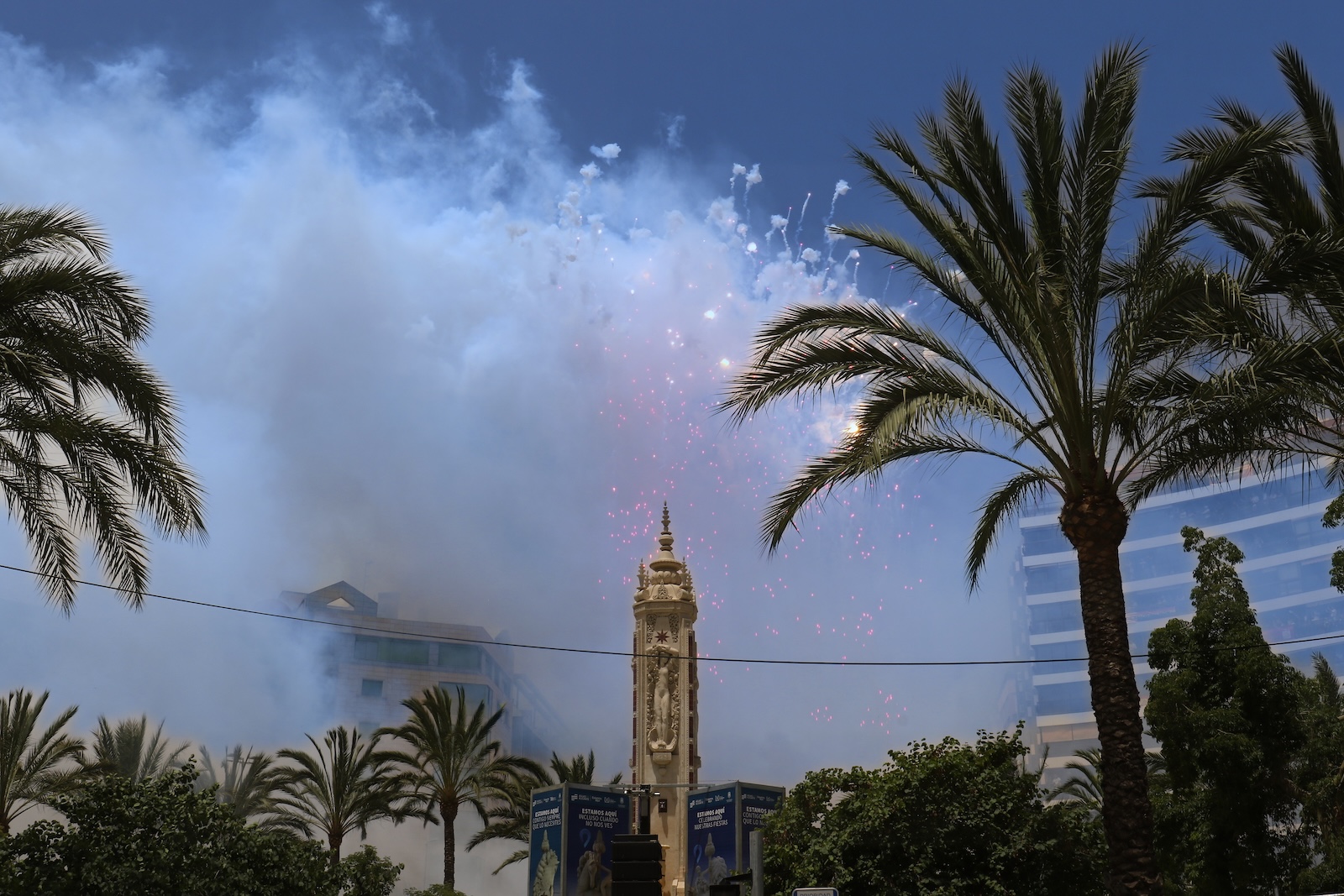
The sky detonates. The loudest noise I’ve had the pleasure of meeting. “Keep your jaw open,” someone yells, “it helps.” I may disagree.
Smoke swallows civilization while sparks fall around the baroque column of the Fuente de los Luceros. The tower somehow survives the booming chaos. Stacked balconies on surrounding apartment buildings are packed with celebrants, drinks, fireworks scorecards. Mostly 10s. A few 9s to keep the ignition crew humble.
The open-jaw guy Jaime helps keep this barraca organized. He calls Hogueras the most important celebration of the year. Tourism, commerce, and visibility matter, he suggests. Then he finds the word beneath all of that. “It’s pride,” he says. “We’ve been burning our bonfires and our traditions for like forever.”
The fireworks end. The crowd does not. It wriggles back into the streets aiming for friends, tunes, food. Preferably all three. Inside another barraca, there is no room for another person. So I go in.
Long tables run beneath temporary walls, temporary roof. White plastic chairs press together. Red shirts, straw hats, beer bottles. Bodies fill nearly every gap. Another somehow appears when someone needs it. Another band plays next to the entrance. Feet answer beneath the tables.
Then a smiling man walks in carrying another tray. The tables are full. More food fits. Somehow.
Cold beer. Catalan sausages. Olives. Black figs. Soft, jammy in the heat. Then coca de tonyina, icon of Hogueras. The golden slab loses a few crumbs over the tablecloth when cut and grabbed. Inside, tuna and onion cooked slowly until savory hits sweet, almost caramelized. A little anise. It travels well, and leaves one hand free for beer.
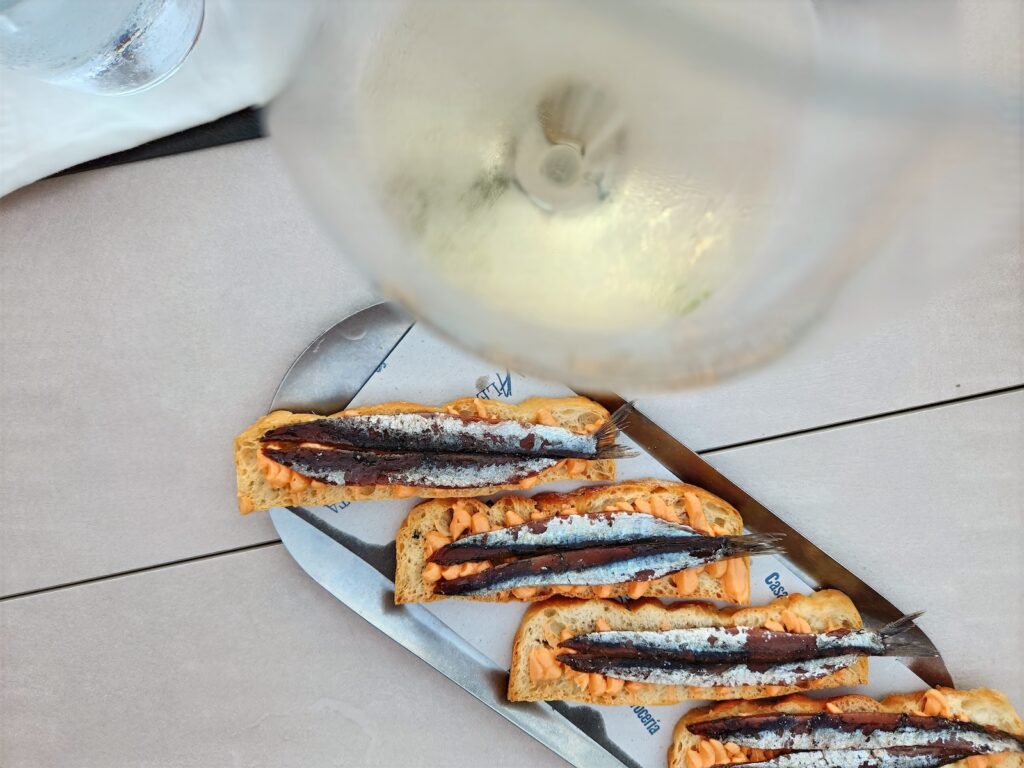
(Howie Southworth) Anchovy and spiced aioli on toast at La Alegria de la Huerta in Valencia
A cartoonish monument depicting a certain oafish world leader dominates the intersection outside. In here, the art seem almost secondary. Though funny.
Artists spend months crafting these monuments that will burn to ash two nights from now. The temporary walls and roofs, the tables and chairs, the music. They all disappear or duck behind a curtain for another year. The people begin again.
I head for another feast, another set of fires. The route carries me north toward Valencia. We pause in Benidorm.
We sit high above the city at La Terrasse in the Port Benidorm Hotel just before sunset. Skyscrapers line up against the Mediterranean. A DJ checks the sound and bartenders shake their elevated work while Benidorm turns to gold below. Sea, sand, spiked skyline, and mountains meet in one widescreen.
Rarefied air with room to breathe it. And the hospitality and the menu have changed clothes.
A foie gras “emerald” comes first. A squat little gem painted gold, filled with vermouth jelly, surrounded by blueberry toast. Crimson beet and avocado tartare, mango vinaigrette. Aged picanha peeks beneath tonnata, goat cheese. Croquettes draped in jamón. A plump shrimp concoction that reminds me of a lobster roll. Wrong coast.
The plates are polished, precise, a bit of theater. Proper wine stems. Soft seats. Enough empty space to recognize as luxury. Glasses fill. Plates multiply. Music drifts through the warm air.
Down the coast in Alicante, the monuments wait for their flame. From this height and with the southern horizon glowing orange it feels like a preview. Or someone lit the fuse a day early.
A friend joins for dinner. Adriana distills the season’s arrival into one sentence: “Summer here is experienced collectively.” Across the Comunitat Valenciana, that communal arrival changes shape. Alicante gives it ill-fated monuments and exuberant crowds. Benidorm gives it height and panache. Valencia goes to the beach.
At L’Alegria de l’Horta on the Malvarrosa Beach promenade, I sit in pressed clothes and drink fine Valencian wine. White, cold, a touch tart. My free hand dangles close enough to touch the sand. I resist.
Bread comes with alioli and grated tomato. Anchovies shine like silver blades over toast and spiced aioli. Hearty slices of calamari singed on the plancha gleam in the fading sunlight. Baseball-sized salt cod fritters arrive golden and hot. Garlic oil erupts from the middle.
Our Summer sale is on!
Support Salon’s bold journalism. Annual members save 58%Then my lubina arrives. A whole fish split open direct from the grill. Smoky. Simply dressed with oil. A lemon wedge. Crispy fries. No sauce. None needed. I work from the tail toward the head until my plate holds just a frame, some skin, one or two fries I’m saving for no good reason.
From my perch I see thousands of revelers pour from the tram, cars that magically found a parking spot, bikes, and buses. They carry blankets, coolers, and totes with dinner. Each group branches off as they meet the sand with enough equipment to establish a civilization for one night. Small fires start within each pod. Smoke begins to rise.
My fish is a buttery memory. My glass is dry. I step off the restaurant’s orderly little terrace and make a slow serpentine path past makeshift dinner parties. The night grows darker. The beach grows brighter as fires multiply from Malvarrosa down toward the port. I stop counting at 175.
A sausage spits over open flame. Meat skewers hiss when fat reaches flame. Corn cobs char and pop. Shellfish, bread, beer circulate around firepits dug into sand. A blanket becomes seating. A cooler becomes a table. And a fridge. A plastic crate holds more wood in waiting.
My friend Felipe had explained the ritual back in Alicante. Make a big fire, jump it several times, then jump several waves. “That will welcome summer,” he told me, “and will give you strength and good luck for the whole of the year.”
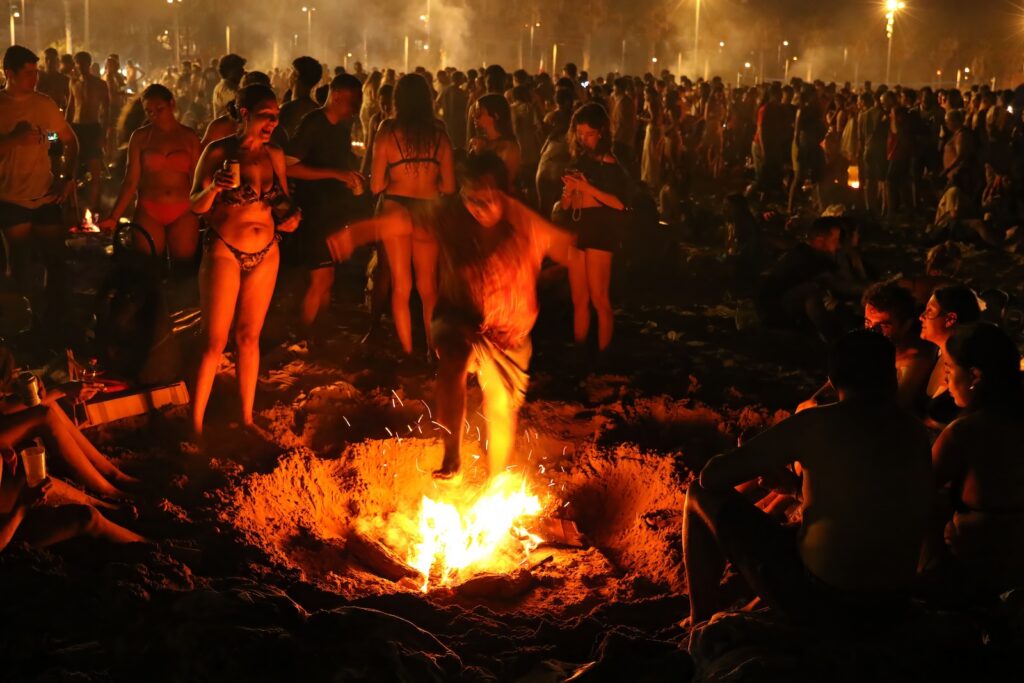
(Howie Southworth) Fire jumping for good luck
On this beach, interpretations vary. Some make deliberate, careful hops. Some leap over flame as friends raise phones and cheer. Some perform feats of strength, flips, aerial dance moves, head-first dives. Possibly singed and mostly sandy, they storm the Mediterranean and return to their grills wet, steaming, and triumphant.
Children thin out before midnight. The club crowd grows afterward. Elbow room becomes a luxury. Groups become amorphous. Firepit boundaries dissolve. Shoes, bottles, hats, towels, coolers migrate. Blankets become rumpled communal flooring. Jumpers still jump. With increasing altitude and inventiveness and shrinking landing space.
Someone asks me to send a photograph I’ve just taken. We trade Instagram handles. Someone has me hold their phone while they dive through shorebreak. Trust abounds. Someone begs me to jump the fire. I jump. Gingerly. For several minutes, I belong to the beach and to no particular party. It seems a common feeling.
Alicante builds upward. Monuments, balconies, barracas, fireworks, towers of smoke. Valencia spreads outward. Blanket beside blanket, grill beside grill, body beside body, fire beside fire. The beach becomes one long temporary table.
By night’s end, campfire settles into my clothes. My dinner had servers, collars, and wineglasses. Beach dinners have coolers, flame, and daredevils. The smoke makes no distinction.
At Cuatrolatas, there was no room for another plate. Another plate arrived. In the barraca, there was no room for another chair. Someone sat down. On Malvarrosa, there was no room for another blanket, another fire, another wet body running back from the sea. They made room.
The monuments burn. The embers go cold. The tents get broken down. The beach empties. What remains is the promise beneath all that food and flame.
Bring everyone back. We will squeeze in.