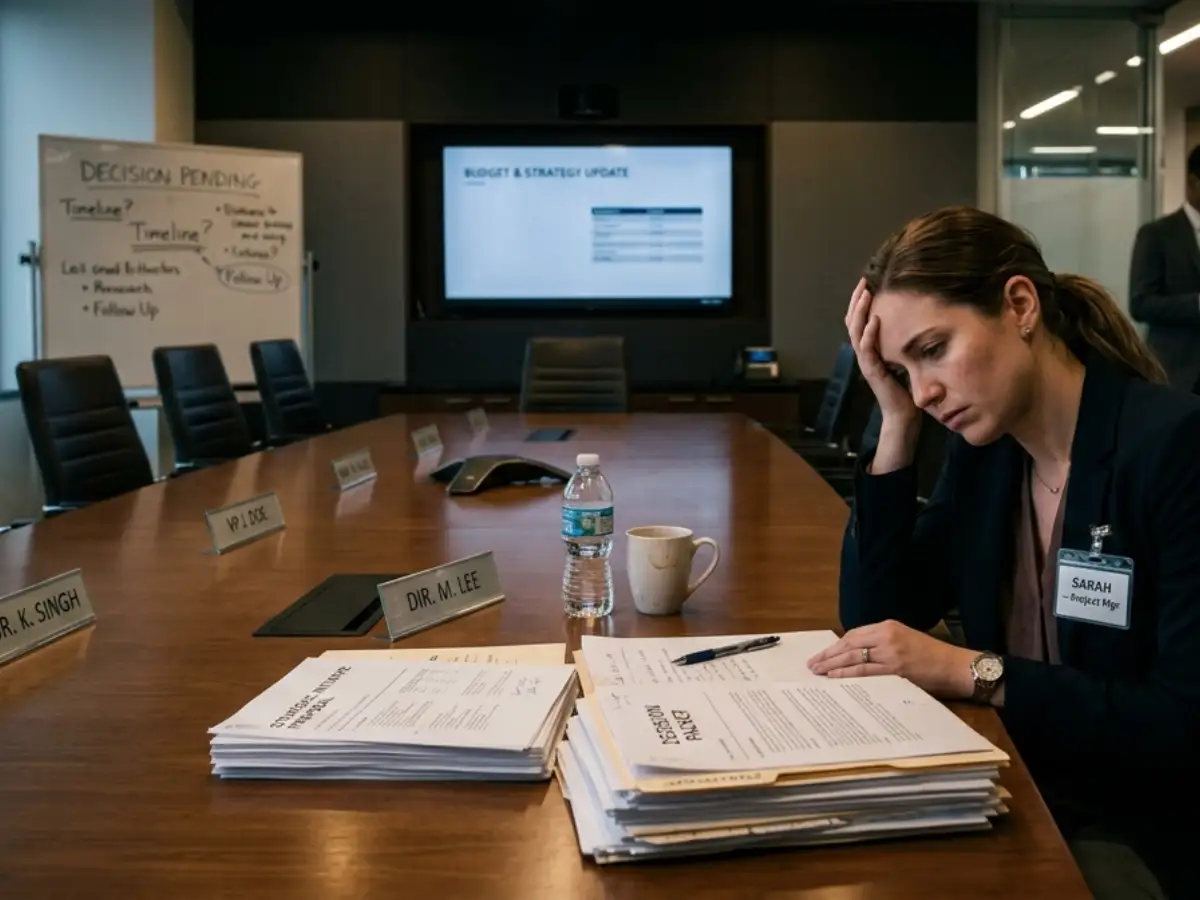
Employees tend to cope with rejection much better than with ambiguity. It’s more difficult when proposals or ideas just evaporate into thin air, when a manager promises to “circle back,” “consider it further,” or “address it next quarter,” but nothing happens for weeks. There is no acceptance of an idea, and there is no rejection either. Just ambiguity.
With time, it leads to a particular kind of workplace frustration. People start asking themselves whether anyone cares about what they think or say, whether their voice is being heard at all, or whether the act of voicing something was ever worth the trouble. Sometimes the problem is not in outright aggression and hostility, but rather in constant avoidance and indecision.
According to the Symonds Research, such patterns usually occur in cases of so-called decision avoidance. It refers to managers’ reluctance to make a decision, which is prompted not by incompetence, but by fear of making mistakes and being blamed for them. Often, such cases are mistaken for laziness or incompetent behavior on the part of a manager, but the truth is quite different.
In any case, workplace frustrations do not always stem from the absence of ideas. Decisions are never really made.
Why managers defer instead of deciding
For many companies, inaction often appears preferable to making the wrong choice. Managers must navigate conflicting demands from higher-ups, tight deadlines, limited resources, and employee expectations. According to research by Symonds, fear of criticism and doubt about the repercussions are two of the primary causes of decision-making delays within the workplace environment.
While it might be linked to risk aversion rather than denial. A manager might choose not to act since approving the proposal may be unsuccessful, but refusing it could lead to disappointment or confrontation. Deferring action serves as a compromise. Yet, procrastinating too often generates its own set of issues.
Workers are forced to wait indefinitely for confirmation that does not come. The issue is that passivity seldom appears neutral to the worker. Employees who constantly receive nothing in response to their contributions will generally assume that a lack of communication means their ideas are meaningless.
As reported by Gallup, continuous interaction, constructive feedback, and supportive supervision are crucial components of engaging with the workforce. As stated by Gallup, employee engagement increases when employees feel valued and involved in their work. Without a feedback system, trust will deteriorate gradually.
What repeated delays do to motivation
Eventually, the workers who feel that they are not heard will cease offering suggestions. This does not usually occur overnight, but is rather something that comes about due to repeated instances in which being proactive did not help. In such situations, the suggestions hang in the air indefinitely, and meetings go on without any direction or action being taken afterward.
Gradually, the workers start conserving their emotional energy. As stated in Gallup’s research, management is an essential factor in achieving high team engagement rates at work. Moreover, Gallup’s studies also demonstrate that employee engagement is strongly linked to productivity and efficiency.
That link explains why unmanaged patterns of communication play such an important role.
Once people no longer believe that anything would change by voicing their opinions, being proactive becomes difficult. Of course, people will continue doing what is asked of them, but stop exerting any discretionary efforts.
The psychological effect of workplace limbo
Uncertainty, in and of itself, can be exhausting. Employees who encounter deferral repeatedly become frustrated because they cannot determine where they stand and whether their efforts are valuable. It is not just the delay of the outcome that exhausts them, but the lack of clarity about the outcome.
The American Psychological Association claims that workplace stress can impair emotional and psychological well-being. The unresolved state of uncertainty over time may be an additional factor leading to emotional exhaustion and disengagement. One study indexed on PubMed Central reveals the effects of prolonged workplace stress and dysfunctional organizations on burnout.
In practice, employees do not see such experiences as a clash but as growing disappointment.
They stop sharing ideas at work meetings. They participate less actively. They emotionally withdraw even before leaving the organization.
Why clarity matters more than perfection
Not all suggestions need to be acted on. What employees need is recognition, communication, and clarification.
While rejection might hurt momentarily, constant delays can lead to demotivation since employees will continue harboring doubt for weeks and months. Avoiding decisions might seem easier, but the consequence is usually that trust is lost.
This is the reason why communication at work is important, even when the leadership doesn’t yet have the best solutions. In many workplaces, employees become tired of not being heard well before anyone stops listening to them.