Understandably, aid workers said it was hard to communicate with them. But when seven asylum seekers, most of them Iranian, sewed shut their lips on Monday in northern Greece, it was nevertheless easy to grasp the broad thrust of their message.
Hundreds of thousands of people of all nationalities have traipsed northwards from Greece so far this year, in search of safety and a better life. Now Macedonia, the first country on the route, has started to block the path of anyone not from Syria, Iraq or Afghanistan. These seven men have reacted to this sealing of the border by sealing their mouths.
The symbolism doesn’t end there: the seven protesters aren’t the only ones who are having trouble communicating. Their predicament is a symptom of a lack of dialogue between the countries of Europe – one that is exacerbating the chaos of the refugee crisis.
Macedonia’s move was prompted by Slovenia’s unexpected decision last week to return dozens of Moroccans to Croatia – prompting panic in countries further to the south, which feared this move heralded a permanent change in Slovenian policy. It didn’t: Croatia refused to take back the Moroccans, the Slovenians shrugged, and things proceeded again as usual. But Macedonia wasn’t convinced, and decided to pre-empt any decision that would see so-called economic migrants trapped on its soil – by blocking their passage themselves.
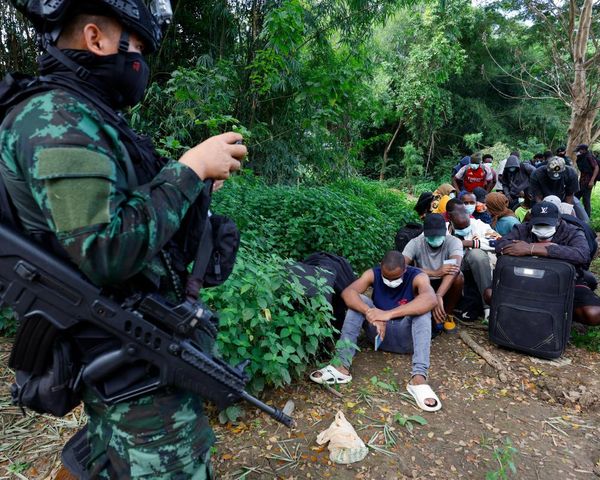
The result is the current logjam on the Greek-Macedonian border. Syrians, Afghans and Iraqis are being allowed through. But Eritreans, Yemenis, Somalians, Moroccans and Iranians – among others – are not. It’s a sad example of Europe’s lack of joined-up thinking. Eritreans are being turned away from Macedonia, on the assumption that EU countries might later do the same, and therefore leave them trapped on Macedonian soil.
But the EU as a whole recently gave Eritreans privileged status and agreed that several thousand of them should be formally resettled in Europe. By contrast, Macedonia is still accepting Afghans – even though Germany, whose policies have the largest bearing on the refugee crisis, says it doesn’t particularly want to welcome them. Similarly, the Greek asylum system gives Afghans much less priority than Somalians and Yemenis – but the latter can’t now get into Macedonia, while the former still can.
Croatia’s interior minister, Ranko Ostojic, summed up the arbitrariness of the decision making when I asked him yesterday how his Balkan neighbours could prioritise asylum seekers based on their nationality. “It’s very difficult to say,” he admitted, citing a country like Yemen as an example. “What is Yemen? Is it in a war or not?”
Yemen is embroiled in a very vicious war – and the fact that European officials aren’t aware of such basic details should highlight how ill-advised it is to make up asylum policy on the hoof. But Ostojic’s wider point still stands: cases need to be assessed on an individual basis, and people shouldn’t be refused asylum just because their countries are largely peaceful. The Iranians who tied shut their mouths, for example, may hail from a stable country – but we don’t know whether they themselves have justified reasons to flee persecution from their authoritarian government. Maybe they don’t – but until we find out, no one benefits from keeping them trapped in limbo on a Balkans border.
Nor does anyone benefit from Europe’s continued refusal to provide safe and legal routes to asylum to significant numbers of Syrian refugees still stuck in the Middle East. It has become abundantly clear this year that Syrians will keep coming from Turkey to Europe while the war in Syria still rages, and while the Turkish government (which houses more Syrian refugees than any other country) has no incentive to properly police its western borders. The result of this unstoppable wave of migration has been the realisation among potential migrants of any nationality that the route is now a free-for-all. Be they a Syrian refugee or a jobless Moroccan, anyone with the money to get to the Turkish coast can now in turn get to Greece (a loophole that it seems at least one of the Paris attackers likely exploited).
While the refugees keep coming, the greater the likelihood that chancers and interlopers will try their luck too. Blocking the Macedonian border is an inefficient and arbitrary way of combating this. Creating a system of mass resettlement for refugees in Turkey and the rest of the Middle East would be a much better long-term bet.