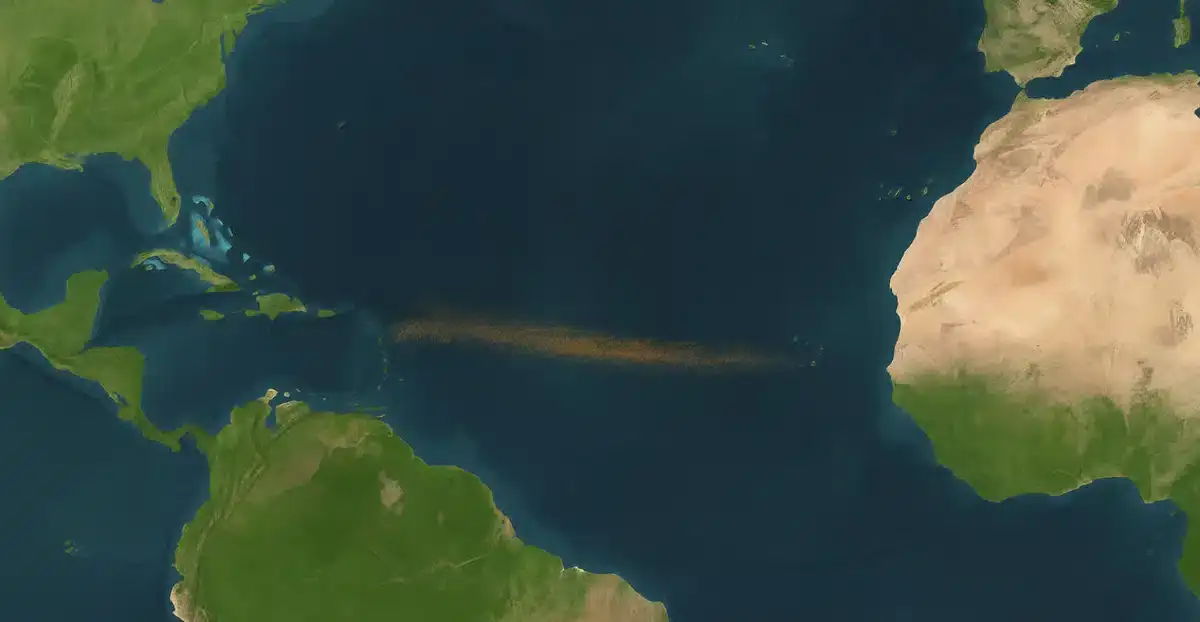
The Great Atlantic Sargassum Belt has become one of the ocean’s most unusual environmental signals. A giant brown ribbon of floating algae is now stretching across the Atlantic, connecting waters near West Africa, the Caribbean, Florida, and the Gulf of Mexico.
Seen from space, the bloom looks like a massive natural stain. However, scientists say this is not simply an ocean surface change. It represents a deeper shift involving marine chemistry, currents, pollution, and climate-related pressures. In May 2025, satellite observations estimated the Great Atlantic Sargassum Belt at around 41 million tons, marking a record level for the Atlantic basin. The scale surprised researchers because sargassum was once mainly linked with the Sargasso Sea.
The floating algae itself is not harmful in the open ocean. It creates shelter for marine species and supports a moving ecosystem. But when enormous amounts reach beaches, the same plant can become a serious environmental challenge. The rise of this Atlantic algae bloom shows how connected Earth’s systems have become. Rivers, farms, oceans, weather patterns, and human activity are now influencing a phenomenon visible from space.
Why did the Atlantic sargassum bloom suddenly expand?
For centuries, sargassum existed mainly in the Sargasso Sea, a warm region of the North Atlantic surrounded by ocean currents. That changed after 2011 when scientists began observing a recurring formation called the Great Atlantic Sargassum Belt.
The belt has stretched thousands of miles across the Atlantic in recent years. It became a yearly event after 2011, except for 2013, when researchers did not observe the same pattern.
Scientists studying the Great Atlantic Sargassum Belt say there is no single explanation behind its growth. Instead, several forces appear to work together. Research from Florida Atlantic University examined decades of satellite images, field studies, and chemical evidence. The study found that nitrogen levels inside sargassum increased by 55% over four decades.
That change matters because nitrogen acts like fertilizer for algae growth. Agricultural runoff, wastewater, river discharge, atmospheric particles, and ocean upwelling may all contribute to the increased nutrients feeding the bloom.
Ocean currents also play a major role. Winds move floating algae across the Atlantic, while warmer waters and sunlight create conditions where sargassum can multiply rapidly.
Scientists continue to study whether climate change directly caused the expansion. Many researchers say the relationship is complicated because natural ocean cycles and human influence overlap.
Is sargassum damaging ocean life or helping it survive?
The Great Atlantic Sargassum Belt creates a complicated environmental picture. In open waters, sargassum is closer to a floating forest than ocean waste. The algae provides shelter, feeding grounds, and breeding areas for fish, crabs, shrimp, sea turtles, and seabirds. Some marine species depend on these drifting habitats during important stages of their lives.
Sargassum mats also support commercial fish species. Researchers have found that animals such as mahi mahi and other ocean creatures use these floating ecosystems while traveling through the Atlantic.
The problem begins when the algae reaches coastal areas in massive quantities. Thick piles collect on beaches, where heat accelerates decomposition. As the material breaks down, it can release hydrogen sulfide, a gas associated with a rotten-egg smell. Large accumulations may irritate the eyes, throat, and lungs, especially for sensitive groups.
The impact extends underwater as well. Huge deposits near shore can block sunlight from reaching seagrass and coral habitats. Reduced oxygen levels can place stress on fish and other marine organisms.
This is why the Great Atlantic Sargassum Belt is not viewed as simply an algae problem. It is a warning about how quickly marine systems can change.
How are scientists preparing for future ocean changes?
Managing the Great Atlantic Sargassum Belt has become a major challenge for coastal communities. Removing the algae sounds simple, but large-scale cleanup creates new problems. Heavy equipment can disturb beaches, remove sand, and damage habitats. Scientists and coastal managers are looking for solutions that protect shorelines while reducing environmental harm.
Some regions use barriers, collection methods, and early warning systems before large mats arrive. Satellite tracking now helps predict where the algae may travel. The goal is not to eliminate sargassum completely. Instead, researchers want better forecasting and safer responses.
Communities are also exploring possible uses for collected algae. Some studies examine whether processed sargassum could support materials, agriculture, or other industries. However, experts warn that safety checks are essential because the algae may contain pollutants absorbed from the ocean.
The future of the Great Atlantic Sargassum Belt depends on understanding the forces behind it. Scientists are watching nutrient flows, ocean temperatures, wind patterns, and changing currents. The massive brown ribbon across the Atlantic is more than a strange satellite image. It is a reminder that Earth’s oceans are constantly responding to natural and human-driven changes.
The bloom shows that environmental problems rarely exist in isolation. What happens on land can travel thousands of miles through the sea, creating consequences far beyond where the story began.
FAQs
What is the Great Atlantic Sargassum Belt and why is it growing so fast?The Great Atlantic Sargassum Belt is a massive floating algae formation spreading across the Atlantic Ocean. Scientists say its rapid expansion is linked to nutrient increases, ocean currents, warmer waters, and changing environmental conditions. The 2025 bloom reached around 41 million tons, making it one of the largest recorded events.
Is the Great Atlantic Sargassum Belt dangerous for oceans and coastal areas?
The Great Atlantic Sargassum Belt supports marine life offshore by creating habitats for fish, turtles, and seabirds. However, when huge amounts wash onto beaches, decomposing algae can release gases, damage coastal ecosystems, reduce oxygen levels, and create health concerns for nearby communities.