The God You Are Allowed to Look Down On
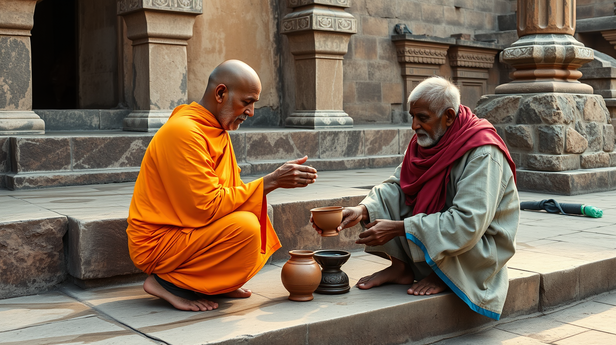
Vivekananda had a specific name for the poor. Not "the underprivileged." Not "the needy." He called them Daridra Narayana, the God who arrives wearing poverty. The formulation is not a metaphor meant to inspire sympathy. It is a theological claim, and it is the most demanding thing he ever said.
If the person in front of you is a manifestation of Narayana, your relationship to them cannot be one of generosity. You cannot be generous to God. You can only serve. And service, in Vivekananda's understanding, carries no ego of the giver, no photograph of the cheque, no name on the ward. The moment you feel good about what you gave, you have already converted seva into something else.
Most of Indian philanthropy has converted it into something else.
What Charity Protects You From
Giving, when it is done from a distance, is among the most effective ways of not actually seeing someone. You write the amount, you sign the form, you attend the gala. The poor remain abstract, a cause, a category, a line in a CSR report. The transaction is complete. Your conscience is, as the phrase goes, clear.
Vivekananda was not interested in your clear conscience. In his lectures compiled in Karma Yoga, he returns repeatedly to the problem of the giver's ego, the way charity can become a performance of one's own goodness rather than an act of genuine attention to another person. He argued that any act of giving that leaves the giver feeling elevated has failed its own purpose. The feeling of elevation is the sign that you have served yourself, not the person in front of you.
This is not a comfortable reading for an era in which philanthropic India has made giving aspirational. The naming rights on hospital wings. The foundation bearing the family name. The carefully photographed school inauguration. None of this is Vivekananda's seva. It may be useful. It is not the same thing.
The Specific Discomfort He Was Asking For
When Vivekananda founded the Ramakrishna Mission in 1897, he insisted that its monks treat service to the sick and the poor as worship, not as social work, not as charity, but as a spiritual practice indistinguishable from prayer. A monk cleaning a wound was performing the same act as a monk sitting in meditation. The logic was exact: if the poor are Narayana, then attending to their suffering is attending to God. There is no hierarchy between the two activities.
What this demands of the person serving is a particular kind of ego-dissolution that is genuinely difficult. You cannot serve Daridra Narayana while maintaining the psychological position of benefactor. The giver-receiver structure has to collapse. And most of us, most institutions, most CSR frameworks, most well-meaning campaigns, are not willing to let it collapse, because the giver-receiver structure is also a power structure, and power is comfortable.
Vivekananda was asking you to give that up too. Not just money. The position.
Why Modern India Heard Only Half of It
The half that was heard: serve the poor, build institutions, give back. The Ramakrishna Mission hospitals, schools, and disaster relief operations are genuine inheritors of this instruction, and they are among the most quietly effective institutions in the country. That half landed.
The half that did not land is the internal requirement. Seva in Vivekananda's sense changes the person doing the serving, not just the person being served. It is a spiritual practice, which means it has to be uncomfortable. It has to cost you something that money cannot cover, your sense of being above the situation, your ability to leave when it gets difficult, your right to feel good about yourself for showing up.
Indian giving culture has become skilled at the donation and unskilled at the dissolution. We have built the infrastructure of seva without accepting the interiority it requires. The hospitals exist. The question Vivekananda was actually asking, whether the person writing the cheque has looked Daridra Narayana in the eye and felt something shift, remains largely unanswered.
The karma of giving, in his reading, accrues not to the gift but to the quality of attention behind it. A crore donated with contempt for the recipient is not seva. An hour given with full presence might be.