
The dialect spoken in gold
The mangalsutra a woman wears in Pune looks nothing like the one her counterpart wears in Chennai. One is black beads strung on gold thread. The other is a thali tied with turmeric cord at the wedding and later restrung on a gold chain. Both signal the same social fact: married. But to different gods, different castes, different geographies. The jewellery does not just decorate. It speaks a dialect.
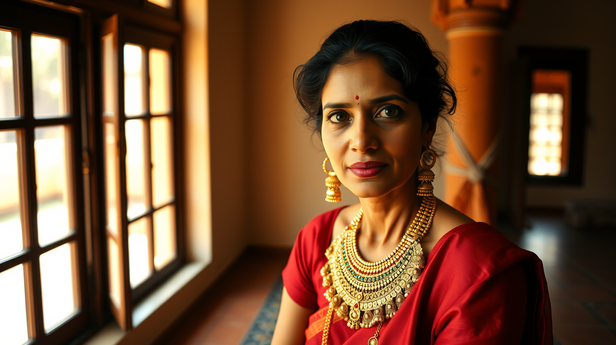
Every region in India developed its own visual vocabulary in metal. The temple jewellery of Tamil Nadu, the long, layered necklaces worn by Bharatanatyam dancers and Brahmin brides, is cast in gold with motifs of Lakshmi and Gaja, the elephant. In Rajasthan, lac bangles stacked to the elbow in red and ivory once told you immediately whether a woman was newly married or widowed. In Bengal, the shakha and paula, white conch-shell bangle on one wrist, red coral on the other, are so specifically married-Hindu-Bengali that wearing them in combination means something precise to anyone who knows the code. You may think you are wearing your mother's bangles. Your mother's community reads them as a sentence.
What religion asks you to carry
Religion does not suggest jewellery in India. It prescribes it. A Hindu bride in Kerala wears the minnu, a small gold cross-shaped pendant on a chain of 21 gold beads, tied by the groom at the wedding. The cross shape predates the Christian influence some scholars attribute it to; it appears in older Nair wedding traditions as a sun symbol. The point is that the minnu is not interchangeable with a mangalsutra, even though both mark the same legal and social transition. The religion is encoded in the design.
Muslim women across India wear gold differently from their Hindu neighbours, and the difference is not wealth but theology. Elaborate gold sets at a Muslim wedding in Hyderabad's old city follow a tradition shaped by Mughal aesthetics and the specific weight of mehr, the obligatory gift from groom to bride, which means the jewellery is also a financial instrument, not only an ornament. Sikh women in Punjab wear the gold choker called the rani haar for weddings, and the kada, the steel bangle, every day, regardless of occasion. The kada is not jewellery in the decorative sense. It is a marker of faith worn on the body the way a prayer might be worn on the mind.
Caste written in metal
This is the part that makes people uncomfortable, and it should. Jewellery in India has historically been one of the clearest markers of caste position. Certain ornaments were, for centuries, legally and socially restricted. In parts of Kerala under the Travancore kingdom, lower-caste women were prohibited from covering their upper bodies and from wearing gold above the waist. The jewellery rules were not custom. They were enforcement.
Those restrictions are gone. What remains is subtler. The style of nose ring a woman wears, whether it is the large nath on a chain hooked to the hair, or a small stud, or a septum ring, still carries regional and caste associations that communities recognise internally even when outsiders do not. The thickness of gold bangles, the preference for uncut polki diamonds over faceted stones, the choice between silver and gold for everyday wear: all of these choices sit inside a system of meaning that was built over centuries and does not disappear because the law changed.
The weight of what you inherit
When a piece of jewellery passes from mother to daughter in an Indian family, it does not arrive neutral. It arrives with its history intact. A set of temple jewellery from a Tamil Brahmin household carries the caste identity of the household. A pair of silver anklets from a Rajasthani farming family carries the class identity of that family. You can wear them out of context, and many women do, deliberately, as a reclamation or a fashion choice, but the object itself still holds its original meaning in the community it came from.
This inheritance is also financial. Streedhan, the gold a woman receives at marriage and owns outright, has functioned across communities as the only asset a woman could control independently of her husband or his family. The jewellery was savings. It was insurance. The social signal and the economic function were never separate; they were the same object doing two jobs at once.
When the signal changes hands
Young Indian women today wear their grandmother's jhumkas with jeans, their mother's temple necklace with a slip dress, their own mangalsutra only on certain occasions or not at all. This is sometimes read as a loss of tradition. It is more accurately a renegotiation of who controls the signal.
The jewellery still means something. The meaning is just no longer fixed by the community it came from. A woman who wears a nath to a fashion week event in Mumbai is not erasing its regional identity, she is adding her own layer of meaning on top of it. The object accumulates readings the way old gold accumulates patina. The original meaning does not disappear. It sits underneath, legible to anyone who knows where to look.
What jewellery reveals, across every region and religion and social position, is that the body in India has never been a private surface. It has always been a text that communities read, argued over, and tried to control. The specific ornament, the thali, the kada, the shakha, the nath, is just the alphabet. The sentence being written is always about belonging, and about who gets to decide where you belong.