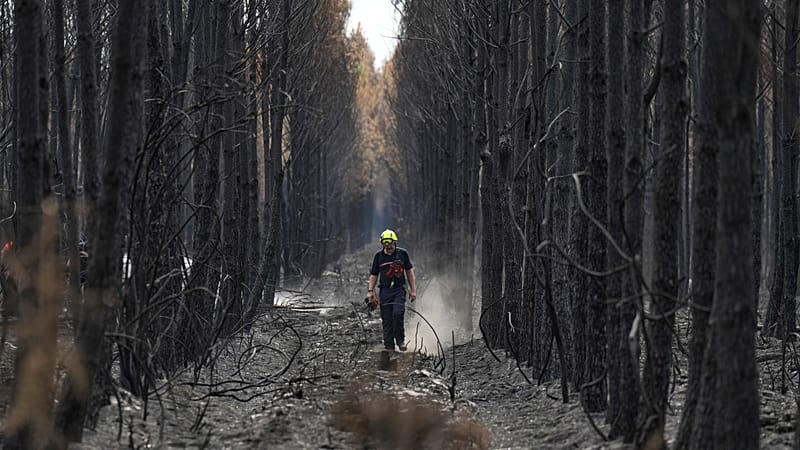
Europe is facing another summer of devastating wildfires. Data from the European Forest Fire Information System (EFFIS) on July 30 shows that more than 434.976 hectares have burned since the start of 2026. So far, 1.407 fires have been detected, releasing an estimated 17.98 million tonnes of CO₂.
"These fires are out of capacity," said a European Commission official, describing how wildfires were spreading faster than firefighting efforts could match.
The EU has spent the last two years building what it calls a more serious, integrated wildfire strategy with new funding, a new fleet, a new Cyprus hub, and since March 2026, a new philosophy that puts prevention ahead of suppression. So, what exactly does the EU have, and is it holding up under this summer’s pressure?
The toolkit
At the centre of the system is the EU Civil Protection Mechanism, a solidarity framework that lets an overwhelmed country ask other member states for help. It does not activate automatically: a state must request assistance, usually once it determines a fire has outgrown its capacity.
Running that process around the clock is the Emergency Response Coordination Centre (ERCC) in Brussels, which matches offers of aircraft, crews and equipment to whichever country needs them, and helps co-finance the transport.
Backing that up is rescEU, the EU’s strategic reserve of firefighting planes and helicopters, held for when national and pooled resources run short. Alongside it is the European Civil Protection Pool, made up of national assets governments have pre-committed for EU-wide use. Layered on top are Copernicus, the satellite mapping service producing real-time maps of burn zones and infrastructure at risk, and EFFIS, the European Forest Fire Information System, which forecasts fire danger up to ten days ahead and tracks active fires every few hours.
New for 2026 is a firefighting hub in Cyprus, able to pre-position six aircraft, plus a dedicated Wildfire Support Team reinforcing the ERCC from June to September.
What’s been sent this summer
For the 2026 season, the Commission put 22 firefighting planes, 5 helicopters, 777 firefighters from 14 countries, and 21 certified teams on standby across 12 countries. As fires in Iberia and France escalated, France received seven planes and four helicopters, drawing crews and aircraft from Czechia, Croatia, Germany, Portugal, Slovakia, Sweden, and Türkiye.
Spain received six planes and three ground teams, with help arriving from Greece, Italy, Portugal and Türkiye. Five Canadian planes were split between the two. Commissioner Hadja Lahbib said the mechanism is “under pressure” but insisted “it is working.”
A strategy still on paper
In March, the Commission presented a communication on integrated wildfire risk management, reframing the EU’s approach around prevention, preparedness, response, and recovery as one continuous cycle rather than a seasonal scramble for planes. It acknowledged that Europe had spent years treating symptoms instead of causes, fighting ever-bigger fires rather than stopping the landscape from becoming so flammable.
Four months on, little of that has translated into new rules. Environment Commissioner Jessika Roswall told agriculture ministers in late May that the Commission does “not plan any new initiatives on forest management” and has no new indicators or guidelines in the pipeline.
The one binding-adjacent document to emerge, a recommendation on integrated wildfire risk management adopted on 29 June, is non-binding. Forest management remains a national competence. A blocking minority, traditionally Sweden and Finland, often joined by France, has resisted giving Brussels more say, having helped stall the Nature Restoration Law in 2024 and pushed back on the proposed Forest Monitoring Law.
“We cannot just blame the fire situation on climate change”
Alexander Held, a forester at the European Forest Institute’s Pan-European Forest Risk Facility, has watched the pattern shift over 25 years in the field. “Now we have fires from Turkey over Greece to Spain to Portugal to France,” he said, describing the collapse of the old split fire season into something closer to simultaneous, year-round risk across the continent.
“We see fires now up in Iceland, we see fires in Greenland, we see fire in the Arctic Rim,” he added, evidence, he said, that “the pyrogeography is definitely changing.”
But climate change is the enabler, not the whole story. “We cannot just blame the fire situation on climate change,” Held said, arguing that land management decisions, abandoned farmland, pine and eucalyptus monocultures, and forests with broken-up canopies, do “our part of making the landscape more flammable.”
Even the newer EU instruments, he said, tilt toward hardware over resilience: “despite all the declarations, we don’t see the coordinated investment in the broader field of learning to live with fire,” because “it’s much easier still to invest in the response side” than in prevention.
Held points to Portugal as the counter-example, a country that “shifted its strategy from fire suppression to really fire management and investing 50percent of the budget in land management and prevention.”
His own wish, he said, would be a euro spent on resilience for every euro spent on suppression: “I would wish that we get a 50percent leverage, any euro that is spent on suppression is going into this 5R framework.”
Crucially, he warned against newly fire-prone countries assuming more trucks and planes is the answer, when even well-resourced states are losing control of major fires: “if other countries with a lot more resources and experience and capacity can’t control [these fires], how do we conclude, oh, let’s do the same and then we can control it?”
The EU is prepared, but stretched
Commission spokesperson Anna-Kaisa Itkonen frames the shift in similar terms, if from inside the institution. “It is very clear that climate change is making each summer hotter and harsher and more dangerous,” she said, noting that “Europe is the fastest warming continent in the world” and that “more than one million hectares were burned” across the EU to wildfires in 2025 alone.
“We cannot focus only on literally putting out fires,” Itkonen said. “Preparedness for us is really, really important.” She pointed to the EU’s forthcoming portal and guidance on integrated risk management, due by early 2027, reinforcement of EFFIS, and the ongoing purchase of a permanent rescEU fleet, 12 new firefighting planes and five helicopters, though deliveries won’t be finished until 2030.
On the funding, she cited a wider climate push behind the numbers: 35percent of the EU’s next long-term budget earmarked for climate and environment, including “almost 19 billion euros from cohesion funds for adaptation.” The Commission’s plan is clear: “the goal is not to fight more fires. The goal is to have a good prevention policy and good coordinated action across the European Union.”
Is it enough?
Even by the Commission’s own account, the system is being tested by scale, not just fire behaviour. Officials have said the 2026 season began earlier than last year’s, with the first activation of the Civil Protection Mechanism at the end of April; by July, fires had burned hundreds of hectares.
Every plane and helicopter in the current fleet remains nationally owned or committed elsewhere when several countries burn at once, and rescEU’s permanent fleet won’t be complete until 2030. Interoperability gaps between national equipment and command systems, an ageing firefighting workforce in several member states, and EU sanctions still grounding Russian helicopters in Spain all narrow the margin further.
The tools themselves: the Civil Protection Mechanism, the ERCC, rescEU, Copernicus, EFFIS, pre-positioned crews, are real, tested, and expanding. The EU’s bet isn’t whether it can find another aircraft, but whether it will fund the slower, less visible work of making its landscapes harder to burn before the next fire season starts. "We know the roadmap," he said, "but it's a long way to go," says Held.