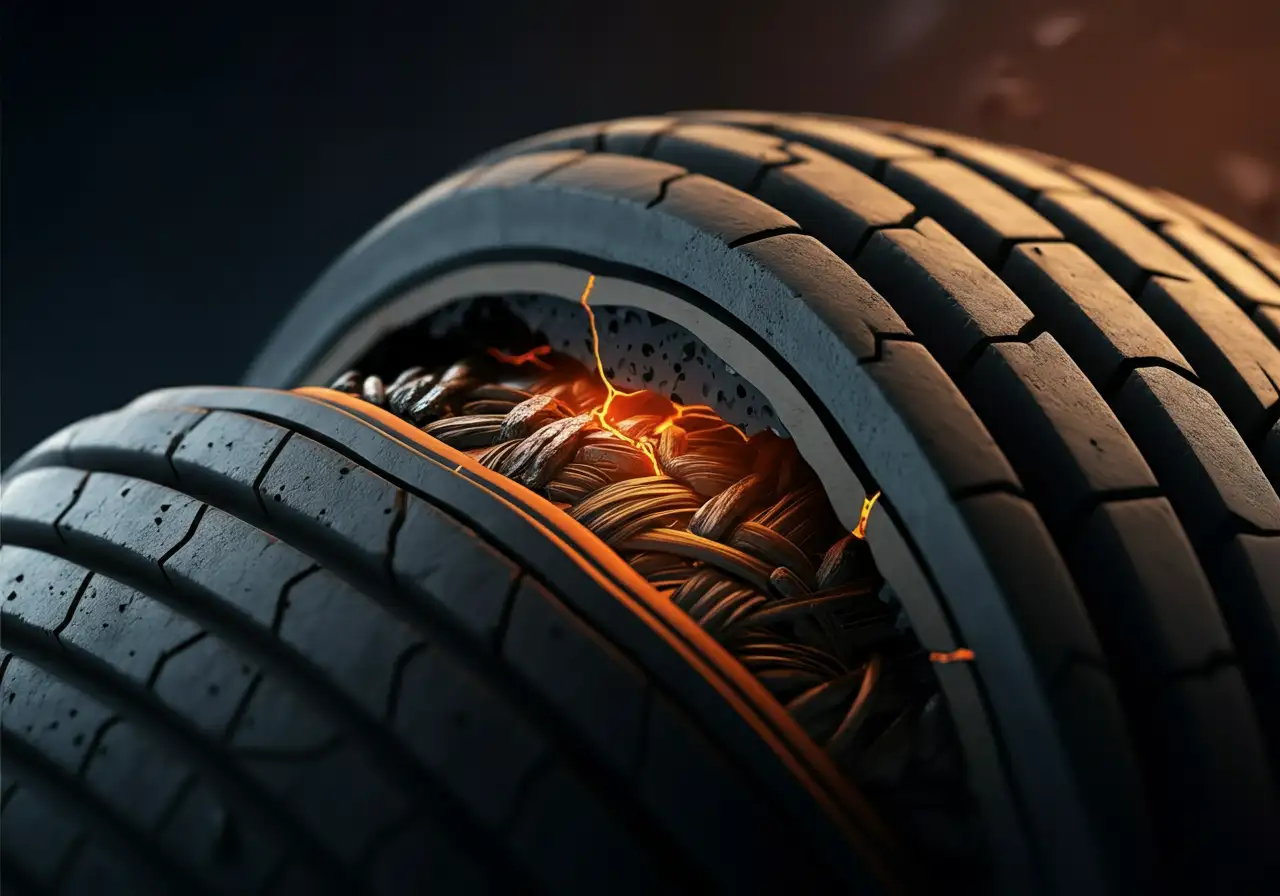
Every time a car brakes suddenly, an airplane lands, or a factory machine runs under intense pressure, one material quietly absorbs enormous stress without falling apart: reinforced rubber. It is used so widely that modern transportation and industrial systems would struggle to function without it. Yet scientists have spent decades debating a surprisingly basic question, why does adding carbon black particles make rubber so much stronger?
The study, headed by engineering professor David Simmons, delved into how microscopic carbon black particles reinforce soft rubber and enable it to survive intense physical tension. The outcomes published in the journal Proceedings of the National Academy of Sciences.
“How is it that we've been using this for 80, 90, 100 years and haven't really known how it works?” Simmons stated. “It's been through enormous trial and error. The tire companies can purchase many different grades of carbon black -- basically fancy soot -- and they just have to use trial and error to figure out what's worth paying more for and what isn't.”
Why black rubber became essential to modern industry
Producers have depended on reinforced rubber for decades because it survives much longer and tolerates pressure far better than untreated rubber by itself. Microscopic carbon black particles are incorporated into the compound to increase longevity, hardness, and resistance against deterioration. The technique also gives tires their recognizable black color. Although the formulation has stayed mostly unchanged for many years, scientists never reached complete agreement about why the process performed so effectively.
One theory stated that the particles formed associated internal networks that strengthened the rubber from within. Another indicated that the particles attached firmly to surrounding rubber molecules, stiffening the surrounding material. Another concept proposed that the particles particularly took space inside the rubber, shifting the way the material stretched under force. Each comprehension spotted part of the picture, but none could completely describe the extraordinary behavior engineers found in real-world materials.
Researchers recreated the material at the atomic level
Because these interactions happen at extremely small scales, direct observation is almost impossible. Instead of depending only on laboratory testing, the researchers utilized advanced computer simulations to reproduce how reinforced rubber behaves internally. Working with USF postdoctoral scholar Pierre Kawak and doctoral student Harshad Bhapkar, Simmons made models containing hundreds of thousands of atoms to analyze the material in motion. The project needed almost 1,500 molecular dynamics simulations. Altogether, the calculations featured almost 15 years of computing time.
“It's not that we literally had a simulation running for 15 years,” Simmons described. “What it means is if you ran a calculation using your laptop for one hour and it used up the whole laptop with six cores, it would be six computing hours. We used USF's large computing cluster with many, many cores for many months.” The team also refined older simulation techniques so the digital models more precisely matched the real shapes and arrangements of carbon black particles discovered in industrial rubber.
The answer came from how rubber responds to stretching
The researchers found that the key is in a property called Poisson’s ratio, which explains how materials change shape when pulled or stretched. Normally, when rubber stretches, it becomes narrower while preserving nearly the same total volume. Introducing carbon black changes that response significantly.
Simmons compared the phenomenon to pulling the plunger of a sealed syringe containing water. Because water strongly resists compression, greater resistance develops as the plunger moves backward. Reinforced rubber responds similarly because the embedded particles stop the material from thinning as freely as it otherwise would. Instead, the rubber is compelled to expand in volume,something it naturally resists. As per the researchers, the material efficiently “fights against itself,” creating a significant increase in stiffness and mechanical strength.
Older theories turned out to be connected
Instead of disproving previous scientists, the new findings indicate those rival theories were actually describing separate aspects of the same mechanism. The study concluded that internal particle frameworks, adhesive interactions between particles and rubber, and space-filling behavior all contribute to the material’s resistance to volume changes during stretching. By merging those mechanisms into a single unified model, the scientists say they created the first comprehensive framework explaining how reinforced rubber genuinely functions.
The breakthrough required years of refinement. Initial versions of the simulations failed to reproduce real experimental observations accurately. The researchers repeatedly modified the models using insights from earlier scientific work until the outcomes finally aligned with observed behavior.
Tire makers could use the findings to design better products
The discovery may eventually help manufacturers enhance tire performance more efficiently.
Engineers have struggled for years with what the industry refers to as the “Magic Triangle” , the difficult challenge of balancing fuel efficiency, traction, and durability. Improving one quality often weakens another, forcing companies into lengthy and expensive trial-and-error development. A deeper understanding of the physics behind reinforced rubber may allow researchers to engineer new tire compounds with greater precision instead of relying heavily on experimentation alone. That could eventually produce tires that endure longer, perform better on wet roads, and improve fuel economy simultaneously.
“The struggle always is to get more than two of the three to be good, and this is where trial and error only gets you so far,” Simmons said. “With these findings, we're laying a new foundation for rationally designing tires.”
Source: ScienceDaily
FAQs:
Q1. What is carbon black?
Carbon black is a fine black powder produced from carbon-rich materials. It is commonly added to rubber to improve strength, durability, and wear resistance.
Q2. Why are most tires black?
Most tires appear black because manufacturers mix carbon black into the rubber compound. The material helps increase durability and extend tire life.