
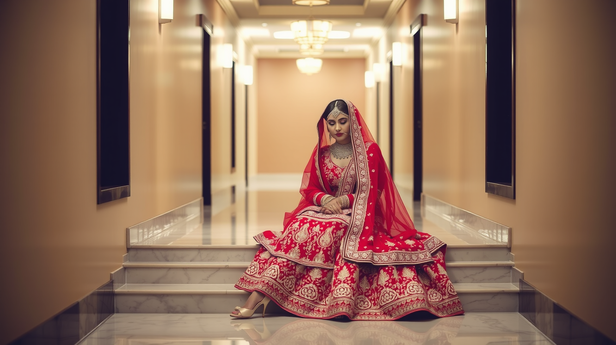
The Moment the Lehenga Stops Feeling Like a Dream
It starts somewhere between the pheras and the first round of family photographs. The lehenga, which felt like a cloud in the trial fitting three weeks ago, has settled into its true weight. A heavily embroidered bridal lehenga, the kind with zardozi work from hem to waist, the kind you spent four months choosing, can weigh anywhere between five and nine kilograms. Nobody says that number out loud at the boutique. They talk about the fall of the fabric and the richness of the thread. They do not say: you will carry this on your hips for eight to twelve hours on the most photographed day of your life.
The skirt is the first thing you stop noticing, because your body has already begun compensating. Your lower back adjusts. Your walk shortens. You stop taking full strides without realising it, because a full stride pulls the fabric taut across the thighs and throws the whole silhouette off. You have become, without anyone telling you, a woman who moves in small careful steps.
What the Dupatta Does to Your Neck by Hour Three
The dupatta is pinned. This is the part the bridal makeup artist handles with twelve pins and a look of absolute concentration, and when she is done, it feels secure. It feels, for the first forty minutes, like it isn't there at all.
By hour three, the pins have begun their quiet work. The dupatta on a bridal outfit is rarely just fabric, it carries embroidery, sometimes mirror work, often a border so heavy it could function as a curtain. That weight is distributed across four or five pins anchored into your hair or your blouse. The tension is constant. It doesn't spike. It just accumulates, the way a headache builds before you've admitted to yourself that it's a headache.
Your neck starts to hold itself at a slight forward tilt to counterbalance the pull from behind. You don't notice you're doing it. The photographer notices, and asks you to lift your chin, and you do, and the moment he looks away, your head drops forward again. This is not bad posture. This is physics.
The Performance of Joy
There is a specific kind of exhaustion that comes from smiling while in discomfort. It is different from ordinary tiredness. Your face knows the difference between a smile that starts in the eyes and a smile that is being held in place by willpower, and after four hours of the second kind, the muscles around your mouth begin to ache in a way that feels almost embarrassing to admit.
You are, after all, supposed to be happy. The wedding outfit was chosen to signal happiness, abundance, the fullness of the occasion. The red or the deep magenta or the antique gold was chosen because it photographs as joy. And you are happy, genuinely, underneath the weight and the pins and the aching arches of your feet inside heels you have worn for six hours on a floor that is either marble or a shamiyana-covered lawn, neither of which forgives a heel.
The performance is not dishonesty. It is something more complicated: the gap between the emotion you feel and the physical state your body is in. You love this person. You wanted this day. Your feet are bleeding slightly at the back of the left heel where the sandal strap has been rubbing since the second hour, and none of these facts cancel each other out.
Hour Six: When the Outfit Becomes the Event
By hour six, the bridal outfit has stopped being something you're wearing and has become something you are managing. The blouse hooks at the back have left two small indentations in your skin. The petticoat drawstring, tied tight enough to keep the lehenga from slipping, has been cutting across your waist at the same point for so long that the skin there is tender to the touch. You know this because you pressed a finger there during a quiet moment in the back room, and it hurt more than you expected.
The jewellery has its own accounting. The maang tikka pulls at the parting of your hair. The nath, if you are wearing one, has been looped around your ear for hours and the cartilage aches. The bangles, which sang beautifully when you moved your hands in the morning, are now just weight on your wrists. You have stopped moving your hands expressively. You have stopped moving more than you have to.
This is the hour when brides disappear into bathrooms for longer than anyone tracks. Not because of the obvious reason, though managing a nine-kilogram lehenga in a venue bathroom is its own ordeal. Because it is the only room where nobody is watching, and you can put your hand on the wall and just stand there for a moment, not smiling, not performing, just being a body that is very tired inside a very beautiful outfit.
What the Weight Is Actually Asking
The bridal outfit in India is not designed for comfort. This is not a critique, it is a description of what the garment is for. The embroidery, the weight, the layers, the jewellery: they are all in service of visibility. The bride must be seen. She must be seen as significant, as adorned, as the centre of an event that two families have spent months and considerable money arranging. The outfit is the visual argument for the occasion's importance.
But visibility is expensive to carry. And the cost is almost entirely borne by the bride, in her body, across the hours of the day, in ways that are never mentioned in the bridal magazine features or the YouTube transformation videos. Those end at the reveal. They end when the bride turns around in the finished look and everyone in the room makes a sound.
What comes after the sound is what nobody films.
The weight of a bridal outfit and the weight of what a bride is expected to feel are not separate things. Both are real. Both are heavy. Both are carried without complaint, because the day is supposed to be one kind of thing, and the body's experience of it is another, and the bride learns, somewhere around hour six, that she will have to hold both at once, the beauty and the ache, and that holding them together, without letting either cancel the other, might be the most honest thing about the whole day.