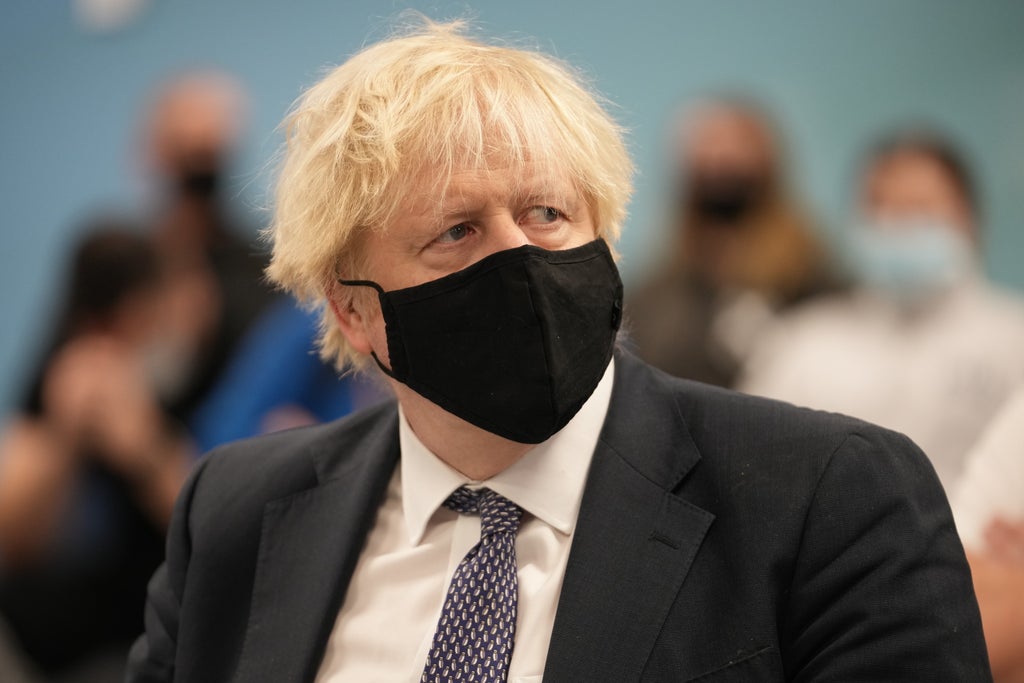
Boris Johnson‘s “Plan B” measures are now in force in England in the hope of limiting the spread of the omicron variant of Covid-19 this winter.
At a Downing Street press conference last Wednesday evening, the prime minister warned that the new strain is “growing much faster” than the delta variant before returning to the air on Sunday to say that the UK’s booster vaccine rollout is being ramped up to see off the threat of a “tidal wave” of infections over Christmas and the New Year.
Cases of omicron could be doubling every two or three days, Mr Johnson said as he announced his new rules to stop the spread, with the UK Health Security Agency warning on Monday that its infection rate could already be up to 200,000 per day.
What are the Plan B rules?
Mandatory mask-wearing - already ordered on public transport and in shops - has been extended to indoor public venues including cinemas, theatres and places of worship but are not yet required in pubs and restaurants.
Exceptions to the mask rule can be made when eating, drinking, exercising or singing, Mr Johnson said.
Guidance to work from home where possible has also returned as of Monday 13 December.
The NHS Covid Pass, which can be obtained via the NHS smartphone app by having two vaccines or a negative lateral flow test, is now needed for entry to nightclubs and other large venues as of Wednesday 15 December.
These health certificates are also required for access to unseated indoor venues with more than 500 attendees and outside where there are more than 4,000 people.
Mr Johnson has indicated that the passes process could evolve as the omicron situation changes, however, commenting: “We will keep this under review as the boosters roll out.”
How long will Plan B rules be in place?
The government has said that its latest measures– which were originally drawn up in September – will be reviewed on 5 January 2022 but, the worse the situation gets, the longer they are likely to be extended.
What about Christmas parties and nativity plays?
Mr Johnson has said Christmas parties and nativities could go ahead but urged people to “exercise due caution” and get their booster jabs.
“The best way to ensure we all have a Christmas as close to normal as possible is to get on with Plan B - irritating though it may be, it is not a lockdown,” he said.
“We don’t want nativity plays to be cancelled, we think it’s OK currently on what we can see to keep going with Christmas parties but obviously everybody should exercise due caution.”
Have the Plan B rules been approved?
Yes. MPs voted in favour on the measures in the House of Commons on Tuesday 14 December.
Almost 100 Tory rebels did break ranks to oppose the government on the Covid Pass, which some consider an infringement of civil liberties, but the rules passed anyway thanks largely to support from Sir Keir Starmer’s Labour Party, which voted broadly in favour after signalling it considered the moves to be in the national interest.
How prevalent is the omicron variant?
On Monday, the UK confirmed the first death from the new variant globally while health secretary Sajid Javid estimated that the rate of omicron infections was already at around 200,000 per day, with the strain expected to become dominant in London imminently.
NHS England meanwhile announced that it will return to its highest level of emergency preparedness, level four national incident, meaning that the NHS response to omicron will be coordinated as a national effort rather than led by individual trusts.
Confirmed Covid cases have since risen to 59,610 in the latest figures, with daily deaths up to 150.
Will Plan B slow the spread of omicron?
Scientists advising the government have said strong measures are needed to slow down the spread of the variant.
Professor Neil Ferguson from Imperial College London, whose data was instrumental to the UK going into lockdown in March 2020, said that “case numbers of omicron are doubling at least every three days, maybe even every two days at the moment, so it’s accelerating very fast”.
He said lockdowns are a possibility and cannot be ruled out but the working from home guidance could help to slow the spread.
“There is a rationale, just epidemiologically, to try and slow this down, to buy us more time principally to get boosters into people’s arms, because we do think people who are boosted will have the best level of protection possible, but also to buy us more time to really better characterise the threat,” Professor Ferguson said.