At midday, strains of the national anthem escaped from Wembley Stadium as the soundcheck accompanied some of the earliest supporters wandering in from the surrounding stations. An ice cream van backed into a spot in the eyeline of children casting their first glances up towards the arch and slid open the window for a bumper afternoon’s take. Touts prowled Wembley Way looking for spares as the numbers grew.
“Ten pound your chequered flags!” Everyone, it seemed, stopped for a selfie in the shadow of the arch and next to an electronic sign welcoming first timers. The women’s FA Cup final has attracted large crowds before – three east Midlands finals between 2007 and 2009 attracted more than 23,000 each – but never before has it been invited to the home of football. There were fans aplenty in the blue of Chelsea and black and white of Notts County, but they were joined by supporters in all colours, here to celebrate this transformative year for the women’s game.
Though it was the London side who had more of the crowd, when the teams were announced before kick-off the loudest cheer came at the announcement of the County captain and scorer of the unfortunate own goal that put England out of last month’s World Cup semi-final, Laura Bassett.
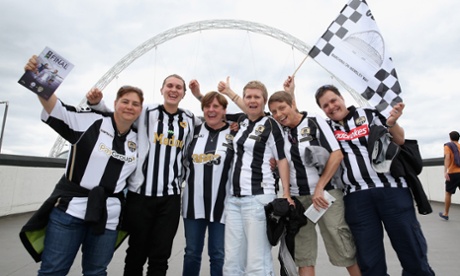
Around 19,000 of the record 30,710-strong crowd bought their tickets after England’s unprecedented victory over Germany in the third-place play-off. People such as Cathy Lucas, a self-described footie nut, who had not seen much women’s football before following England’s success in Canada on television and travelled from Preston to be at Wembley. These are the conversions that the Football Association has long hoped to make: turning fans in to matchday supporters.
Packed in to the lower tier of the stadium, the crowd filled the air with noise, even without the aid of the band that trumpeted intermittently from the south stand. Chelsea fans had not had far to travel, while County, formerly Lincoln Ladies, have consistently attracted some of the Women’s Super League’s highest attendances since their move to Meadow Lane 18 months ago. Crowds across the league are at record highs since the World Cup and there certainly seemed to be more baritone voices in the cheers (and occasional boos - the referees are still referees, after all) than there have been at cup finals in the past.
Previous international tournaments had been supposed to light the blue touch paper on women’s football in this country, but as we all stood back and braced for the bang, the crowds drifted away again – after the north-west hosted Euro 2005, after England’s defeat to Germany in the final of Euro 2009. Now, finally, it seems we have the fireworks. England’s most successful Women’s World Cup is clearly at the heart of this; their trials and eventual third-place triumph won hearts across the globe. The Lionesses have moved from being the sort of team that attracts well-worn post-match platitudes to one that can be backed without attracting accusations of jingoism. Now the game is benefitting from the sense of occasion and recognition bestowed by venue – whether that is the national stadium or BBC One on a Saturday night.

The FA made the most of things, inviting the England manager, Mark Sampson, to be guest of honour and present the trophy. The much-requested bronze-medal walkabout was not possible, but this match was marketed with images of Chelsea’s and County’s England players lined up in national kit, with the words “Rivalries resumed”. At the centre was the Chelsea forward Eniola Aluko and the County goalkeeper, Carly Telford, and so it proved once the match began.
Having started England’s first two matches, Aluko watched much of the World Cup from the bench, but there was no doubt that she would start for Emma Hayes’s side – especially as one of the players to have experienced playing here with England last year and as part of the GB team in 2012.
She had described it as a “unique, out of body experience”, though she seemed comfortable enough out there on the turf. It was her surging runs that brought the match, and Chelsea’s attacks, to life – switching from one flank to the other her directness and speed had County’s backline twisting and turning.
Telford watched Aluko’s first effort into the side-netting and was forced twice to save from her England team-mate, but there was nothing she could do when Aluko turned Sophie Walton and fed the ball to Chelsea’s Ji So-Yun, who placed the ball past Telford at the second attempt.
When Aluko was replaced with nine minutes to go, limping slightly having been just been prevented from causing more havoc the only effective way – painfully – it was to a standing ovation.
Chelsea’s 1-0 win brings them their first silverware. Hopefully they will be the first of many women’s FA Cup winners to lift the trophy as Wembley roars its approval.