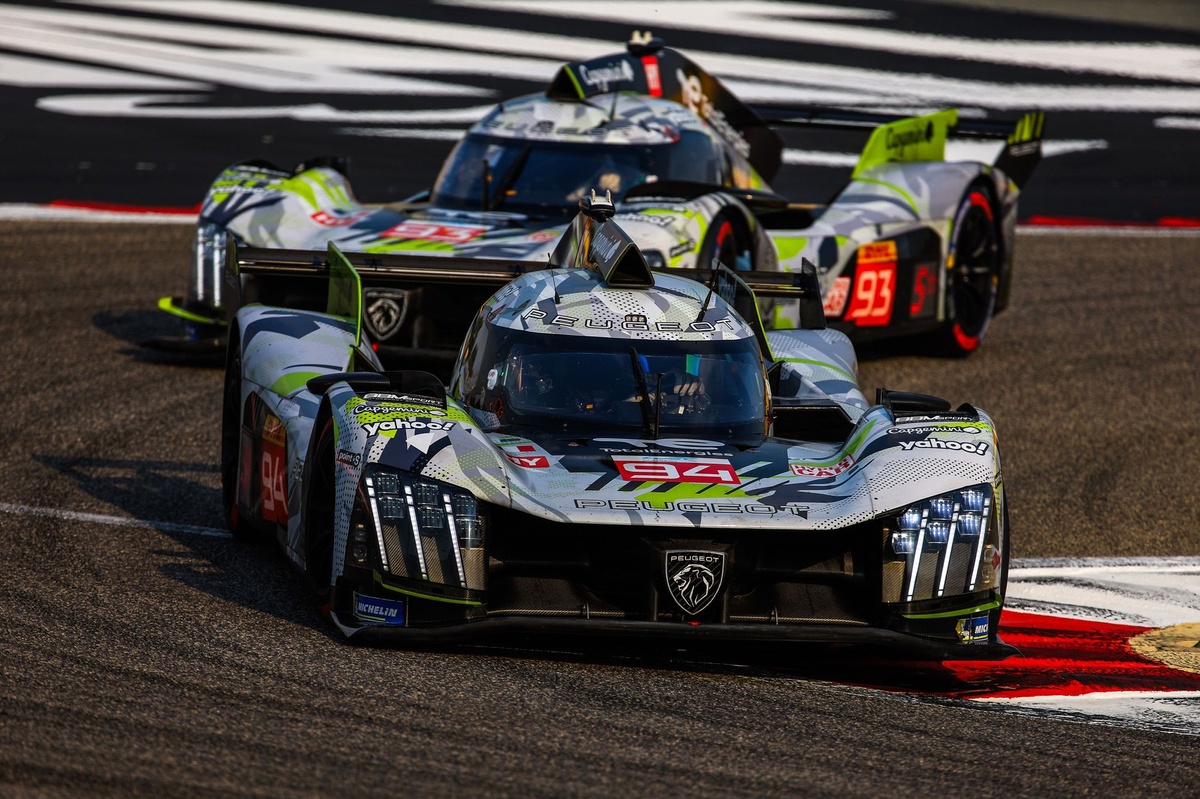
Above all else, Peugeot should be admired. Imagine building a hypercar for a completely different set of regulations that gets drastically altered due to the LMH-LMDh convergence just as the car’s development is finished.
Then overhauling the car completely two years later only to find out that five Evo Jokers weren't enough to catch up to the competition, resulting in continued struggles on track. Still, Peugeot is here to stay.
Analysing the BoP of every single race makes little sense here. For almost the entire season, on tracks with regular, automated BoP, the 9X8 raced with the best possible power-to-weight ratio of 1.981kg/kW in the relevant sub-250 kph range, with only minor alterations at the season opener and the finale.
Far more important is the relative gap to the competitors. At the opener in Qatar, the least favourably-rated hypercar had a gap of 0.128kg/kW to Peugeot's power-to-weight ratio.
By the time WEC reached Fuji Speedway, where Peugeot finally had a realistic chance of winning, that gap had grown to 0.246 kg/kW. So, why did Peugeot require such an immense amount of support from the BoP?
The Curse of convergence
The answer is simple: the Peugeot 9X8 had never been developed for the current set of Hypercar regulations. The 9X8’s original concept featured a 50:50 weight distribution with four identical tyres and nearly permanent all-wheel drive.
Peugeot decided to enter the WEC with an LMH car in late 2019. When the LMDh category was announced in early 2020, Peugeot stuck with the LMH concept, intent on fielding a car without a rear wing and creating a truly standout machine. That decision haunts the factory team up to this day.
It wasn't until the summer of 2021 that the LMH-LMDh convergence was codified in the regulations. By then, the Peugeot 9X8 was already fully developed and had to be completely rebuilt.
A more rear-heavy weight distribution of 48.5:51.5 favored the LMDh cars but was entirely counterproductive to the 9X8’s philosophy.
Furthermore, the introduction of a minimum deployment speed for the hybrid system—initially 150 kph instead of 190 kph for the old model with four equal tyres really destroyed the car’s fundamental philosophy.
It quickly became clear that a major update was needed. However, the 2024 overhaul, which led to LMDh tyre sizes and a small rear wing, could not fix all inherent problems with only five permitted Evo Jokers.
The now-retired Jean-Marc Finot noted Motorsport.com’s German sister publication Motorsport-Total.com at Spa-Francorchamps that the powertrain was a major hurdle, as it had been strictly designed for lightweight construction to achieve the 50:50 weight distribution.
As a result, the lightweight 2.6-litre V6 powertrain had to be made artificially heavier to shift more mass to the rear.
In contrast, the Toyota GR010 Hybrid with its larger 3.5-litre engine was much better suited for adaptation to the new rules. Finot confirmed: "We still have the DNA of the original regulations in this car."
This was evident throughout the 2025 season. At Qatar and Imola, Peugeot was nowhere near the front, managing only two ninth-place finishes.
At Spa-Francorchamps, the LMH performed better, and Peugeot ran with the leading group for a long time. But when the cards came on the table, the team messed up the strategy for the #93, while the #94 retired due to contact with a BMW.
No chance at Le Mans
The unique Le Mans BoP brought a massive shock. The Peugeot 9X8, which had always enjoyed the most favourable rating sub-250 kph, was given a ratio of 2.049kg/kW—the worst of all Hypercar contenders.
Above 250 kph—for once in the season, this ratio is a crucial factor at Le Mans—the 9X8 received the second-worst rating at 2.074 kg/kW.
From Sao Paulo onwards, the BoP gap to the other hypercars widened significantly. It was clear that Peugeot and Aston Martin needed so much help that all other hypercars had to be rated even less favourably, which in turn helped Peugeot.
The breakthrough came at the Circuit of the Americas, where the #94 secured the first podium of the season in the Texas rain.
The Peugeot’s power-to-weight ratio stayed favourable for Fuji. The #93 came within a whisker of the effort’s long-awaited first victory, but this time it were strategically outplayed by Alpine to finish second.
Still, Fuji was the very first race where the 9X8 could have won on pure merit, giving the team a much-needed boost.
For Bahrain, the BoP still looked good on paper, but Peugeot once again fumbled operationally, putting both cars on the wrong strategy after the mid-race Safety Car.
This proves that Peugeot still has room for improvement on an operational level, as strategic errors were a recurring theme throughout the season. Especially with two cars in the hunt, a strategy split at Bahrain would have been the logical choice.
On a positive note, the 9X8 has finally put its reliability issues to rest with the only retirement of the season being courtesy of a collision.
However, it is the perseverance of the Stellantis brand that deserves to be applauded. Other manufacturers might have walked away long ago given the hand Peugeot was dealt by the regulations since 2021. But the Lions remain, and for that, should be given the utmost respect.