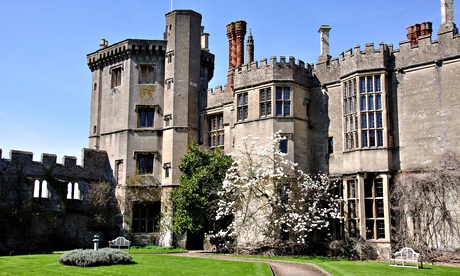
“The stately homes of England! / How beautiful they stand,” exclaimed Felicia Hemans in 1827. Reading Clare Clark’s latest historical fiction, set between 1910 and 1920, you can’t help recalling Noel Coward’s parody: “How beautiful they stand, / To prove the upper classes / Have still the upper hand.” But many were already in ruins. Nearly a century on from Coward, the elite life of the grand estates still grips the popular imagination. Nostalgia for the glamour of privilege, manifest in the success of Downton Abbey, mingles with schadenfreude as the toffs get what’s coming to them.
Clark’s fictional Ellinghurst, populated by a family at odds with itself and fraught with secrets, recalls the houses in Kazuo Ishiguro’s The Remains of the Day, Ian McEwan’s Atonement and Alan Hollinghurst’s The Stranger’s Child. As a great-war novel, it shares territory with Pat Barker and Helen Dunmore. But its contrived romance plot renders the story less strikingly original than Clark’s acclaimed debut, 2005’s The Great Stink, exploring noxious subterranean secrets in the bowels of the London sewerage system, or her 2010 novel Savage Lands, set in 18th-century Louisiana.
What will become of Ellinghurst in the postwar world? Does it face demolition or abandonment like so many ancient houses in the early 20th century? With its “castellated bastions and turrets” and “vast ivied walls”, Ellinghurst is actually a phoney. The Victorian capitalist Jeremiah Melville, cotton magnate, adapted an original manor into a Gothic castle, “with minstrel’s gallery and towers with arrow slits”. This fake medievalism includes a folly in which the pampered 20th-century Melville heir, Theo, upon whom the estate is entailed, has his “private fiefdom”. The tribe’s grandiose living stalls as the Melvilles face the heir’s death, the abdication of the servant class, women’s enfranchisement and death duties. What is the answer?
The marriage of daughters, to breed new male heirs, would do the job, as paterfamilias Sir Aubrey explains: “You will raise your sons at Ellinghurst and they shall inherit in their turn. The Melville line will continue.” But Jessica is vampish and fiercely frivolous, while Phyllis is intent on a meaningfully modern life. She replies to Sir Aubrey’s ultimatum, “I mean to be an archaeologist. I don’t intend ever to marry.” The sisters constitute a somewhat allegorical pair of opposites.
Narrative focus is divided between Jessica, sexually predatory and privately lost, and Oskar Grunewald, the son of a dead German artist. Godson of the Melvilles, Oskar holds an anomalous position as a household dependant. A mathematics genius, he’s obsessed with the developing science of relativity: from earliest youth, “Oskar could not explain how he felt about numbers except to say that they were his friends”. This is novel and interesting, though the intermittent physics lessons Clark offers the reader seem laboured. Oskar, however, carries the novel’s truest insights, recognising for instance the way Theo’s mother had “touched Theo … as if he was a magnet and her fingers made of iron filings”. This single observation does more to realise Evelyn’s subsequent anguish of bereavement than the pages devoted to her imploring and credulous attendance at seances.
When Jessica hurls a book at Oskar, who’s hiding with an encyclopedia in a window seat of Ellinghurst, she repeats, with a twist, a leitmotif in Jane Eyre, by denying the rights of a forlorn dependant. “It’s my book,” she claims, “just as much as Father’s.” But it isn’t. She’s a girl. All three young people at Ellinghurst are without entitlement. Hope lies in Oskar’s intellectual calibre and intuitive empathy. Phyllis, his counterpart, feels the prevailing emotional and physical cold, and Oskar lends her his scarf. When she balls it up and hands it back, it’s “warm, like something alive” from contact with her skin. It’s a lovely moment, and I wished for more of them.
We That Are Left carries ponderous historical themes and marches along burdened by their weight. Progressive in its resistance to archaic patrilinear customs, the novel is conservative in its devotion to a country house that seems more a stage set than a thing of beauty or value. Personally, I wouldn’t have grieved to see Ellinghurst demolished.
• Stevie Davies’s Awakening is published by Parthian. To order We That Are Left for £13.59 (RP £16.99), go to bookshop.theguardian.com or call 0330 333 6846.