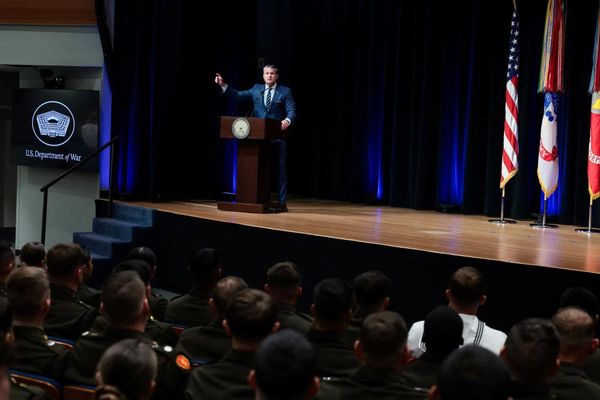
HOUSTON — Former Defense Secretary James Mattis offered a sobering take Monday on the Strait of Hormuz, criticizing the Trump administration for what he saw as a failure to think strategically about Iran.
Why it matters: The CERAWeek conference here has been clouded by uncertainty over the future of a conflict that's bringing historic supply disruptions — and upending industry planning in the process.
- "We're in a tough spot, ladies and gentlemen, and I can't identify a lot of good options," the retired Marine general told attendees at the CERAWeek by S&P Global conference.
Driving the news: If President Trump declares victory and pulls back the U.S. military, Iran "would now say we own the Strait," said Mattis, who served in the president's first term before resigning in 2019 after the commander-in-chief reportedly rebuffed his advice on Syria.
- "I think that you could see a tax for any ship going through — something completely unsustainable in the international market," Mattis said.
- The overall U.S. and Israeli strategic objectives for Iran remain "murky," he said.
- "The Americans are fighting in a markedly limited war, and I think that what we're seeing is a situation where [airplane] targetry never makes up for a lack of strategy," he said.
Threat level: Mattis also explained why naval protection of ships would prove a huge challenge and leave major vulnerabilities.
- Even a degraded Iran retains the ability to attack ships from shore along a vast stretch of coastline in the wider region, he said.
- "If you look at the Texas Gulf Coast, that's about 367 miles, that gives you an idea of how difficult this will be for the U.S. Navy to try and protect ships in that shipping lane, 600 miles down the Gulf, 100 miles through the Straits and then out into the water," Mattis said.
- "And they've got anti-ship cruise missiles that could be fired off the back of a pickup truck that can go 100 miles. So there's the problem."
Zoom out: Oil prices eased Monday after Trump backed off threats to strike Iranian power plants.
- Trump also said his envoys had been negotiating with a senior Iranian official and claimed the parties agreed on many points.
- Brent crude remains quite high, but is trading just below $100 per barrel Monday evening after closing last week at $112.
- Oil was roughly $73 right before the strikes on Iran started three weeks ago, and even that price reflected an expectation of hostilities.
Brookings Institution vice president Suzanne Maloney, who directs its foreign policy program, agreed that the U.S. aim of toppling Iran's leaders and encouraging regime change has proven exceedingly difficult.
- "I think anyone who knows Iranians, knows the country, has tremendous hope and optimism for Iran, but unfortunately, this regime has been quite good at survival," said Maloney, who appeared on the panel with Mattis.
The bottom line: Tackling the energy crisis will require that the U.S. work with allies, Mattis and Maloney said.
- "The bottom line is, there is not a problem associated with this current loss of energy supplies that can be solved by any one country," Mattis said.
- "So if you start with that strategic appreciation of the situation, you can see the role of allies, whether it be on the military side, economic sanctions side, to do some of the things that would force Iran to the negotiating table."