“I used to think, ‘Am I going to be doing this in 10 years’ time, or 20?’” says John Lawton, 69-year-old singer with 70s hard-rock giants Uriah Heep, with whom he still occasionally performs between touring the world as a solo artist. In fact, he’s as busy as ever. “You make provisions that it will all be over. Then you find that you are still doing it,” he says. “Not because you have to, but because you want to.”
The Halifax-born “adopted Geordie” is in good company among pioneering singers rocking on towards their 70s. Ozzy Osborne is 66, AC/DC’s Brian Johnston and Alice Cooper are both 67, and Deep Purple’s Ian Gillan turns 70 this week. Motörhead’s Lemmy reaches the same milestone in December, with no discernible dip in packed-out houses. As Saxon frontman Biff Byford, 64, puts it: “The rock retirement age is 106. What else are we supposed to do? Sit in wicker chairs?”
“If you don’t act old, you don’t feel it,” agrees 67-year-old Bob Catley, a genial Brummie who still fronts the formerly arena-filling and still popular progressive hard rockers Magnum. “I’m Eighteen – to quote Alice Cooper – till I die.”
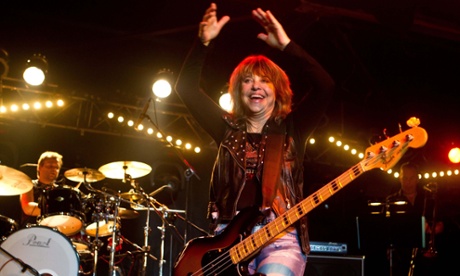
Suzi Quatro was 23 when her glam-rock No 1 single Can the Can made her an international star in 1973. “I chose the heaviest instrument (the bass) to carry and the hottest clothing (leather jump suits) to wear,” she points out, “but I do 60 shows a year at 65. The day I turn up in my leather jumpsuit, shake my ass and there is silence, I’ll know it’s time to stop. Thank God, it hasn’t happened.”
Lawton admits he did get to a stage where he thought, “Should I be really standing like this, flaunting the tight stuff?” and stopped wearing leather because “it looks silly at 69. But other musicians will tell you the same. There’s kids who have grown up listening to their parents’ music and you think, ‘Maybe this is what they want to see.’”
Few of the big names are doing it for the money, although Byford admits it helps “if you want a nice lifestyle”.
Catley remembers the thrill of his first gig as a teenager. He was told his band were “better than the Beatles” and given a bar of chocolate. Not long after that, as frontman of Smokestacks and Capitol Systems, he was playing at festivals with the likes of Pink Floyd and then heading – “sleepy and bedraggled” – into work the next day.
“My boss said, ‘Lad, it’s time you decided what you want from life’,” he chuckles. “I looked at him and thought, ‘I don’t want to be you when I’m 50, so I’ll take my chances with the band.’ I’ve made my living in music ever since.”
Similarly, Wishbone Ash founder Martin Turner combined hard rocking with delivery driving, until he was so tired that he crashed the van. “The policeman told me that if I hadn’t hit a parked car, I’d have driven into a mother and child,” he remembers. “That did my head in. I realised I wasn’t Superman – I couldn’t do both things.”
After taking a year to recover from “the shock of blood and grinding metal”, Turner turned professional. He now tours the world as a solo artist, performing the band’s songs. “I thought I’d always regret it if I didn’t give music a try,” he says. “I now accept that this is what I was born to do.”
All agree that performing hard rock for two and a half hours – as Turner and Quatro often do – isn’t too difficult if you stay fit, and that playing live is a workout in itself. Quatro jogs and Byford goes fell running, but Catley maintains his 28in waist with nothing more strenuous than “walking to the pub”.
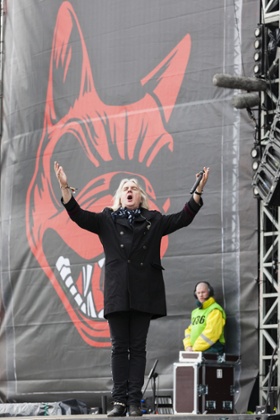
The hardest aspect is the singing. Older rockers tend to shift down a semitone when they start struggling to hit the high notes they managed in their 20s. “My manager suggested changing my tuning from E to E flat,” reveals Turner. “It was a revelation.” Quatro reveals that a stint in theatre with Annie Get Your Gun in the 1980s did wonders for her longevity. “I don’t know any other rocker who walks around with a tape doing vocal warm-ups,” she says. “It’s weird, isn’t it?”
Byford claims that he sings better now than in 1980, when Saxon’s platinum-selling Wheels of Steel set the benchmark for the new wave of British heavy metal. “When you’re 20, running around screaming your bollocks off isn’t good for your throat,” he explains. “As you get older and realise this is going to be your living, you develop technique and look after your voice.” Since he stopped smoking 20 years ago, he says his vocals have gone “to a different place”. Turner has been puffing for 50 years, but says his voice benefits from life experience – notably a gruelling legal battle with a former bandmate that left him bankrupt after selling millions of albums: “You can wrap yourself round the lyrics and emotions in a way that you couldn’t do in your 20s.”
It’s no coincidence that, where peers have retired or even died, most of the more evergreen stars have shunned the serious excesses of the rock’n’roll lifestyle. Byford says Saxon “partook a little” in drugs in their unit-shifting heyday, but they “never really took hold”. In 1976, when Wishbone Ash were huge, Turner would consume “two thirds of a bottle of whiskey a day, with Bolivian marching powder” but quit after contracting hepatitis. Now he doesn’t even drink before going on stage. Catley allows himself a medicinal Jack Daniels: “Then it’s, ‘Death to false metal! Tally ho! Off we go!’”
Lawton, whose drug now is the adrenaline of performing (he has also reunited his pioneering doom-metal band Lucifer’s Friend), tells a familiar story of a working-class lad turned rock star. When he fronted the Deans in working men’s clubs in North Shields aged 15, the band would be on before the bingo. Later, girls stared, drink came in and things “got wilder”.
“I’ve had days when I’ve woken up and thought, ‘What the hell did I do last night?’ he admits. “But I’ve never driven a car into a swimming pool. I tried coke once in 1973 and vomited all night. I’ve seen how other musicians look before and after a trip to the loo and thought, ‘I never want to be like that.’”
During his first stint with Uriah Heep between 1976 and 1979, there were some occasions when he’d drink a bottle of whiskey before a gig and another in the bar, but he stopped when it affected his singing. “I thought, ‘I’m doing a job that thousands would give their right arm to do; either do it properly or not at all.’”
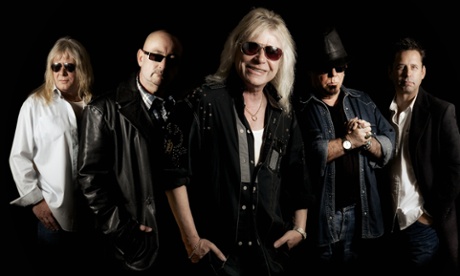
He retired once, nine years ago, when his doctor told him his blood pressure was so high that he would die on stage. After taking a year off, an offer to play in Russia came in and he’s been touring ever since, with his blood pressure carefully monitored. Like Lemmy, he has diabetes.
“I was a fool for stupid things like sugary sweets and Coca-Cola,” he explains. “That year off brought me back to normality. Now I’ll just have the odd biscuit. I know it’s not very rock’n’roll.” He can laugh about it, but he tells a humbling story about a singer friend who can only manage two songs a night because of emphysema. “But he doesn’t give up, because he loves it.”
These stars are all carrying scars from a lifetime of hard rocking. Turner has hearing problems; Byford has two cracked vertebrae, “probably from headbanging”; Quatro a fused backbone from carrying the bass and calluses, “which isn’t very feminine”.
Three years ago, she fell from a plane carrying her gear and broke her wrist and knee. “I had to learn how to walk and play the bass again. It could have ended my career, but now I’m better than ever.”
Travel remains gruelling. “When I found myself having to get up at 4am to do a Bulgarian festival, I asked, ‘Why am I doing this?’” admits Lawton. “But then I walked out on stage, on cliffs overlooking the Black Sea – an amazing feeling. I thought, ‘This is why I’m doing it.’”
Catley similarly relishes his autumn years: the gig, the communal experience of performing to longtime followers and their children, and the breakfast and newspapers the morning after. “I like being me. I wake up and think, ‘I’m in Magnum!”
Nor will Biff Byford give up Saxon lightly. “When we’re on it,” he says, “we’re still a force to be reckoned with.” In the 80s, he described his lifestyle as one of “motorbikes, freedom, fast cars and loose women”. And now?
“Well, I’m a married man with children, but my outlook’s still the same,” he insists. “I don’t wear trousers so tight I have to gaffa tape my testicles any more, but it’s all about rebellion and I’m still young at heart. I’m getting a motorcycle again, actually. I’m going to ride it on stage.”
• Saxon’s 21st studio album, Battering Ram, is out on 16 October on UDR. Martin Turner plays Under the Bridge, London SW6, on 5 September, then tours.