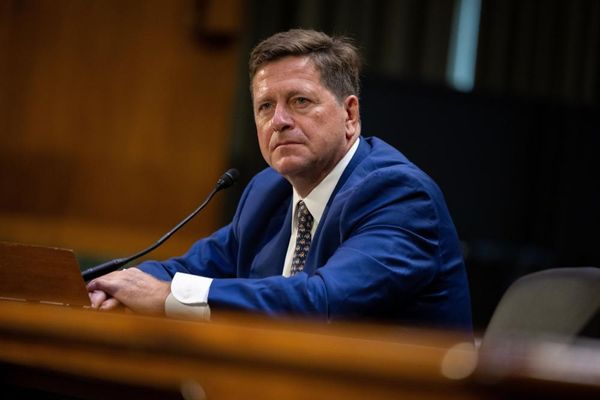
The S&P 500 and Nasdaq closed down by more than 1.0 per cent on Wednesday, as traders bet the Federal Reserve's next move would be a rate hike after new Fed Chair Kevin Warsh highlighted the need to tame inflation and other policy makers projected rising interest rates later this year.
The Fed left rates unchanged as expected, but new quarterly projections showed nine central bank officials expect at least one rate hike by the end of 2026 to combat higher inflation. The policy statement removed previous language that had flagged the likelihood for rate cuts this year.
In his first meeting as Fed Chair, Warsh told reporters the central bank would deliver on price stability. Breaking with past practices by Fed chiefs, Warsh did not submit an interest-rate-path projection as part of quarterly forecasts.
Policymakers had been widely expected to hold interest rates unchanged at the 3.5-3.75 per cent range as they wrestled with inflation pressures from the oil-price spike during the Iran war.
After the meeting, short-term US interest-rate futures were pricing in a bigger chance that the Federal Reserve will deliver a rate hike as soon as September than opt to keep rates where they are, according to CME Group's FedWatch tool. Bets that rates would hold steady by year-end were around 13 per cent versus 40 per cent on Tuesday.
"There was clearly a hawkish tilt to the Fed's statement and Chair Warsh's comments at the press conference. The main takeaway, in my opinion, is the Fed's focus on the commitment to deliver price stability and the commentary about inflation," said Michael James, managing director and equity sales trader at Rosenblatt Securities.
Warsh also talked about a "new chapter" for the Fed and announced a wide-ranging project to review key aspects of central bank policy making. He said he would like financial markets to price securities based on their own reading of economic data rather than trying to price for what they think central bank officials think.
The Dow Jones Industrial Average fell 507.12 points, or 0.98 per cent, to 51,492.55 after two straight sessions of record-high closing levels. The S&P 500 lost 91.25 points, or 1.21 per cent, to 7,420.10 and the Nasdaq Composite lost 354.69 points, or 1.34 per cent, to 26,021.66.
All of the S&P 500's 11 major industry indexes closed lower after the meeting. Communications services was the leading laggard with a roughly 3.0 per cent loss. The top performer was industrials, which finished down 0.1 per cent. Regional banks underperformed large banks with the KBW Regional Banking index finishing down 1.8 per cent compared with a 0.2 per cent drop for the S&P 500 bank index.
Rosenblatt's James noted that regional banks would be hurt more by higher rates. He also pointed to a 2.3 per cent decline in the State Street SPDR S&P 500 homebuilders ETF as higher rates also tend to put pressure on housing.
The Cboe volatility index finished up 2 points at 18.44 for its biggest one-day increase in four days.
Stock moves had been muted ahead of the Fed meeting. Wall Street's main indexes had rallied sharply from Thursday through Monday as oil prices fell after President Donald Trump announced a preliminary US-Iran peace deal. Oil prices edged back up on Wednesday after Trump said the agreement with Iran was not final and that the war could resume if he is unsatisfied.
Earlier in the day, economic data showed US retail sales increased more than expected in May, with households purchasing more cars and other vehicles even as they paid higher prices for gasoline.
In individual stocks, shares of Elon Musk's SpaceX closed down 4.9 per cent, in the space and AI company's first decline since its market debut on Friday.
CME Group slipped 3.5 per cent after the exchange operator said its CEO, Terry Duffy, will step down on March 1, and transition to the role of executive chairman.
Shares of Allbirds soared 39 per cent after the footwear maker-turned-AI company changed its name to Smartbird and appointed former Amazon executive Nadia Carlsten as CEO.
Declining issues outnumbered advancers by a 2.62-to-1 ratio on the NYSE, where there were 282 new highs and 131 new lows. On the Nasdaq, 1,778 stocks rose and 3,131 fell as declining issues outnumbered advancers by a 1.76-to-1 ratio.
The S&P 500 posted 27 new 52-week highs and 18 new lows while the Nasdaq Composite recorded 86 new highs and 117 new lows.
On US exchanges, 23.66 billion shares changed hands compared with the 21.07 billion average for the last 20 sessions.