
MARGAO: Several prominent environmental activists have expressed their disapproval over the absence of a proper khazan management plan in the draft Coastal Zone Management Plan (CZMP). In the written submissions over the draft, the activists have sought for a plan to protect and conserve khazan lands, which are core to Goa’s food security and are highly biodiverse.
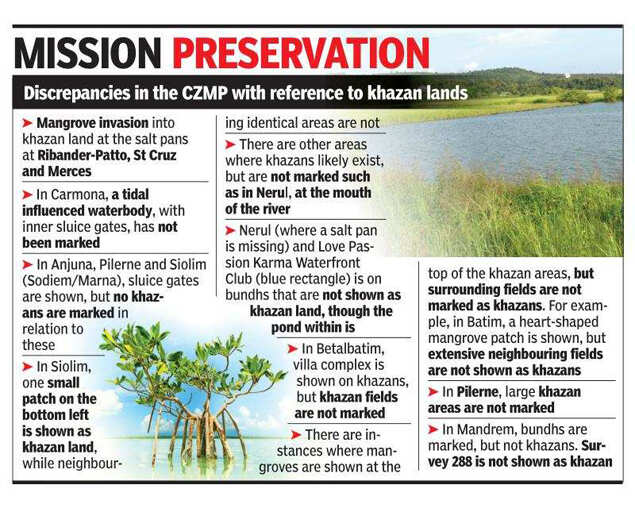
“The representation of the khazan system in the draft CZMP is wholly deficient and unacceptable,” Goa Foundation’s Claude Alvares said in his submission. “As for a khazan management plan, none exists. In this respect, the CZMP is a failure.”
He said that khazan structures that provide shelter, food and serve as nesting sites for wildlife are inaccurately marked as mangroves when they are actually traditionally khazan land.
“This diminishes the value of khazans as habitats for these species and reduces the incentive to preserve these lands from an ecological perspective,” Alvares said in his submission.
He said that khazans, which have been flooded due to breaching of bundhs, have not been mentioned in the plan, but are marked as regular khazan lands/mangroves in the CZMP maps.
Alvares said that while a certain number of sluice gates have been disclosed in the plan, minor (inner) ones have been left out. As a result, he said, large areas of khazan lands around these inner sluice gates haven’t been marked. He also made a case for an inquiry into why the water resources department (WRD) hasn’t mapped certain survey numbers while developing the khazan maps in certain areas. “For example, survey number 288 in Mandrem is reported to be khazans, but this is not marked in the CZMP. There are other examples of khazan areas left out as well, in Carmona, Cavelossim, Orlim, Candolim and Anjuna,” he said.
Alvares said that the government should take steps to ensure that the khazans be inscribed as a Globally Important Agricultural Heritage System (GIAHS)
In their joint written submission, Arturo D’Souza, Elsa Fernandes, Gabriella D’Cruz and Hyacintha Aguiar said that khazan water bodies (poiem) beyond the high tide line (HTL) in every village have to be zoned under eco-sensitive zone CRZ-IA “as they are critical to the existence of the other CRZ-IA components of the khazan ecosystem like mangroves, salt marshes, etc”.
“All khazan water bodies should be clearly indicated with a distinct colour code and listed in eco-sensitive areas, which presently in some cases are completely missing and in some cases, show a lot of ambiguity in their boundaries, extent and colour code across various village maps,” they said.