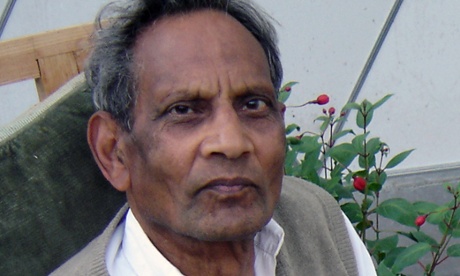
My father, Virén Sahai, who has died aged 81, was a distinguished architect with a passionate concern for improving standards in design and the built environment.
Virén was born in Shahjahanpur in Uttar Pradesh, India, to Uma and to Girwar, an economist. He began cultivating his sharp mind and healthy disrespect for unthinking authority at an early age. He was particularly unimpressed by an English teacher who rigidly insisted on the rote learning of Wordsworth’s Daffodils without having any idea what a daffodil was.
After leaving school, he worked as a draughtsman in Delhi and then in Rangoon, Burma. He saved up for the passage to Britain, where he arrived in 1955 with nothing but a letter of introduction to an architectural practice in London. He worked during the day and finished his architectural training in the evenings. Once fully qualified, he worked for many of the leading lights of British architecture, including Edwin Maxwell Fry and Jane Drew.
Between 1974 and 1987 Virén was regional architect for the Southwestern regional health authority, where he tried to raise design standards and challenge the blinkered thinking of senior management. Based in Bristol, he co-founded the city’s Centre for the Advancement of Architecture, a not-for-profit organisation that champions better buildings and which continues today as the Architecture Centre. In his job he contributed to the design of hospitals throughout the south-west and in 1985 was appointed OBE for his work.
His next move was to become head of design at Cambridgeshire county council, where he was instrumental in the design of many buildings, including Hinchingbrooke House Performing Arts Centre in Huntingdon. In 1993 he also became chairman of Cambridge Urban Forum, which lobbied for improved building standards and planning in Cambridge.
Moving to England opened new cultural horizons for Virén. He was deeply moved by European classical music and artists such as Henry Moore and Henri Matisse. He became an accomplished artist in diverse media, with one-man shows in Paris, London, Oxford and Cambridge. Although he initially immersed himself in abstract expressionism, he later moved to greater realism and sought to incorporate aspects of his Indian heritage into his art. He became particularly accomplished at line drawings, and his pictures were frequently used in publications, including his own book, Discovering a Historic City – Cambridge (1994), which featured drawings of Cambridge architecture.
Outside his rich intellectual pursuits, Virén loved good food, cricket, the Guardian, Radio 3 and good company. He met my mother, Ingrid (nee Darré), a nurse who was born in Germany and moved to London in the 1950s, on a boat crossing the Channel. They were married in London in 1966.
He is survived by Ingrid, by myself, and his grandchildren, Liam and Zara.