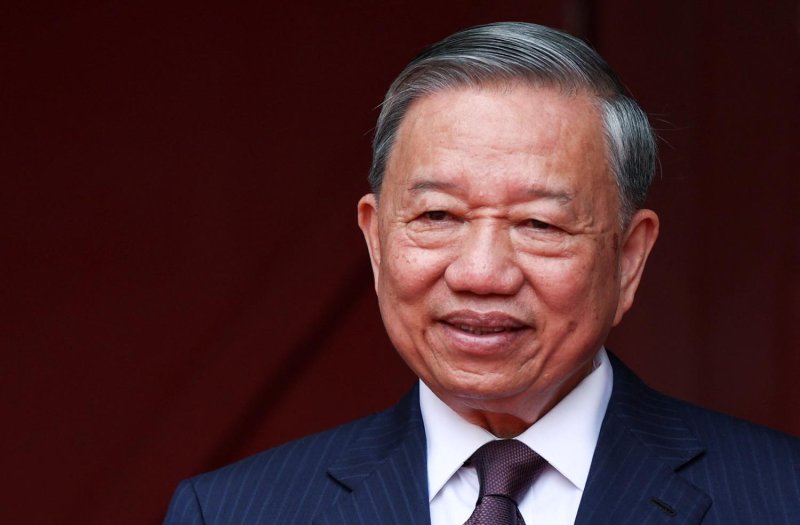
Tomorrow, Vietnam's President To Lam is expected to visit Thailand at a particularly important moment in bilateral relations. The two-day visit comes as Vietnam and Thailand commemorate the 50th anniversary of diplomatic ties, which is a milestone that reflects not only the remarkable transformation of bilateral relations but also the increasing strategic relevance of the partnership as the Association of Southeast Asian Nations (Asean) navigates heightened great-power rivalry, regional instability, and emerging non-traditional security challenges.
Few relationships in Southeast Asia have evolved as dramatically as that between Vietnam and Thailand. Once divided by Cold War tensions and opposing geopolitical alignments, the two countries have gradually transformed their relationship into one of Asean's most dynamic and substantive bilateral partnerships.
A major turning point emerged in the late 1980s when Thai Prime Minister Gen Chatichai Choonhavan advanced the vision of turning Indochina "from a battlefield into a marketplace", signalling Thailand's shift from confrontation towards reconciliation and engagement with its neighbours, including Vietnam.
Since the establishment of diplomatic relations on Aug 6, 1976, Vietnam and Thailand have steadily progressed from cautious engagement to strategic cooperation, culminating in the elevation of ties to a Comprehensive Strategic Partnership in 2025, the highest cooperation framework Vietnam currently offers to its foreign partners.
The upgrading of bilateral relations reflected a convergence of strategic interests, deepening political trust, and growing economic interdependence between two of mainland Southeast Asia's most important economies. Today, both countries increasingly view one another not simply as neighbours, but as indispensable regional partners amid intensifying geopolitical competition and regional fragmentation.
Recent developments, including border tensions between Thailand and Cambodia, cybercrime networks operating across mainland Southeast Asia, and growing maritime security concerns, have further highlighted the need for stronger regional coordination and political trust. For both Hanoi and Bangkok, strengthening bilateral cooperation is becoming not merely a diplomatic option, but a practical strategic necessity.
Political trust remains the foundation of the relationship. The resumption of the Joint Cabinet Retreat mechanism in 2025, after a decade-long interruption, signalled both sides' determination to elevate cooperation to a new level. The visit by the Vietnamese leader is expected to further deepen the Comprehensive Strategic Partnership through concrete initiatives and long-term coordination mechanisms.
Economically, Vietnam and Thailand have become deeply interconnected. Bilateral trade surpassed US$22 billion (716 billion baht) in 2025, making Thailand Vietnam's largest trading partner within Asean. Thai investment in Vietnam has also accelerated rapidly, particularly in energy, retail, logistics, industrial estates, and food processing. Vietnam continues to emerge as one of Southeast Asia's most attractive manufacturing and investment destinations.
Yet the relationship is no longer defined solely by trade figures. Increasingly, both sides are attempting to align their long-term development strategies.
Vietnam's ambitions for industrial modernisation, digital transformation, and green growth complement Thailand's National Strategy 2018–2037 and its efforts to revitalise economic competitiveness under the Thailand 4.0 agenda. Renewable energy, digital economy cooperation, electric vehicles, logistics connectivity, and supply chain resilience are likely to become major pillars of future bilateral cooperation.
Connectivity is another promising area. The growing number of direct flights, expanding tourism flows, and enhanced subregional transport links are bringing the two societies closer together. Both countries also stand to benefit from Thailand's proposed "Six Countries, One Destination" tourism initiative connecting mainland Southeast Asia.
Importantly, Vietnam and Thailand increasingly share common strategic concerns within Asean. Bangkok and Hanoi support Asean centrality and seek to preserve regional stability. Cooperation in Mekong subregional frameworks, maritime security, cybercrime prevention, and other non-traditional security issues is becoming increasingly important.
As middle powers in Southeast Asia, Hanoi and Bangkok recognise that closer coordination strengthens Asean's collective resilience, not only bilateral interests. This coordination is likely to become even more significant as Vietnam prepares to host Apec 2027 and Thailand assumes the Asean chairmanship in 2028, providing both countries with important opportunities to shape regional agendas and reinforce Asean-led multilateral cooperation.
At the same time, Thailand's pursuit of membership in the Organisation for Economic Co-operation and Development reflects Bangkok's broader ambition to strengthen international trade integration, improve governance standards, and attract higher levels of foreign investment, creating additional opportunities for economic coordination between the two countries.
The 50th anniversary of diplomatic relations, therefore, offers an opportunity not merely for celebration, but for strategic reflection. The Comprehensive Strategic Partnership must now move beyond declarations towards practical implementation.
As Southeast Asia navigates an increasingly turbulent geopolitical landscape, stronger Vietnam-Thailand relations will not only benefit the two nations. They may also serve as an important stabilising force for the broader region in the decades ahead.
Dang Trung Dung is a PhD candidate at the International Relations Diplomatic Academy of Vietnam, a public research university located in Hanoi, and an administrative unit under the management of Vietnam's Ministry of Foreign Affairs.