Welcome to the Tuesday, July 14, 2026, Brew.
By: Briana Ryan
Here’s what’s in store for you as you start your day:
- USDA releases SNAP error rate data that could affect state cost-share
- Colorado's pre-2028 redistricting measures blocked, but mid-decade redistricting potential continues in three other states
- Five candidates are running in the Aug. 4 Democratic primary for Missouri’s 1st Congressional District
USDA releases SNAP error rate data that could affect state cost-share
On June 24, the U.S. Department of Agriculture (USDA) released fiscal year 2025 (FY25) payment error rate data for the Supplemental Nutrition Assistance Program (SNAP). This was the first update of payment error data since the One Big Beautiful Bill Act (OBBBA) established a cost-share system based on this data, and the first year of data that may determine the share of benefit costs that states must pay beginning in 2028.
Payment errors occur when SNAP benefits are issued incorrectly, either to an ineligible household, in the wrong amount, or based on misapplied eligibility rules. The OBBBA, which President Donald Trump (R) signed into law in 2025, established a cost-share system for SNAP benefits, under which states must pay a share of benefits based on their payment error rate. Beginning in fiscal year 2028, states will be required to pay a share of SNAP benefit costs if their program error rates exceed 6%. Previously, the federal government has paid for the entirety of SNAP benefit costs.
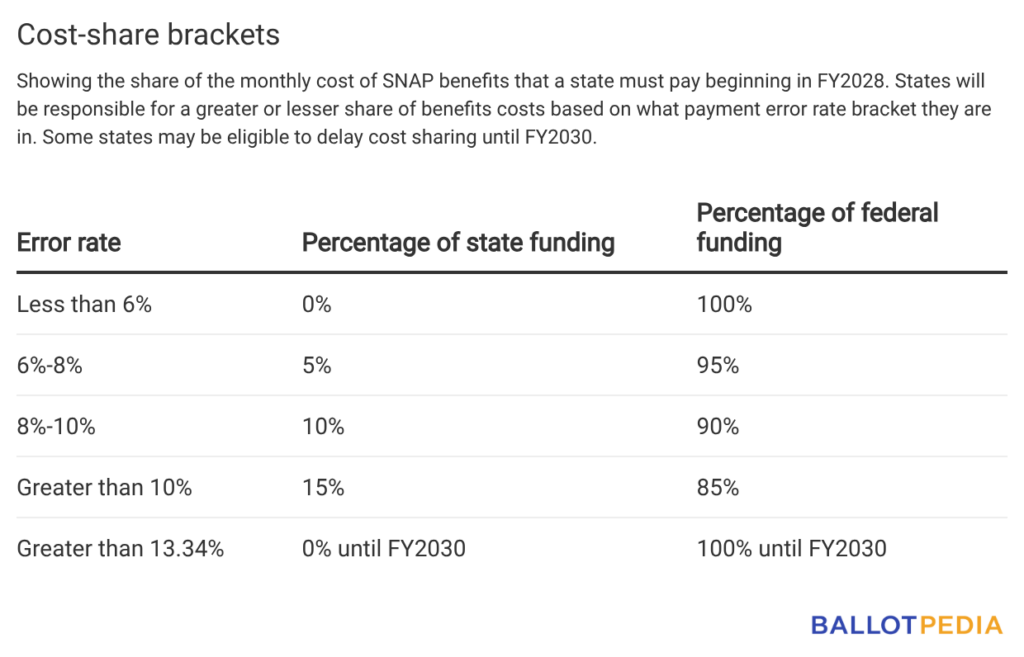
For FY28, states will be able to choose to use their 2025 or 2026 error rate to determine their cost-share. Starting in FY2029, the cost share will be calculated using the rate from three years prior (e.g., error rate from 2026 determines cost-share in 2029). States with error rates from 6%-8% will pay 5% of benefits, states with 8%-10% will pay 10% of benefits, and states with error rates over 10% will pay 15%. For states with error rates under 6%, the federal government will continue to pay all of SNAP benefits. For states with exceptionally high error rates (where the rate × 1.5 exceeds 20%, or 13.34%), implementation of this section can be delayed until FY2030.
Error rates are determined through federally required quality control reviews on sampled cases. States submit their rates to the USDA, which verifies the data and works with states to locate the source of errors or implement corrective action plans.
Biggest increases and decreases in payment error rate
The release of FY25 payment error data marks the first update to states’ rates since federal law created financial penalties for error rates above certain thresholds. Whether or not a state’s rate increased or decreased since this change may provide an indication as to how a state is responding to these penalties.
Between FY24 and FY25, the error rate in 25 states and the District of Columbia increased, and the error rate decreased in the remaining 25 states. Click here to see a visualization that displays the change in each state's error rate from FY24 and FY25.
The five states where the error rate increased the most were:
- Hawaii (+4.24%, Democratic trifecta)
- Delaware (+3.63%, Democratic trifecta)
- Minnesota (+3.6%, divided government)
- Illinois (+3.11%, Democratic trifecta)
- New Mexico (+2.2%, Democratic trifecta)
The five states where the error rate decreased the most were:
- New Jersey (-7.47%, Democratic trifecta)
- Kentucky (-4.41%, divided government)
- North Carolina (-2.85%, divided government)
- West Virginia (-2.74%, Republican trifecta)
- Ohio (-2.25%, Republican trifecta)
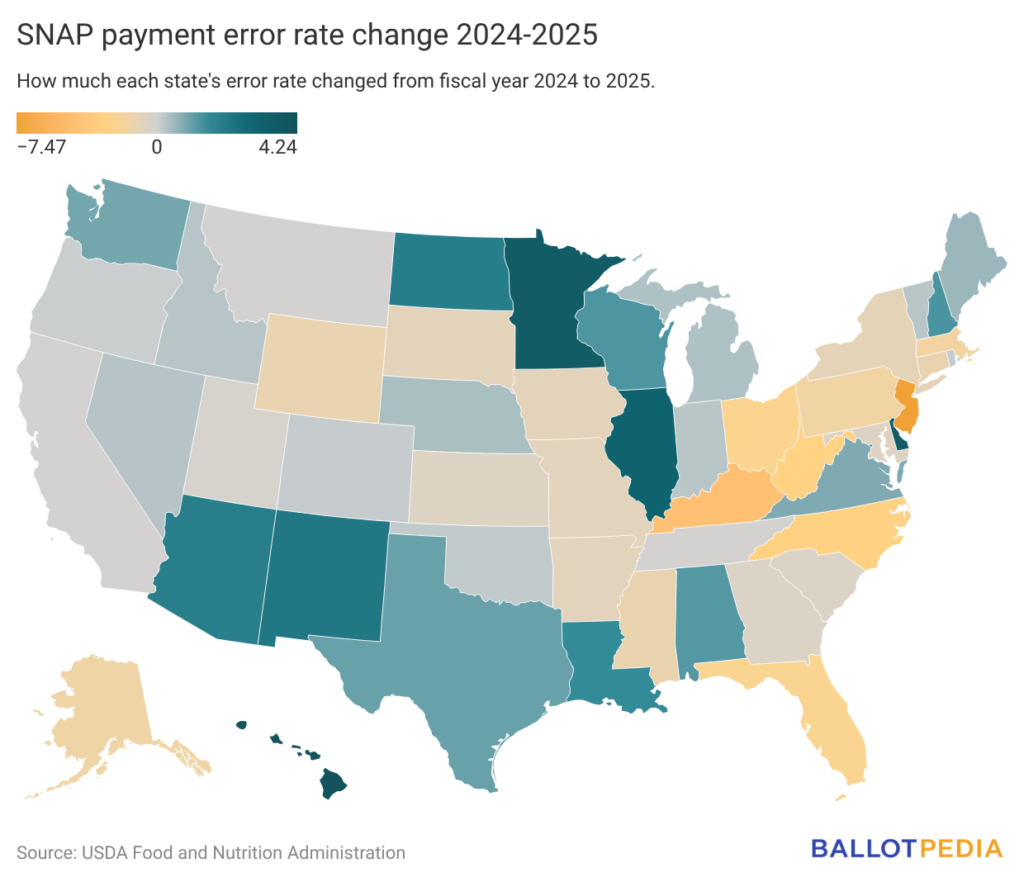
Among the five states where the error rate increased the most, four were Democratic trifectas and one was a divided government. Among the five states where the error rate decreased the most, there was no trend in trifecta status, with the group containing two Republican trifectas, one Democratic trifecta, and two divided governments.
The reason why payment error rates increase or decrease depends on various factors, including whether or not states have pursued policy changes intended to reduce those error rates, and the efficacy of those changes in reducing error rates.
For example, in testimony to the New Jersey Legislature, Stephen Cha, the director of the agency that administers SNAP in the state, said that his department was implementing protocols to reduce payment errors and coordinating closely with county officials that process SNAP applications as part of those efforts.
On the other hand, Niki Kozlowski, director of New Mexico's Income Support Division, said that reducing the payment error rate is her division's top priority, but that the division was taking a strategic approach to the timing of corrective measures. That's because New Mexico currently qualifies to delay the start of cost-sharing until 2030, and reducing the error rate before then may result in increased costs for the state. The department requested an additional $2.9 million in funding to reduce the state's payment errors through technological improvements and additional caseworkers.
Changes in states' cost-share bracket
Overall, 13 states moved down at least one bracket, meaning either they will be expected to pay a smaller percentage of SNAP benefits in 2028 or that they no longer have an error rate high enough to qualify to delay the beginning of the cost-share. Ten states moved up at least one bracket, meaning either they will be expected to pay a greater percentage of SNAP benefits in 2028 or that they now have an error rate high enough to qualify to delay the beginning of the cost-share.
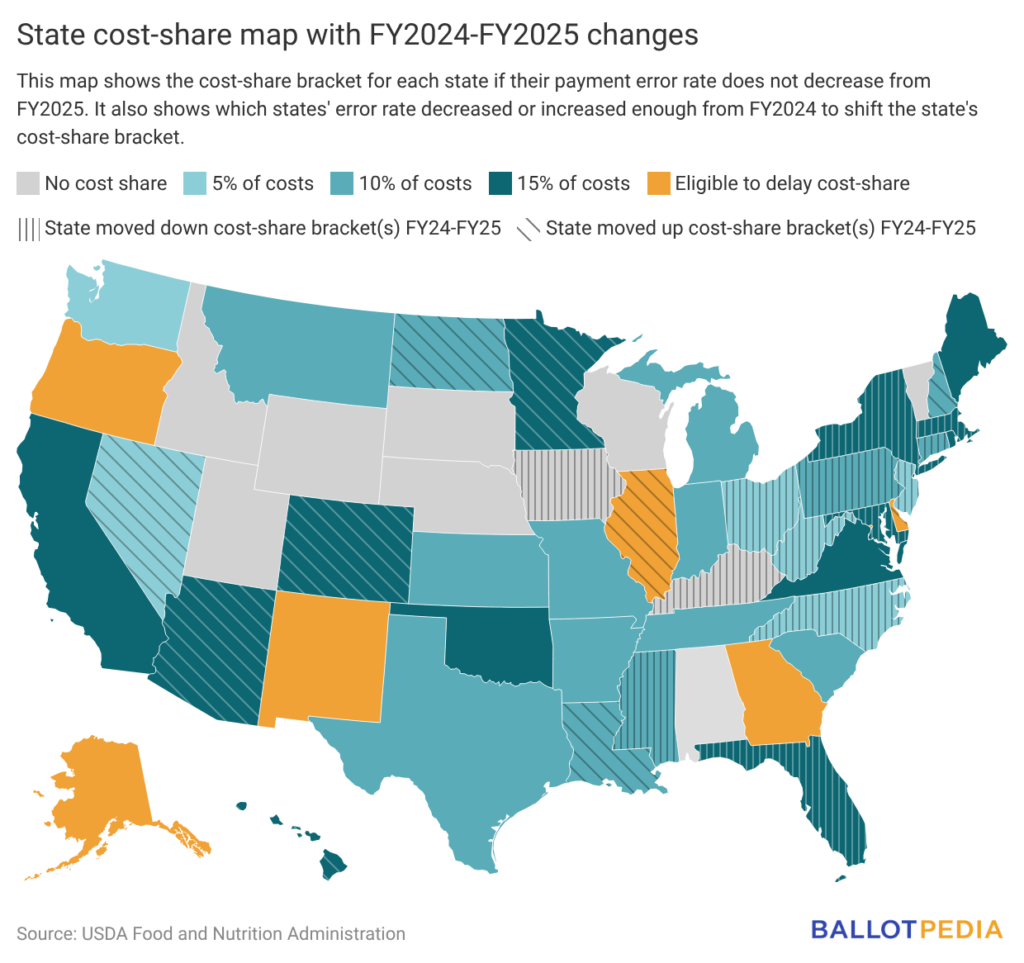
The 13 states that went down at least one bracket include five states with Democratic trifectas, five with a Republican trifecta, and three with divided government. The ten states that went up at least one bracket include four with Democratic trifectas, three with Republican trifectas, and three with divided government.
Florida, Maryland, Massachusetts, New Jersey, and New York lost their eligibility to delay the cost-share. Of these five states, four dropped one bracket, requiring payment of 15% of benefits. New Jersey dropped multiple brackets, to the 5% bracket.
Two states with a Democratic trifecta — Delaware and Illinois — gained eligibility to delay the cost-share. Both of these states were previously in the 15% bracket.
Twenty-seven states and the District of Columbia remained in the same bracket as projected by 2024 error rates. See the maps below for more information.
Click here to read more about the implementation of SNAP provisions from the OBBBA.
Colorado's pre-2028 redistricting measures blocked, but mid-decade redistricting potential continues in three other states
New congressional maps remain possible in at least three states – Wisconsin, Maryland, and New York – ahead of the 2028 elections, after the Colorado Supreme Court blocked competing ballot measures that would have redrawn the state's map for that cycle.
On June 29, the Colorado Supreme Court ruled against five congressional redistricting ballot measures, finding that each violated the state constitution's single-subject requirement for citizen initiatives. The court concluded that the measures improperly combined a change to Colorado's redistricting process with the adoption of new district boundaries. Ballot measures filed by the group Coloradans for a Level Playing Field in February would have created a map likely to give Democrats up to 7-1 control of the state's eight congressional districts, currently split 4-4. Republican-aligned measures, filed by Advance Colorado and attorney Scott Gessler, would have adopted a map with a potential 5-3 Republican split. As a result of the ruling, however, none of the measures will appear on the November 2026 ballot.
The Colorado measures were part of several ongoing efforts to redraw congressional lines before the next scheduled redistricting following the 2030 census. Many of the remaining efforts are proceeding on longer timelines as a result of court schedules, constitutional amendment processes, or legislative calendars that could not be completed in time for this year's midterms.
In Wisconsin, a state lawsuit alleges that the state’s congressional map constitutes an unconstitutional partisan gerrymander. The Wisconsin Supreme Court dismissed two challenges to the map in March 2024 and June 2025. However, in November 2025, the court ordered a pair of three-judge panels to hear two additional lawsuits challenging the map. After the panels dismissed the suits citing state supreme court precedent that partisan gerrymandering claims are not justiciable, plaintiffs appealed to the state supreme court, which agreed in May and June 2026 to take up the cases.
In Maryland, Senate President Bill Ferguson (D) and House Speaker Joseline Peña-Melnyk (D) announced an August 2026 special session for congressional redistricting. Attempts to take up redistricting ahead of the 2026 elections did not gain traction – Ferguson opposed Gov. Wes Moore’s (D) advisory commission’s proposal for an all-Democratic map.
In New York, the Legislature approved a proposed constitutional amendment that would repeal the state's prohibition on partisan gerrymandering and allow the Legislature to redistrict mid-decade, a process that is otherwise the responsibility of the state’s redistricting commission. Under New York's constitutional amendment process, the Legislature must pass the measure again in a subsequent session before it can go before voters in a statewide vote, which is expected in 2027. If approved, any resulting map would take effect for the 2028 elections.
Georgia also considered mid-decade redistricting after Gov. Brian Kemp (R) called a special legislative session in June 2026, but Republican legislative leaders announced on the session's first day that they would not redraw the state's congressional map, and no new map was considered.
Click here for more information about redistricting ahead of the 2028 elections.
Five candidates are running in the Aug. 4 Democratic primary for Missouri’s 1st Congressional District
Five candidates are running in the Aug. 4 Democratic primary for Missouri's 1st Congressional District. Incumbent Rep. Wesley Bell (D) and Cori Bush (D) lead in noteworthy endorsements and fundraising.
This primary is one of five this year in which a former member of the U.S. House of Representatives is running against an incumbent member. Bush represented Missouri's 1st Congressional District from 2019 to 2025. In 2024, Bell defeated Bush 51.1% to 45.6% in a field of four candidates.
During the 2024 primary, the American Israel Public Affairs Committee's (AIPAC) affiliate and the United Democracy Project (UDP) spent approximately $8.5 million either against Bush or in support of Bell. The Cook Political Report's Matthew Klein wrote that "As the Democratic electorate grows increasingly angry over the war in Gaza and AIPAC's meddling in primaries across the country, Bush is counting on an anti-Israel backlash to put her over the top." As of July 8, the UDP had spent $540,000 in the 2026 primary, and AIPAC endorsed Bell.
On AIPAC's involvement in elections, Bush said, "The tide has already turned, and people are saying no. They want to be the ones to pick their representatives. And so, whether that money filters into the community or not, I think the community is also going to call out any candidate who is accepting that money."
Bell said the organization's involvement in the 2024 primary would not affect the 2026 primary: "Voters in our district are worried about the cost of living. They're worried about health care costs. If you don't have anything to run on, well, you got to create something. And that's what other folks in the race are doing."
Before serving in the U.S. House, Bell served as the St. Louis County Prosecuting Attorney from 2019 to 2025, and on the Ferguson City Council from 2015 to 2018. He also worked as a lawyer. Democratic Leader Rep. Hakeem Jeffries (D-N.Y.), Democratic Whip Rep. Katherine Clark (D-Mass.), and the Congressional Black Caucus PAC endorsed Bell.
Before serving in the U.S. House, Bush worked as a pastor and a registered nurse. She was also the co-director of the nonprofit The Truth Telling Project. U.S. Sen. Bernie Sanders (I-Vt.), Our Revolution, and St. Louis Democratic Socialists of America endorsed Bush.
Carl Harris Sr. (D), Carl Henderson (D), and Alissa Murphy (D) are also running in the primary.
Click here to read more about the Democratic primary for Missouri's 1st Congressional District. Also, if you're a Missouri voter, check out our Sample Ballot Lookup here to prepare for Election Day.