The United States has pushed its way into the Caucasus peace process, sidelining France’s former role as a key Armenia-Azerbaijan mediator with the launch of the Trump Route for International Peace and Prosperity, known as TRIPP.
The framework was published Tuesday after US Secretary of State Marco Rubio met Armenian Foreign Minister Ararat Mirzoyan. It gives Washington a 74 percent stake in a TRIPP Development Company tasked with building roads, rail, energy and digital infrastructure.
The project centres on a 42-kilometre corridor through Armenia’s Syunik province, linking mainland Azerbaijan to its Nakhchivan exclave on the border with Turkey. The route would operate under an initial 49-year lease, extendable by a further 50 years.
Armenia would retain 26 percent equity, with the option to increase its share to 49 percent. It would also keep full sovereignty, including border control and law enforcement powers.
Armenian Prime Minister Nikol Pashinyan said the deal would benefit Yerevan, Washington and “likely” Baku, and would strengthen Armenia’s position as a regional transit hub after its 2023 loss of Nagorno-Karabakh.
US leverage
The framework channels US $145 million in seed funding into critical minerals extraction and Trans-Caspian trade routes. It would bypass Russia and Iran and reflects Donald Trump’s broader focus on securing access to strategic resources.
“The American company is the one that will do the construction, while Armenia provides the land and existing infrastructure," Joshua Kucera, a researcher with the International Crisis Group, told RFI.
He added that the document does not make clear how large the commercial activity could become.
“Judging from the document, Armenia’s sovereignty is not at risk,” he told RFI.
Kucera said Azerbaijan could be more uneasy.
“If anyone is going to be worried, it will be Azerbaijan: they appear not to have been part of the negotiations of the modalities of passport and customs control,” he said – calling these issues central to earlier disputes over transit.
He noted that Baku has yet to comment on the arrangement.
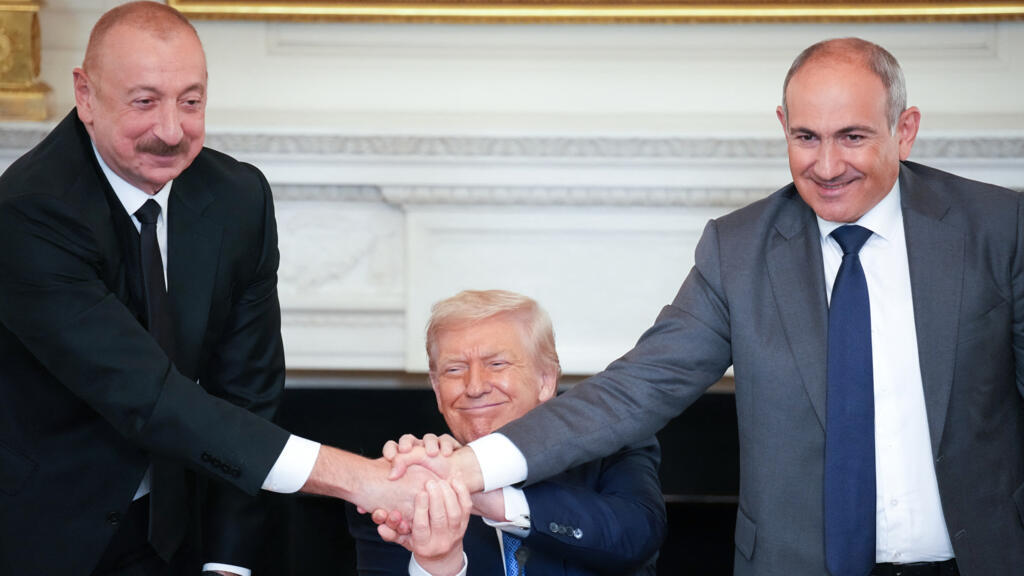
The project activates the August 2025 Washington peace declaration signed by Trump, Azerbaijani President Ilham Aliyev and Pashinyan.
That declaration replaced mediation led by the OSCE Minsk Group, where France had co-chaired alongside Russia and the US.
Baku has welcomed the outcome as its so-called Zangezur corridor, saying it involves no loss of sovereignty. Construction could begin in late 2026.
France’s fading role
France’s influence as a Caucasus broker risks being eclipsed by Washington’s more assertive approach. Paris has long backed Armenia, supplying arms, Bastion armoured vehicles and €44 million in aid after the 2023 displacement from Nagorno-Karabakh.
France also signed a defence roadmap with Armenia covering air defences and training, running to 2026. Azerbaijan has criticised Paris as biased, fuelling information battles between the two sides.
Paris nonetheless welcomed the 2025 Washington declaration as a “major step” towards peace, signalling acceptance of the end of the Minsk process. It has not commented publicly on the details of TRIPP.
France has deepened bilateral defence ties with Armenia, including offers of radar systems and dual-use technology. However, it plays no role in the infrastructure core of the US-led project.
Limits of US engagement
Kucera said TRIPP was “clearly a way to get the US a ‘win’ in peacemaking using this narrative of business, which Trump obviously loves.”
But he added that Washington’s engagement appears limited.
“Several months after this deal was reached, there really hasn’t been any other significant US involvement in the region than TRIPP,” he said. That, he added, “suggests that the interest from Washington in the Caucasus still isn’t very deep”.