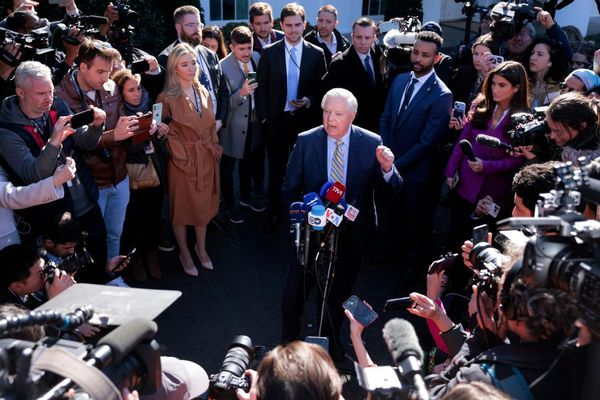
“You don’t want this smoke,” Rochelle Bilal, Philadelphia’s sheriff, warned Immigration and Customs Enforcement (ICE) agents during an 8 January press conference. Her words have since become a rallying cry for resistance to the Trump administration’s immigration crackdown. At the conference with Larry Krasner, Philadelphia’s district attorney, and city council members, Bilal spoke out against the 7 January fatal shooting of Renee Nicole Good by an ICE agent in Minneapolis. “We stand here today with all those who stand against the made-up, fake, what you can call ICE, professional law enforcement,” she said at the conference. “I don’t call them none of that. I call them made-up, fake, wannabe law enforcement. Because what they do is against not only legal law, but the moral law.”
Bilal is part of a growing body of elected officials who are speaking out against the Trump administration’s immigration policies and ICE’s alleged misconduct and aggressive enforcement tactics. As the first Black female sheriff of Philadelphia elected in 2019, Bilal has faced perhaps the most vitriol from opponents who have targeted her for her race and gender. “Race played a big [role in the] response,” Bilal told the Guardian in a conference room on her Philadelphia office floor. “The negative, nasty messages that are being received is ridiculous.” Since the video of her speech went viral, Bilal told the Guardian that death threats that she’s received have required her to increase her security detail. In a Facebook post, ICE also said that she should resign.
“I’m not going anywhere,” Bilal said. The gold, seven-pointed star of her sheriff’s badge gleamed above the pocket of her white blouse. “I’ve been elected by the people of Philadelphia, and I abide by the constitution of the United States, the Philadelphia home rule charter, the state constitution, and I basically work for the people, not the ICE agents.”
Bilal’s comments diverged from the stance of Mayor Cherelle Parker’s administration to avoid criticism of the Trump administration’s immigration policies. The sheriff said it was important for her to be vocal after seeing a change in ICE’s conduct under the Trump administration. Historically, ICE agents would detain someone with a warrant signed by a judge before people were transported, she said. But over the past year, she’d seen national reports of people “being pulled and dragged out of cars, dragged by their hair down the streets … The death of Renee Good showed me as a law enforcement professional, that’s what we don’t do.”
Bilal called the officers “fake” law enforcement during the press conference, she said, in reference to the abridged training for ICE agents under the Trump administration, which has been reduced from several months to weeks under Trump.
When asked what she meant by “you don’t want this smoke,” Bilal chuckled. “You know that’s the famous one,” she said, adding that she was referring to the agony that results from committing a crime. “You don’t want to get charged, you don’t want to go to jail, and you don’t want to get convicted and have to stay in jail. That’s the smoke. So that’s not only for ICE agents … that’s for any individual,” she said. “And for citizens, we’re trying to tell them: ‘Don’t allow the ICE agent to pull you into a situation where you will be dealing with all that smoke.’ You will be dealing with arrests. You will be dealing … with getting charged, you would be dealing with getting arrested, you would be dealing with going to jail, and now you have to pay out all this money to deal with that kind of stuff.”
Prior to her speech condemning ICE and the Trump administration, Bilal said that she has advocated for justice and fairness from a young age. Growing up in north Philadelphia, a predominantly Black area with a high poverty rate, Bilal watched law enforcement mistreat her family, she said. “I made a decision back then that I was going to stand up for what was right,” Bilal added.
But she had no desire to be a law-enforcement professional until the Guardian Civic League, a local non-profit composed of former and current police officers aimed at bettering community relationships, visited her neighborhood during her youth. They encouraged her, she said, “to be the change that you want to see”.
“They think I’m just coming out for Renee Good, but my life since I’ve been a teenager has been about advocacy,” Bilal said. She served in the Philadelphia police department for 27 years, as the secretary of the Philadelphia chapter of the National Association for the Advancement of Colored People (NAACP) for more than 14 years, and as the president of the Guardian Civic League. Previously, she was a delegate for Black Cops Against Police Brutality, and is a delegate for the National Black Police Association, a US organization for Black officers. “I’m about fairness,” Bilal said. “So no, none of this is new to me.
“I’m just a girl from Philly trying to keep everybody safe.”
The circulation of the press conference video spurred confusion about the role of law enforcement officials in Philadelphia, causing the city’s police commissioner Kevin J Bethel to issue a statement on X clarifying that the sheriff’s department was a separate body. “The Philadelphia Police Department is the City’s primary law enforcement agency,” he wrote on 9 January. “Our officers are responsible for citywide patrol, criminal investigations, emergency response, and the enforcement of state and local laws. I serve as Police Commissioner by appointment of the Mayor of Philadelphia and operate within the City’s executive structure.”
For her part, Bilal said that she is responsible for executing court orders, civil processing, courtroom security, prisoner transport, and service of warrants. ICE agents must not enter courthouses with their masks on, she said: “They don’t make any attempts to take anybody out of a courtroom or in a courthouse.”
On 14 January, Bilal and Krasner held a press conference on public safety, in which Krasner stated that ICE agents who break the law would be arrested.
Bilal encouraged people to continue exercising their first amendment rights and to safely protest. “You got to resist because we have democracy, and we want to keep it that way,” she told the Guardian. “Stand up against things that are happening around the world, but keep yourself safe, and don’t let them pull you into harming yourself. Don’t let them pull you into the smoke.”