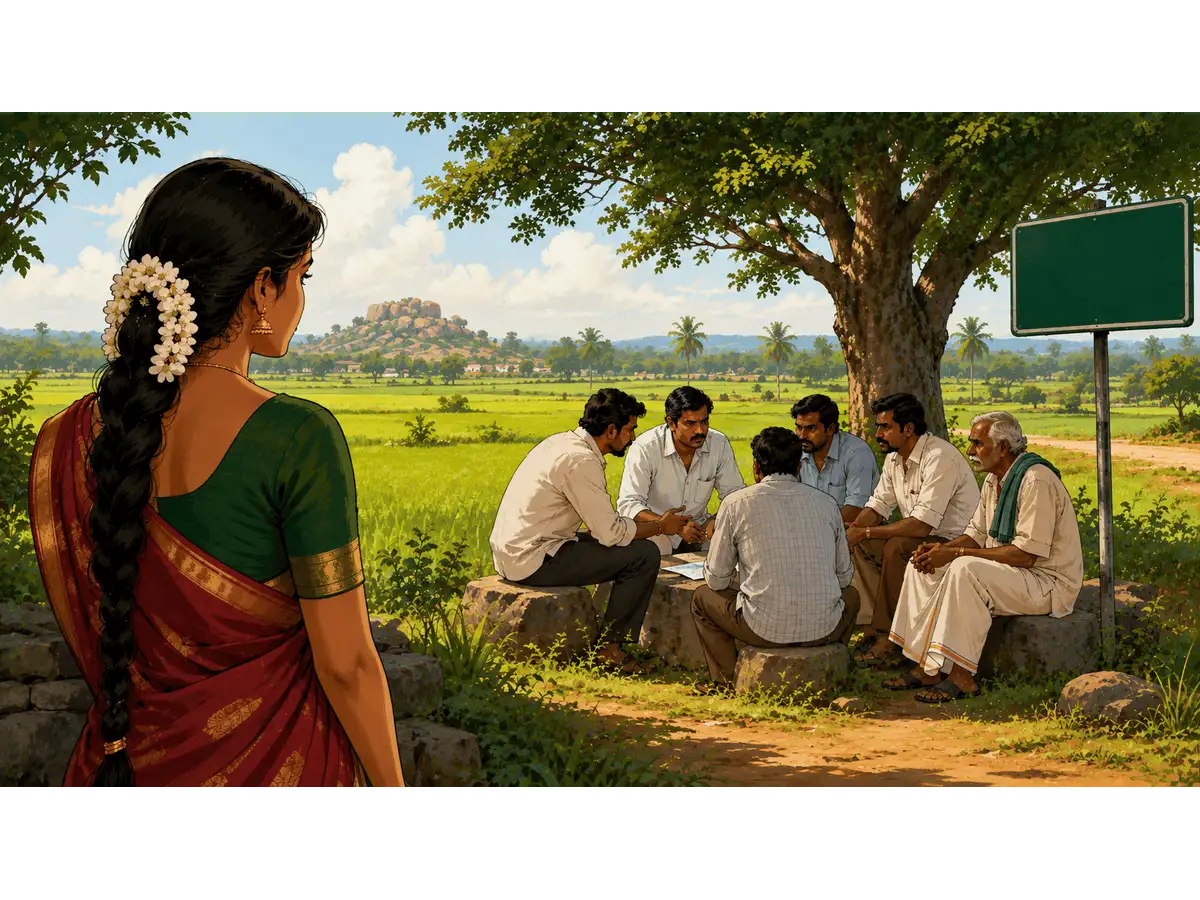
When Smt Usha from Bengaluru married Doctor Swamy in 1979, she relocated to Illinois, USA to be with him. This move meant she left behind her family’s properties in India. Her family lived in Bengaluru and managed the joint family assets.
Despite owning several lands and properties in and around Bengaluru, there had never been any dispute within the family regarding these properties. However, on December 19, 2011, without her knowledge, her family sold 10 acres of joint family land to Mr M. Narayanaswamy, son of late Muniyappa, by a sale deed. This created a rift between her and her family.
Usha identified four properties (A,B,C,D) as ancestral and demanded that these properties be partitioned and her rightful share be given to her. Her family disagreed with her demands and said that the properties that she had identified are her father’s self-occupied assets, and not ancestral property as she believed.
Usha disagreed with her father and said that property ‘A’ is her grandfather’s property which he gave to her father and accordingly her father got his name recorded as Khatedar from the year 1982 to 2013. According to her, the income generated by property ‘A’ was used to buy property ’B’.
Regarding property A, she contended that after the Karnataka government granted a quarrying licence in the land, her parents carried out quarrying activities there and generated substantial wealth. She claimed that property B was bought from the income earned through these quarrying operations.
Regarding properties C and D, she alleged that her father had inherited them from her grandfather. Property C is an agricultural land located at Badavanavrathna Kavalu, while property D is located in Pattabhirama Nagar, Bengaluru.
So, Usha decided to take legal action against her family for the partition of the properties on the ground that her parents over a period of time used the income and proceeds from the ancestral inherited properties to buy other properties and so she should get a share in these properties.
However, she lost the case in Karnataka High Court as the court ruled that the properties which she claims as ancestral are indeed self-occupied by her father, According to the law, a person only inherits a property from one of their three immediate paternal ancestors, and their sons, grandsons and great grandsons acquire an interest in it by birth or under Section 6 after the amendment in the Hindu Succession Act made on September 9, 2005.
The Karnataka High Court said that Usha failed to prove that the properties in question were coparcenery properties and that she acquired rights in those properties by being a member of the joint Hindu family.
Family tree
The family lineage goes back to the late Muniyappa, who was the father of Sri M. Venkataswamy (defendant No.1) and the Grandfather of the Plaintiff (Usha) and Respondent No. 3, Sri M. Venkataswamy (defendant No.1), is the son of late Muniyappa, and defendant No.2, Smt. Jayamma, is the wife of defendant No.1.
The plaintiff, Smt. Usha N. Swamy, and defendant No.3, Smt. Shyla Venkataswamy, are the daughters of defendant Nos.1 and 2. During the ongoing proceedings, Smt. Roopasri, another daughter of late M. Venkataswamy, was impleaded as respondent No.4.
The family tree is as follows: