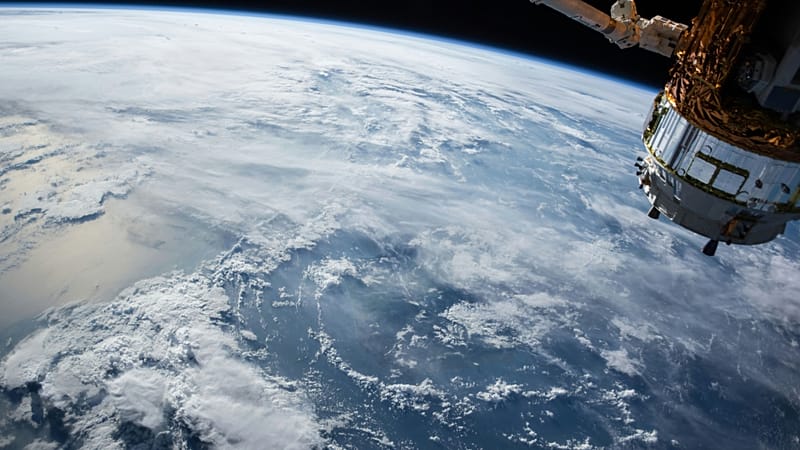
Climate change is slowing the planet’s spin at an “unprecedented” rate compared to the past 3.6 million years – as scientists warn that our days are getting longer.
Research had previously shown how the melting of polar ice sheets and mountain glaciers is raising sea levels and slowing Earth’s rotation.
As meltwater spreads from the poles toward the equator, its effect is similar to a figure skater spinning more slowly once they stretch their arms.
“What remained unclear was whether there were earlier periods when climate increased day length at a similarly rapid pace,” says Mostafa Kiani Shahvandi of the University of Vienna’s department of meteorology and geophysics.
How climate change is impacting day length
New research from the University of Vienna and ETH Zurich has managed to reconstruct ancient day-length fluctuations using the fossil remains of single-celled marine organisms called benthic foraminifera.
The chemical composition of the foraminifera fossils can infer sea-level fluctuations, helping scientists derive the corresponding changes in day length.
Previous research showed that from 2000 to 2020, our days were lengthened by 1.33 milliseconds per century due to climate-related factors. In the new study, published in the Journal of Geophysical Research: Solid Earth, scientists found that this “rapid rise” in day length is unparalleled over the last 3.6 million years.
“The current rapid rise in day length can thus be attributed primarily to human influences,” says Benedikt Soja, a professor of Space Geodesy at ETH Zurich.
Why longer days can be a problem
Soja warns that climate change is predicted to impact day length even more strongly than the moon by the end of the 21st century.
While these changes are only milliseconds and will be imperceptible to humans, they can trigger widespread problems in a tech-dominated world. Accurate time measures are crucial for computing systems such as GPS and space navigation, which use atomic time based on the frequency of certain atoms.
These changes are unlikely to impact human biology, such as our sleep and circadian rhythm.
If the world continues to warm due to heat-trapping emissions, scientists predict that climate change could increase the length of a day by 2.62 milliseconds by the end of the century.