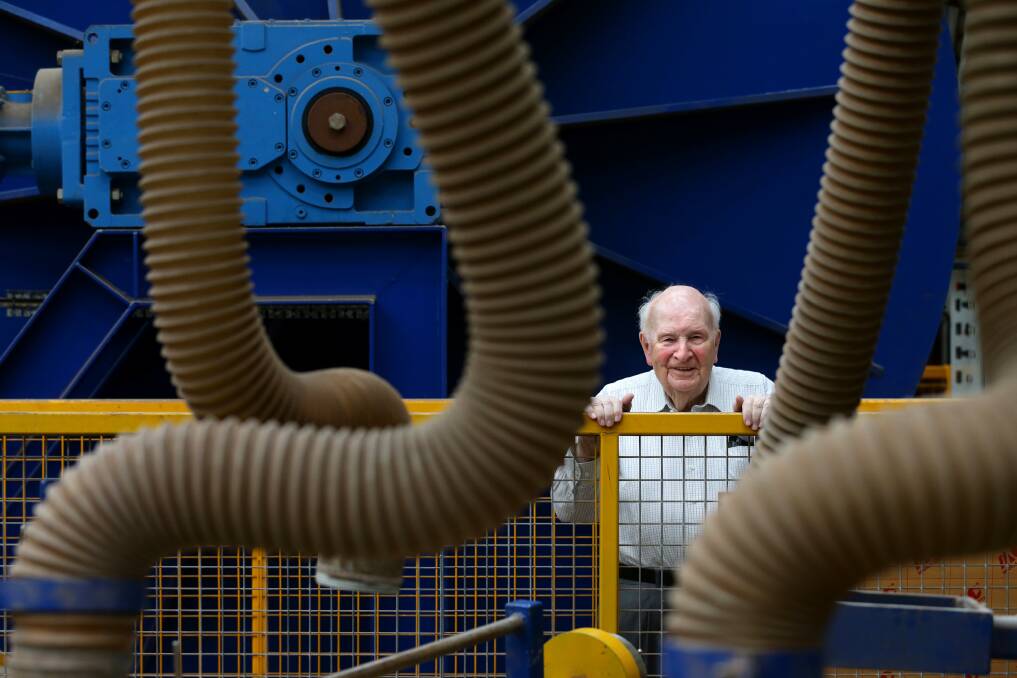
EMERITUS Professor Alan Roberts AM has been involved with the University of Newcastle under all its vice chancellors and 28 years after his retirement, continues to relish working with its "keen" staff and students.
The world-leading researcher and consultant in the field of bulk solids has received the UON Alumni Excellence Awards Convocation Medal for Exceptional Contribution.
"I'm overwhelmed by it, it's the last thing I might have expected," he said.
"I'm extremely honoured [but] I feel a little bit embarrassed because there's so many other people I work with who do so much and I think they deserve recognition more than me."
Professor Roberts, 91, joined UON as Professor of Industrial Engineering in 1974 and became Dean of the Engineering Faculty and Head of the Department of Mechanical Engineering later that year.
He was later the director of the School of Engineering and Architecture.
He established TUNRA Bulk Solids Handling Research Associates in 1975, a not-for-profit company and unique model that has completed around 5000 projects in more than 40 countries.
He retired in 1993 and was awarded an honorary PhD in 1995.
"I'm lucky to be still involved because it's my mission," Professor Roberts said.
He said his field covered the handling and processing of materials in powdered or bulk form across a range of industries including agriculture, energy and power, food, mining and minerals and pharmaceutical.
For example, iron ore being mined from beneath the water table in the Pilbara is sticky, which can cause blockages.
He said TUNRA tests samples and evaluates how material should be handled, which informs the design of equipment, storage bins, stockpiles, conveying equipment and processing.
"What invariably I've found is the problems we have to counter in industry... are always a magnitude more difficult than the level of research available to solve them, so you do what you can do from your research base, but at some stage the science and technology ends and you have to use your own judgement and professional experience.
"We identify problems that really need ongoing research and we feed that back into the university for students to look at."