The first time I understood that names could hold two worlds was not by changing mine, but by hearing it differently. As a Pakistani child growing up in Canada, I learned early that my name could sound different depending on who was saying it. My name is simple and deeply familiar in my family. Yet in school and, later, in professional spaces, I became accustomed to the anglicized pronunciation.
Over time, I introduced myself that way at work, and still do, because it became my new normal. At home, my name still sounds like me.
Many young children, especially newcomer and racialized children, face similar circumstances from the earliest grades and learn to make this same quiet adjustment long before they can explain what they are giving up.
It is the everyday morning greetings, language expectations and reactions to food or clothing that teach children who they can be at school.
Importance of names
Research shows name mispronunciations, alterations or avoidances are not trivial: Name-based microaggressions in early schooling disrupt identity and belonging and produce identity shame, and this is often initiated or normalized by educators themselves.
Microaggressions are the everyday, subtle, often unintentional comments or actions that communicate bias toward marginalized groups. Notably, as Kevin Nadal, a psychologist who has studied microaggression, notes, the “micro” does not mean the impact is small — and these moments, especially as they accumulate, can land hard on the people receiving them.
When an educator stumbles over a child’s name year after year, or when a child’s food or language is treated as strange, these messages build up.
The earliest cuts
When names are mispronounced or disrespected, what could be a ritual of recognition is one of erasure.
Even when unintended, name mispronunciation and other forms of marginalization that communicate children must leave parts of themselves at the door — like discouraging home language during circle or misreading cultural communication styles — chip away at safety and participation for young children.
The takeaway for educators: intent does not cancel impact, especially for children still learning who they are.
Belonging: Something children can feel
Canadian research shows that belonging is a protective factor across K–12 (including the primary years), while loneliness is widespread and felt most strongly by marginalized students.
In the early years sector, newcomer families often face barriers that shape young children’s social-emotional well-being, including one-way communication, limited linguistic responsiveness and monocultural expectations. It also shows that using developmentally appropriate, participatory methods (drawing, photos) helps pre-school newcomers express what belonging feels like and what they need.
Early childhood education programs that partner with settlement agencies work best when they have conditions highlighted in pan-Canadian research on newcomer-focused ECE programs: diverse educator teams, stable funding, licensing support and strong connections to licensed child-care programs.
In Ontario, belonging and identity are built into provincial guidance:
• The resource “How Does Learning Happen? Ontario’s Pedagogy for the Early Years” identifies belonging as one of the four foundations for children from birth through the primary grades. It outlines program expectations to cultivate authentic relationships and connections.
• School Mental Health Ontario, a provincial support team that helps school districts enhance student mental health through the use of evidence-informed strategies and services, suggests daily practices. These include greeting each child by name, as well as establishing predictable visual routines, multilingual signage and regular family connections that help newcomer and racialized children feel seen and supported.
Early years practices for belonging
So, how do we make equity, inclusion and belonging felt in the early years? Three practices to consider:
1) Learn, and use, each child’s real name (every day).
This is one of the simplest and most powerful ways educators communicate respect. Name mistakes, mispronouncing, shortening or anglicizing can make children feel less seen and signal whose identities are considered “easy” or “normal.”
To do for educators: Ask caregivers for pronunciation, practice until it’s fluent and use children’s full names in greetings and routines to reinforce that every identity belongs.
2) Celebrate the languages and cultures children bring.
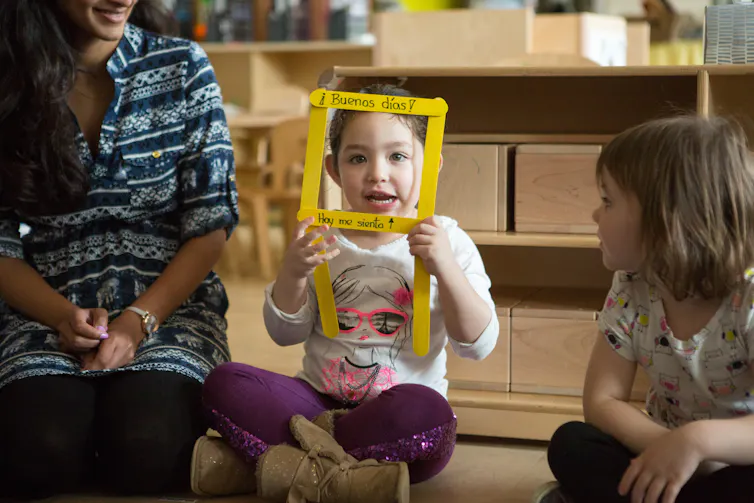
Young children participate more confidently when their home languages and everyday cultural practices are reflected in the classroom. A Canadian review of research found that linguistic responsiveness and intercultural communication are key to newcomer children’s well-being.
To do for educators: Add multilingual labels and bilingual books, invite families’ words and songs into circle time and welcome trans-languaging — moving fluently between languages — during play.
3) Build small belonging-focused rituals or practices into the day.
Belonging in the early years is created through simple, predictable interactions that help children feel recognized. Canadian analyses show these routines support social-emotional development, particularly for marginalized learners.
To do for educators: Greet each child warmly by name, use brief check-ins where every voice is heard and display children’s names, photos and home languages at their eye level.
Small choices speak
As a Pakistani educator whose name is said one way at work and another at home, I know how easy it is to slip into the version that fits the room. Many young children learn to do the same long before they can explain what’s happening.
That is why this work matters.
When adults take the time to pronounce a child’s name correctly, welcome their home language and check in with them every day, these small choices signal that all parts of children belong.
If we want every child to carry their full self through the door, we have to show them, every day, that everything about them fits here.

Amina Yousaf does not work for, consult, own shares in or receive funding from any company or organisation that would benefit from this article, and has disclosed no relevant affiliations beyond their academic appointment.
This article was originally published on The Conversation. Read the original article.